
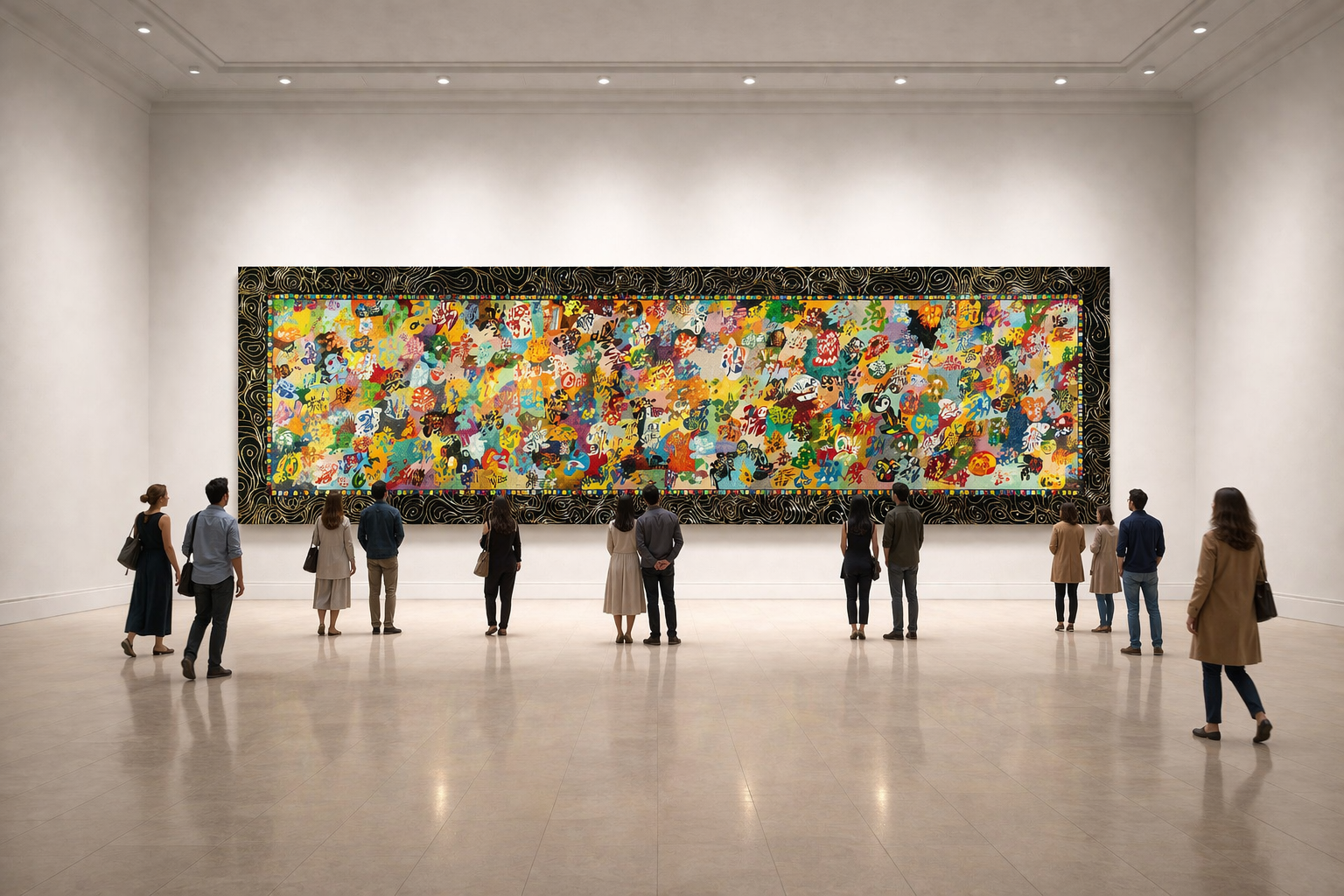
Divine DNA (2016)
Curatorial Essay
03 Apr 2026At a scale exceeding twelve meters in length, Divine DNA presents itself not simply as a painting, but as a constructed system—an attempt to render, in visual terms, a totalizing structure of global human identity. Developed from a conceptual framework conceived in 2006 and realized over a six-year period, the work occupies a distinct position between abstraction, cartography, and symbolic encoding. Its ambition lies not only in its physical magnitude, but in the completeness of its internal logic.¹
The composition consists of 249 unique abstract icons, each corresponding to a specific nation. These forms are neither arbitrary nor expressive in the conventional sense; they are determined. Each icon is assigned a particular morphology and color structure intended to encode the perceived characteristics of the country it represents. In this respect, the painting operates analogously to a language or code—one in which visual differentiation carries semantic weight.² The absence of repetition is critical: every element is singular, reinforcing the premise that no nation is interchangeable within the system.
Yet Divine DNA is not a catalogue in the descriptive sense. Its ordering principle is relational rather than taxonomic. The placement of each icon follows a deliberate spatial logic in which nations are grouped according to ethnographic and cultural proximities. These groupings are not demarcated through borders or separations, but instead emerge through adjacency and continuity. The pictorial field remains uninterrupted, allowing distinctions to coexist within a shared visual continuum. In doing so, the work proposes a model of global structure that resists both fragmentation and hierarchy.³
The title introduces a second layer of interpretation. By invoking “DNA,” the work aligns itself with the idea of an underlying code—an organizing principle through which complexity is generated and sustained. This analogy is not scientific in execution, but conceptual in scope. Just as genetic systems encode diversity within a unified structure, Divine DNA translates geopolitical multiplicity into a visual order in which each component is discrete yet interdependent.⁴ The term “Divine” extends this framework beyond material systems, suggesting a level of origin or totality that exceeds empirical description. Together, the terms articulate a synthesis: a vision of the world as both structured and unified, differentiated yet indivisible.
Central to this synthesis is the painting’s border, which functions as more than a compositional device. Encasing the entire field, it operates as a continuous, undulating structure that both contains and connects. Its intricate patterning suggests movement without direction—a rhythmic continuity that stands in contrast to the density and variability of the interior forms. Rather than isolating the composition, the border reinforces its cohesion, acting as a visual manifestation of unity. Developed over an extended period of consideration, it serves as the structural counterpart to the internal system, ensuring that the work remains both bounded and whole.
A defining aspect of Divine DNA is the relationship between conception and execution. The system was fully formed prior to its material realization, having been developed and refined mentally over several years. The subsequent process of painting did not involve improvisation, but translation—an exacting effort to bring a fixed conceptual structure into physical form. This distinction is significant. It situates the work not within traditions of spontaneous abstraction, but within a lineage of constructed systems, where the artwork exists first as an idea and only secondarily as an object.⁵
Despite its determinacy, the painting does not impose a singular reading. Its density resists immediate comprehension, requiring sustained engagement. The viewer encounters the work as both surface and structure: at a distance, it appears as a unified field; at proximity, it dissolves into a multiplicity of distinct elements. This oscillation between totality and detail mirrors the conceptual framework of the work itself, in which unity is not the absence of difference, but its condition of coexistence.⁶
Importantly, Divine DNA does not visualize the world through familiar cartographic conventions. There are no borders, no geographic outlines, no textual identifiers. Instead, it constructs an alternative mode of representation—one that operates through abstraction while maintaining specificity. In doing so, it challenges the viewer to consider how identity, difference, and relation might be understood outside of conventional systems of depiction.³
As a whole, the painting can be understood as an attempt to fix, in visual form, a complete and internally coherent model of global humanity. It is not open-ended, nor does it seek to evolve. Rather, it presents itself as resolved: a closed system in which every element has been accounted for. What remains open is the viewer’s engagement with that system—the process of navigating its complexity, recognizing its structure, and reflecting on the relationships it encodes.
In this sense, Divine DNA operates at the intersection of image and idea. It is both a painting and a proposition: that the diversity of the world can be conceived as a unified structure without erasing its differences.
Artist Biography
Gheorghe Virtosu is a contemporary painter whose work explores the intersection of political ideology, identity, and systems of power. Combining abstraction with symbolic figuration, he constructs compositions that are conceptually rigorous and visually layered. Virtosu’s practice engages the viewer as an active participant in the interpretation of meaning, emphasizing observation, reflection, and critical engagement.
Technical Notes
Divine DNA is executed in oil on canvas at a monumental scale (300 × 1240 cm). The work’s extended horizontal format required a modular and sequential approach to production, while maintaining strict adherence to a predetermined compositional system.
The surface is characterized by:
- High-density micro-compositional structuring, with each icon individually delineated
- Layered paint application, allowing for precise color calibration and edge definition
- Controlled brushwork, balancing clarity of form with overall visual cohesion
Given the absence of repetition across 249 distinct elements, the execution demanded sustained precision over an extended period. The consistency of scale, spacing, and chromatic intensity across the composition indicates a methodical working process aligned with the original conceptual schema.
The border, integral to the work, demonstrates a separate but related technical treatment. Its continuous, rhythmic patterning suggests iterative development while maintaining uniform visual tension across the entire perimeter.
The painting’s material stability is supported by the inherent durability of oil on canvas; however, due to its size, considerations for display, transport, and storage require specialized handling and structural support.
Acknowledgments
Presented by El Arte Monumental
Curatorial Team: Daniel Varzari
Photography: Courtesy of El Arte Monumental
Special Thanks: Daniel Varzari
Notes
- The number of icons (249) corresponds to the total number of nations conceived by the artist at the time of the work’s development, forming a complete and finite system.
- The conceptual framework of Divine DNA was formulated in 2006 and developed mentally over a four-year period prior to execution (2010–2016).
- Each icon is unique and non-repeating, with its form and color encoding specific attributes associated with an individual nation.
- The spatial arrangement reflects ethnographic and cultural relationships rather than geographic cartography.
- The border functions as a unifying structural element and was developed through prolonged iterative refinement.
- The work is defined as a closed system; all elements are predetermined and fixed prior to execution.
Selected Bibliography
- Foucault, Michel. The Order of Things: An Archaeology of the Human Sciences. New York: Pantheon Books, 1970.
- Gombrich, E. H. Art and Illusion: A Study in the Psychology of Pictorial Representation. Princeton: Princeton University Press, 1960.
- Manovich, Lev. The Language of New Media. Cambridge, MA: MIT Press, 2001.
- Benjamin, Walter. The Work of Art in the Age of Mechanical Reproduction. 1936.
- Barthes, Roland. Image Music Text. New York: Hill and Wang, 1977.
- Wood, Denis. The Power of Maps. New York: Guilford Press, 1992.
- El Arte Monumental, “New Perfection and Systemic Abstraction in Contemporary Painting.” 2026.