
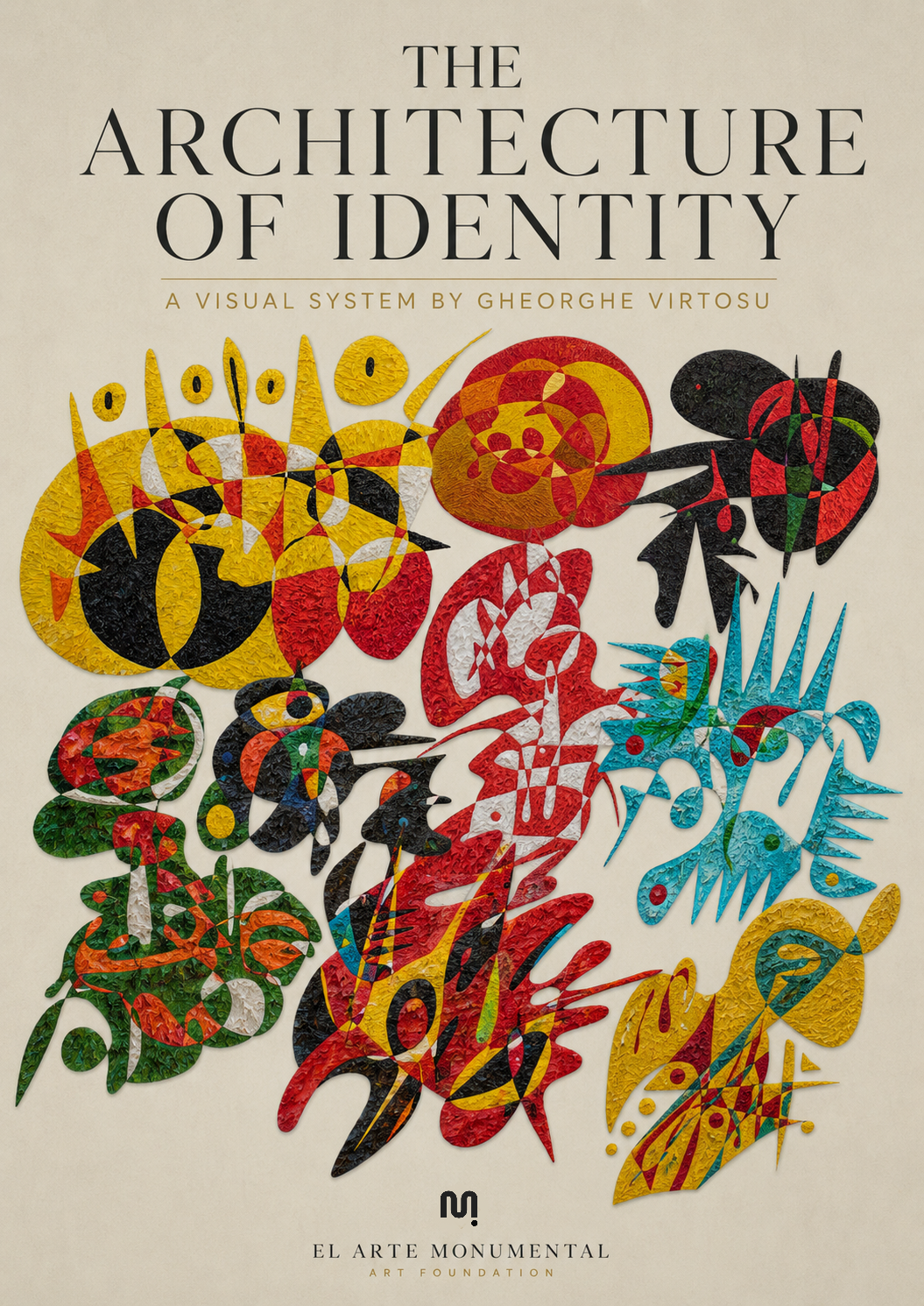
Divine DNA: The Architecture of Identity
A Theoretical Framework for Cultural Research
06 Jun 2026The question of identity has occupied philosophy, religion, politics, anthropology, and art throughout human history. Across these fields, identity has frequently been understood through categories of origin: ancestry, territory, language, belief, culture, and collective memory.
Divine DNA emerges from this problem. Rather than approaching identity as a subject to be depicted, the project investigates the organizational conditions through which identity becomes possible.
The title establishes the conceptual foundation of this inquiry. DNA signifies inheritance and transmission, while the term “divine” introduces belief, symbolic knowledge, collective imagination, and cultural memory.
Within this framework, identity cannot be reduced to a singular origin. It emerges through historical events, religious traditions, political formations, linguistic structures, social institutions, and personal experience.
The objective of Divine DNA is not to illustrate identities or catalogue cultural differences. Instead, the project investigates the structures through which identities are generated, maintained, transmitted, and transformed.
Individual paintings, codices, and symbolic formations function neither as isolated images nor as fragments of a linear narrative. Their significance emerges through relationships, correspondences, and patterns of organization.
What ultimately distinguishes Divine DNA is its proposal that identity may be approached as an architecture: an evolving arrangement of relationships capable of producing coherence without eliminating difference.
By shifting attention from representation to organization, Divine DNA proposes that identity is not something that simply exists. It is continually constructed through the structures, memories, beliefs, and relationships that shape human life.
Related Resources
Collection: The Architecture of Identity
Catalogue: The Architecture of Identity — Exhibition Catalogue
Notes
- The term Divine DNA is used as a conceptual framework through which identity is examined as a process of formation rather than a fixed condition of origin.
- This essay distinguishes between the representation of identity and the investigation of identity as structure. The project approaches identity through relationships, transmission, memory, belief, and organization rather than symbolic classification.
- The title combines two domains of inquiry: biological inheritance, represented by DNA, and cultural, spiritual, and symbolic systems, represented by the term “divine.”
- Within this framework, identity is understood as a dynamic condition shaped by historical, social, political, cultural, and spiritual forces.
- The project rejects essentialist models of identity founded upon singular origins or fixed categories.
- Individual artworks function as autonomous entities while participating in larger configurations of relation and correspondence.
- The codices operate as parallel structures that expand the conceptual field of the central work without functioning as illustrations or subordinate elements.
- Meaning is generated through position, alignment, repetition, variation, and structural relationships rather than through narrative sequence.
- The project approaches visual organization as a mode of inquiry through which systems of identity become perceptible.
- Identity is examined as a condition of continual formation produced through interaction between inheritance, memory, culture, belief, and experience.
- The publication is structured as a spatial configuration rather than a linear document, allowing multiple points of entry and interpretation.
- The concept of architecture is employed as an analytical model describing the organization of relationships rather than the construction of physical form.
- Divine DNA situates identity within a broader field of interconnected historical, symbolic, and cultural processes.
- The central proposition of the project is that identity may be understood as an evolving architecture generated through systems of transmission, transformation, and relation.
Selected Bibliography
- Anderson, Benedict. Imagined Communities: Reflections on the Origin and Spread of Nationalism. London: Verso, 2006.
- Assmann, Jan. Cultural Memory and Early Civilization. Cambridge: Cambridge University Press, 2011.
- Bhabha, Homi K. The Location of Culture. London: Routledge, 1994.
- Cassirer, Ernst. An Essay on Man. New Haven: Yale University Press, 1944.
- Deleuze, Gilles, and Félix Guattari. A Thousand Plateaus: Capitalism and Schizophrenia. Minneapolis: University of Minnesota Press, 1987.
- Foucault, Michel. The Archaeology of Knowledge. New York: Pantheon Books, 1972.
- Hall, Stuart. “Cultural Identity and Diaspora.” In Identity: Community, Culture, Difference. London: Lawrence & Wishart, 1990.
- Jung, Carl Gustav. The Archetypes and the Collective Unconscious. Princeton: Princeton University Press, 1981.
- Latour, Bruno. Reassembling the Social: An Introduction to Actor-Network-Theory. Oxford: Oxford University Press, 2005.
- Lévi-Strauss, Claude. Structural Anthropology. New York: Basic Books, 1963.
- Luhmann, Niklas. Social Systems. Stanford: Stanford University Press, 1995.
- Ricoeur, Paul. Memory, History, Forgetting. Chicago: University of Chicago Press, 2004.
- Taylor, Charles. Sources of the Self: The Making of the Modern Identity. Cambridge, MA: Harvard University Press, 1989.
- Wheatley, Margaret J. Leadership and the New Science. San Francisco: Berrett-Koehler, 2006.
- Virtosu, Gheorghe. Divine DNA — Volume I: Catalogued System. El Arte Monumental, 2026.