
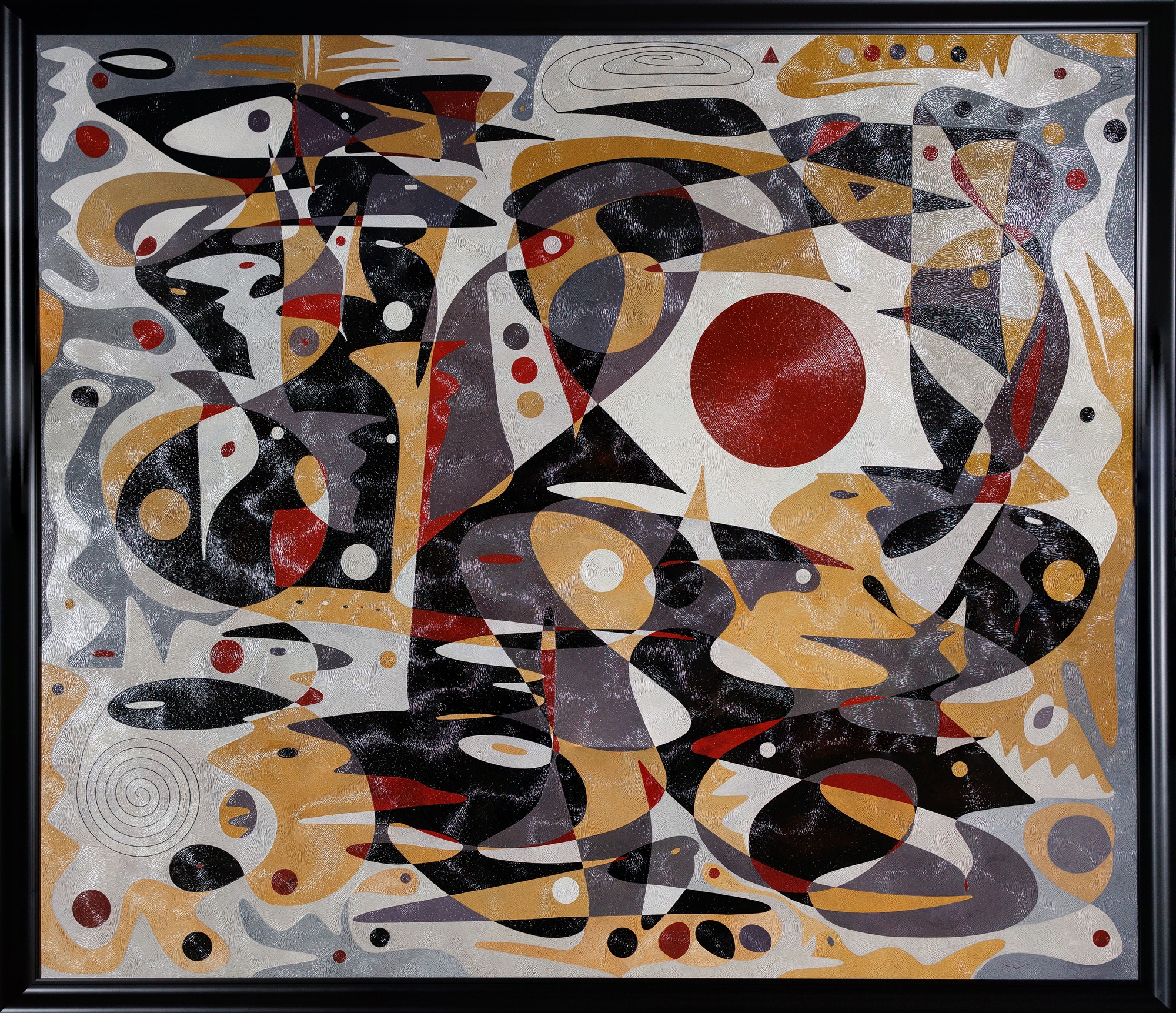
Hawai Sakusen (2004)
Curatorial Essay
18 Apr 2026In Hawai Sakusen (2002–2004), Gheorghe Virtosu constructs a pictorial field that reconfigures the Attack on Pearl Harbor as a system of coordinated forces rather than a representational event. Extending across a monumental horizontal format, the composition abandons figural narration in favor of a distributed visual matrix in which geometric precision and biomorphic fluidity operate in continuous interaction. The painting does not depict ships, aircraft, or landscape; instead, it translates the operational logic of planning, synchronization, and execution into an abstract language structured by alignment, tension, and controlled movement.1
A defining feature of the composition is the relative openness of its ground, which introduces an initial sense of clarity and spatial accessibility. This apparent stability, however, is systematically disrupted by sharply articulated forms that traverse and interlock across the surface. Unlike the dense compression characteristic of earlier works, the elements here maintain a high degree of relational precision, suggesting a system in which movement is not chaotic but orchestrated. Diagonal vectors and curvilinear passages do not collide but align, producing a visual logic of coordination that reflects the calculated sequencing of military action.2
Figuration is present, yet remains contingent upon perception. Silhouettes—profiles, partial faces, and elongated figures—emerge through the viewer’s engagement with strategically placed eye-like forms that function as anchors of recognition. These eyes stabilize local configurations, allowing surrounding shapes to cohere temporarily into identifiable presences. However, this coherence is never absolute; figures dissolve as attention shifts, generating a condition in which identity is continuously constructed and withdrawn. The painting thus displaces the authority of the individual subject, replacing it with a system of distributed roles and perceptual events.3
The composition may be read as a spatial condensation of temporal phases. Linear and symbolic elements in the upper register evoke systems of communication and pre-operational coordination, while the left-hand vertical accumulations suggest hierarchical structures of command. The central field, characterized by interlocking forms and dynamic alignment, corresponds to the deployment and approach of coordinated forces. A pivotal zone near the center introduces perceptual instability, marking the threshold at which planning encounters contingency. Toward the right, a more stabilized configuration—articulated in relation to a dominant circular form—signals the concentration of action and the moment of execution.1
Chromatically, the work departs from the darker tonalities of Virtosu’s earlier battle compositions, employing a palette in which light grounds are punctuated by saturated reds, yellows, and deep blacks. Color operates as both structuring and destabilizing force: bright zones assert presence and intensity, while darker passages interrupt and redirect visual flow. The large red circular form functions as a fixed point within the composition, anchoring the otherwise fluid system and introducing a locus of convergence. Its stability contrasts with the surrounding fragmentation, reinforcing the tension between fixed objective and shifting conditions.2
The lower register introduces a counterpoint to the coordinated activity above, where elongated and less resolved forms suggest dispersion and residual motion. Here, figuration weakens and directional force diminishes, indicating a transition from active execution to aftermath. Movement becomes horizontal and continuous, no longer driven by precise alignment but by inertia and diffusion.3
Ultimately, Hawai Sakusen constructs a visual system in which history is articulated not as a sequence of images but as an interdependent network of actions, perceptions, and outcomes. By dissolving the singularity of the historical subject and embedding figuration within a field of relational forces, Virtosu challenges the conventions of history painting and its reliance on narrative clarity. The work proposes instead that historical events are best understood as dynamic systems—structured, coordinated, and contingent—whose full complexity can only be apprehended through active perceptual engagement.
Artist Biography
Gheorghe Virtosu is a contemporary painter whose work explores the intersection of philosophy, historical systems, and visual abstraction. His practice is defined by large-scale compositions that integrate biomorphic forms, geometric structures, and fragmented spatial logics.
Engaging with global historical events and conceptual frameworks, Virtosu translates complex systems into abstract visual languages that resist fixed interpretation while maintaining internal coherence.
Central to his practice is an ongoing investigation of history as a network of forces, reconfigured through abstraction into immersive pictorial environments.
Working primarily in oil on canvas, Virtosu employs layered techniques that allow forms to emerge, dissolve, and reconfigure across multiple perceptual planes.
Technical Notes
Executed in oil on canvas at a monumental scale (3.23 × 4.05 meters), the painting establishes an expansive horizontal field that encourages lateral visual navigation. The lighter ground enhances spatial legibility while allowing superimposed forms to maintain clarity and separation.
The interplay between sharply defined geometric structures and fluid biomorphic shapes produces a controlled tension between precision and organic movement. Layered applications of pigment create subtle depth without relying on traditional perspective, emphasizing interaction over illusion.
Chromatic contrasts generate zones of intensity and visual anchoring, with the prominent circular form acting as a focal point within an otherwise distributed system.
Notes
- Gordon W. Prange, At Dawn We Slept: The Untold Story of Pearl Harbor. Penguin Books, 1981.
- Jonathan Parshall and Anthony Tully, Shattered Sword. Potomac Books, 2005.
- Marc Bloch, The Historian’s Craft. Vintage Books, 1953.
Selected Bibliography
- Prange, Gordon W. At Dawn We Slept.
- Parshall, Jonathan, and Anthony Tully. Shattered Sword.
- Bloch, Marc. The Historian’s Craft.
- Deleuze, Gilles. Difference and Repetition.
- Krauss, Rosalind. The Originality of the Avant-Garde and Other Modernist Myths.