
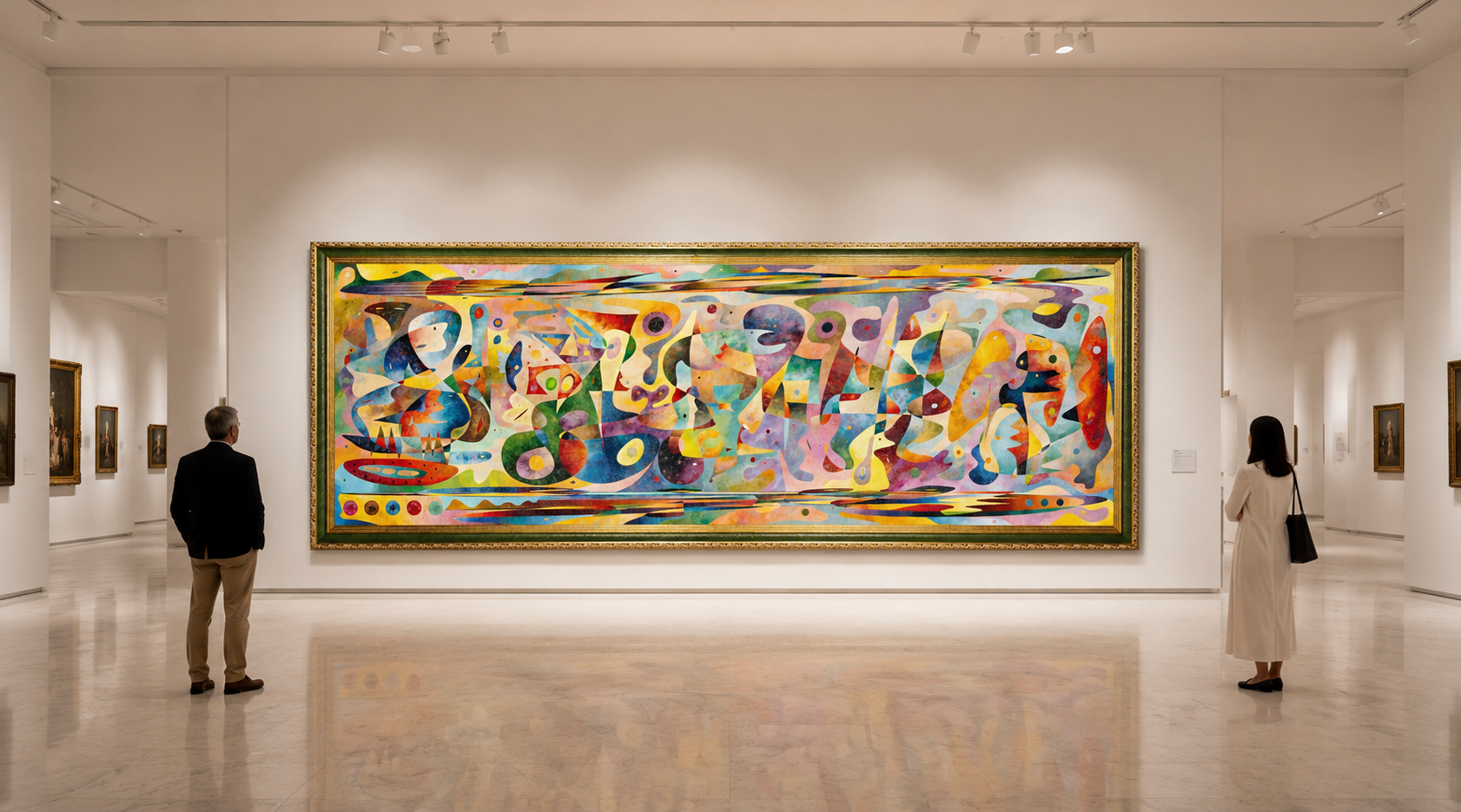
Hinduism (2017)
Curatorial Essay
05 Apr 2026In Hinduism (2015–2017), Gheorghe Virtosu constructs a complex visual field that resists direct representation in favor of process. Rather than depicting a religious system through fixed iconography, the painting operates as a dynamic network in which forms continuously emerge, transform, and dissolve. Across its expansive horizontal format, the work articulates a shifting interplay between figuration and abstraction, suggesting that meaning, identity, and perception are not stable entities but transient configurations within a broader continuum.
This instability aligns closely with Roland Barthes’ critique of the sign as inherently unfixed and perpetually deferred¹. Motifs within the painting—circular “eyes,” lotus-like expansions, and mandala-like clusters—never resolve into singular meanings. A single form may simultaneously evoke perception, origin, or cosmological unity, yet it resists closure. In this sense, the painting exposes the mechanics of signification itself, revealing how symbols are constructed, layered, and destabilized. It becomes not a system of symbols, but a system that demonstrates how symbolic meaning is generated.
The spatial logic of the composition further resonates with the rhizomatic model proposed by Gilles Deleuze and Félix Guattari². Rather than organizing itself hierarchically or around a central axis, the painting unfolds as a distributed network of connections. Forms appear across the surface without clear origin or endpoint, and visual motifs—particularly eye-like structures—are detached from stable bodies, suggesting a model of consciousness that is diffuse rather than localized. Perception becomes ambient, dissolving the distinction between observer and observed.
The interaction between curvilinear and angular forms introduces a productive tension that can be understood through Deleuze’s distinction between smooth and striated space³. Flowing, organic shapes create a sense of continuity and undivided being, while sharp, triangular intrusions articulate division, segmentation, and structure. These opposing spatial logics coexist without hierarchy: structure emerges from flow, only to fragment and return to it. The result is a visual field defined by oscillation rather than stability.
This dynamic is particularly evident in the recurring face-like configurations that appear throughout the painting. These forms emerge briefly before dissolving into surrounding structures, refusing any stable identity. Here, the concept of becoming, central to Deleuzian philosophy⁴, is operative: identity is not fixed but continuously produced and transformed. The face is not an endpoint but a temporary stabilization within an ongoing process of change.
Symbolic density intensifies this effect. Individual clusters often carry multiple, overlapping meanings: an “eye” may simultaneously function as a point of perception, a lotus-like emergence, or a nodal center within a larger network. This overdetermination resists reductive interpretation and aligns with post-structuralist approaches in which meaning is contingent and relational. The viewer is thus positioned not as a passive recipient, but as an active participant in the production of meaning.
While the work draws structurally from concepts associated with Hindu philosophy—such as non-duality, cyclical existence, and the relationship between individual and universal consciousness—these references remain implicit. They are embedded within the painting’s formal logic rather than presented through explicit iconography. The distributed presence of perception evokes the equivalence of self and universal consciousness, while the continuous transformation of forms mirrors cyclical cosmology. However, these ideas are not illustrated; they are enacted through the painting’s internal dynamics.
Ultimately, Hinduism proposes a metasymbolic cosmology: a system in which symbols do not represent fixed meanings but participate in an ongoing process of generation and dissolution. By destabilizing the boundaries between subject and object, form and meaning, unity and multiplicity, the work enacts a visual philosophy of becoming. Interpretation remains open, contingent, and in motion, reflecting the very processes the painting brings into view.
Artist Biography
Gheorghe Virtosu is a contemporary painter whose work explores the intersection of symbolic systems, philosophy, and visual abstraction. His practice engages with global belief structures and ideological frameworks, translating them into complex compositions that emphasize transformation, interconnection, and the instability of meaning. Through his 10 Religions series, Virtosu investigates shared conceptual foundations across cultures, inviting viewers into an active process of interpretation.
Technical Notes
The work is executed in oil on canvas at a large scale (2 × 6 meters), allowing for an immersive visual experience. Layered applications of paint create depth and translucency, enabling forms to overlap and interact across multiple perceptual planes. The contrast between fluid brushwork and sharply defined edges reinforces the conceptual tension between continuity and division.
Acknowledgments
Presented by El Arte Monumental
Curatorial Team: Daniel Varzari
Photography: Courtesy of El Arte Monumental
Special Thanks: Daniel Varzari
Notes
- Roland Barthes, Mythologies (Paris: Seuil, 1957).
- Gilles Deleuze and Félix Guattari, A Thousand Plateaus (Minneapolis: University of Minnesota Press, 1987).
- Gilles Deleuze, Difference and Repetition (New York: Columbia University Press, 1994).
- Ibid.
Selected Bibliography
- Barthes, Roland. Mythologies. Paris: Seuil, 1957.
- Deleuze, Gilles. Difference and Repetition. New York: Columbia University Press, 1994.
- Deleuze, Gilles, and Félix Guattari. A Thousand Plateaus. Minneapolis: University of Minnesota Press, 1987.
- Flood, Gavin. An Introduction to Hinduism. Cambridge: Cambridge University Press, 1996.
- Zimmer, Heinrich. Philosophies of India. Princeton: Princeton University Press, 1951.