
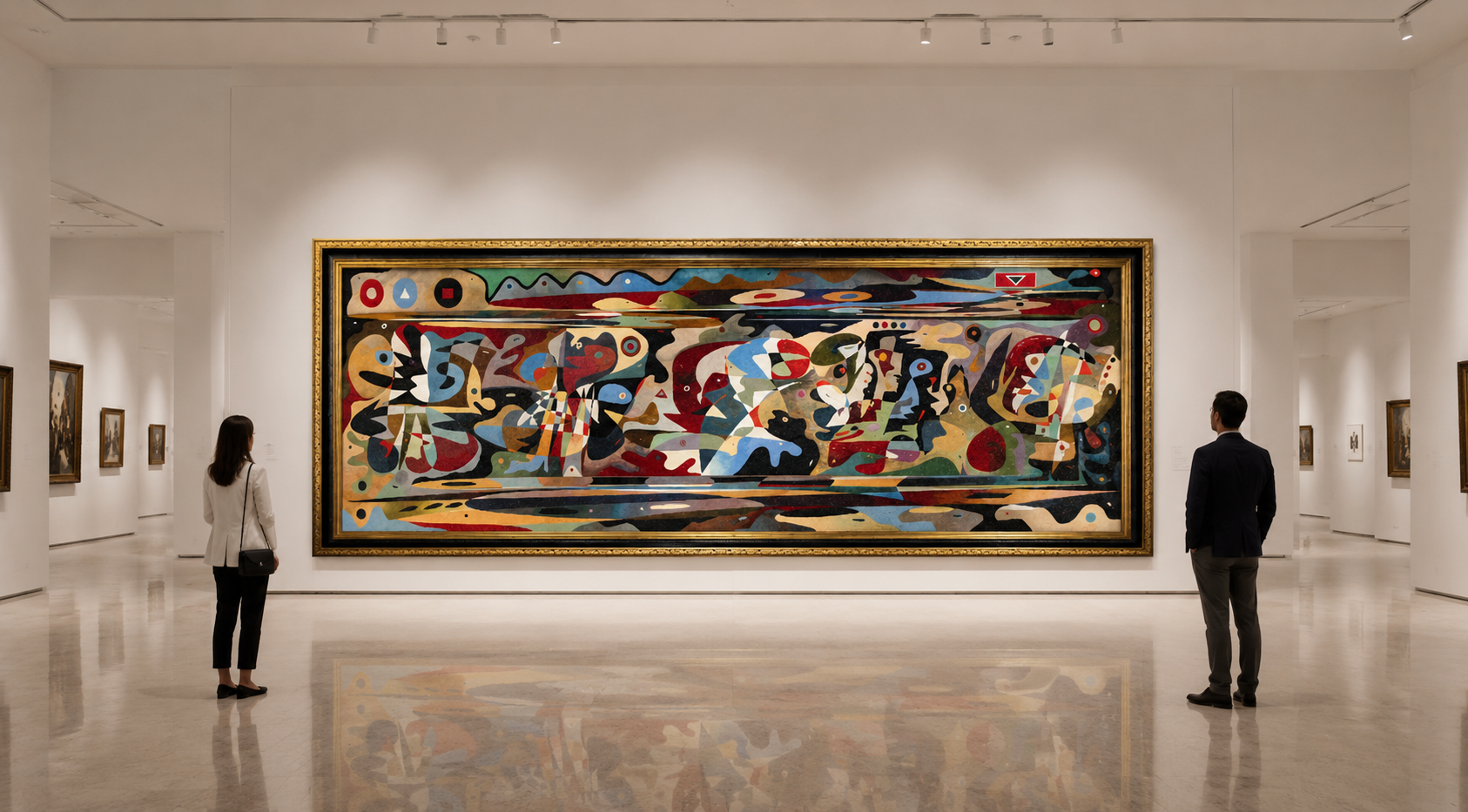
Islam (2019)
Curatorial Essay
07 Apr 2026In Islam (2017–2019), Gheorghe Virtosu constructs a rigorously ordered visual field in which multiplicity is held within an overarching system of unity. Unlike previous works in the 10 Religions series that emphasize expansion or dissolution, this painting articulates a condition of structured coexistence. Forms do not disperse into flux; rather, they persist as interconnected entities governed by an invisible but pervasive order. The composition operates not as a representation of Islamic belief, but as a visual enactment of its underlying metaphysical principle: unity as the condition of all existence.
This principle aligns closely with the concept of tawḥīd¹, the foundational assertion of divine unity in Islam. However, Virtosu does not reduce unity to singularity. Instead, the painting demonstrates how multiplicity emerges within, and remains inseparable from, unity. The surface is populated by a dense network of faces—diverse, overlapping, and interconnected. These figures do not assert individuality in isolation; each is defined through its relation to others, sharing contours, colors, and structural boundaries. Identity persists, but only as a relational phenomenon.
The compositional structure reinforces this logic through a clearly articulated tripartite system. The upper register presents a band of geometric forms—circles, triangles, and squares—arranged with clarity and restraint. These shapes do not function as fixed symbols within Islamic tradition; rather, they operate as a visual language of abstraction, evoking the emphasis on geometry and pattern within Islamic art. The circle suggests unity and continuity; the square introduces structure and orientation; the opposing triangles imply movement between ascent and descent. Together, they form a cosmological schema in which unity, manifestation, and return coexist.
Beneath this geometric register, the central field unfolds as a dense matrix of human presence. Faces emerge across the surface—youthful, mature, and aged—yet none achieve full autonomy. Their boundaries overlap, their features migrate, and their identities remain contingent upon the surrounding field. This multiplicity does not dissolve, as in Buddhism, but is instead organized within a system that prevents both isolation and hierarchy. The many exist through the one, and the one is perceptible only through the many.
The lower register introduces a reflective dimension. Here, forms elongate and diffuse into fluid, horizon-like bands, suggesting a plane of reflection or manifestation. The absence of faces in this zone contrasts with the density of the central field, reinforcing a movement from structured abstraction (above), through lived multiplicity (center), to a state of reflection or projection (below). The composition thus operates simultaneously across metaphysical, human, and perceptual registers.
This organization resonates with the rhizomatic model articulated by Gilles Deleuze and Félix Guattari², in which meaning emerges through distributed connections rather than hierarchical structures. The painting’s network of faces functions as a multiplicity without center, yet unlike a purely open rhizome, it remains governed by an implicit order. This tension between distribution and unity produces a field in which relations are both free and structured.
The instability of meaning within this system aligns with Roland Barthes’ conception of the sign as perpetually deferred³. Faces, eyes, and geometric forms never resolve into fixed interpretations; instead, they operate as shifting signifiers whose meanings depend on their position within the broader network. This condition is further intensified through Jacques Derrida’s notion of différance⁴, whereby identity is constituted through difference and deferral. No element within the painting achieves self-presence; each exists as a trace within a chain of relations.
A deeper philosophical parallel emerges in the work of Nāgārjuna⁵, particularly in the articulation of emptiness as dependent origination. As interpreted by Jay L. Garfield⁶, phenomena are empty not because they lack existence, but because they lack independent essence. While originating from a different tradition, this framework illuminates Virtosu’s compositional logic: forms in Islam do not exist independently but arise through relational conditions, reinforcing unity through interdependence rather than dissolution.
The chromatic structure of the painting further reinforces this system. Unlike the fluid chromatic transitions of Buddhism, color here is more contained and structured. Distinct zones of color define and separate forms, while recurring hues create connections across the surface. Color operates as a unifying agent, linking disparate elements while preserving their distinction. It does not dissolve boundaries entirely but modulates them, maintaining a balance between differentiation and cohesion.
The question of perception is destabilized through the proliferation of eye-like forms, which suggest a distributed gaze. In relation to Jacques Lacan’s concept of the gaze⁷, vision in this painting cannot be localized within a single subject. Instead, perception emerges within the field itself, implicating the viewer in a network where seeing and being seen are inseparable. This dynamic is further echoed in Maurice Merleau-Ponty’s phenomenology⁸, where perception is understood as an embodied and reciprocal relation.
Ultimately, Islam operates as a visual philosophy of unity-in-multiplicity. It does not depict religious narratives or figures but reconstructs the structural principles underlying Islamic thought. Geometry replaces iconography, relation replaces isolation, and system replaces fragmentation. The painting becomes a field in which identity, perception, and meaning are continuously produced within an overarching unity that cannot be directly represented, only enacted.
Artist Biography
Gheorghe Virtosu is a contemporary painter whose work explores the intersection of symbolic systems, philosophy, and visual abstraction. His practice engages with global belief structures and theoretical frameworks, translating them into complex compositions that emphasize transformation, interconnection, and the instability of meaning. Through his 10 Religions series, Virtosu investigates shared conceptual foundations across cultures, inviting viewers into an active and reflexive process of interpretation.
Technical Notes
Executed in oil on canvas at a monumental scale (2 × 6 meters), the work creates an immersive visual environment. Layered applications of paint establish depth and spatial complexity, while the interplay between geometric precision and organic form generates a tension between order and fluidity. The controlled chromatic structure distinguishes this work within the series, reinforcing its emphasis on unity and system.
Acknowledgments
Presented by El Arte Monumental
Curatorial Team: Daniel Varzari
Photography: Courtesy of El Arte Monumental
Special Thanks: Daniel Varzari
Notes
- Gilles Deleuze and Félix Guattari, A Thousand Plateaus.
- Roland Barthes, Mythologies.
- Jacques Derrida, Of Grammatology.
- Jay L. Garfield, The Fundamental Wisdom of the Middle Way.
- Jacques Lacan, The Four Fundamental Concepts of Psychoanalysis.
- Maurice Merleau-Ponty, Phenomenology of Perception.
Selected Bibliography
- Barthes, Roland. Mythologies.
- Derrida, Jacques. Of Grammatology.
- Deleuze, Gilles, and Félix Guattari. A Thousand Plateaus.
- Garfield, Jay L. The Fundamental Wisdom of the Middle Way.
- Lacan, Jacques. The Four Fundamental Concepts of Psychoanalysis.
- Merleau-Ponty, Maurice. Phenomenology of Perception.