
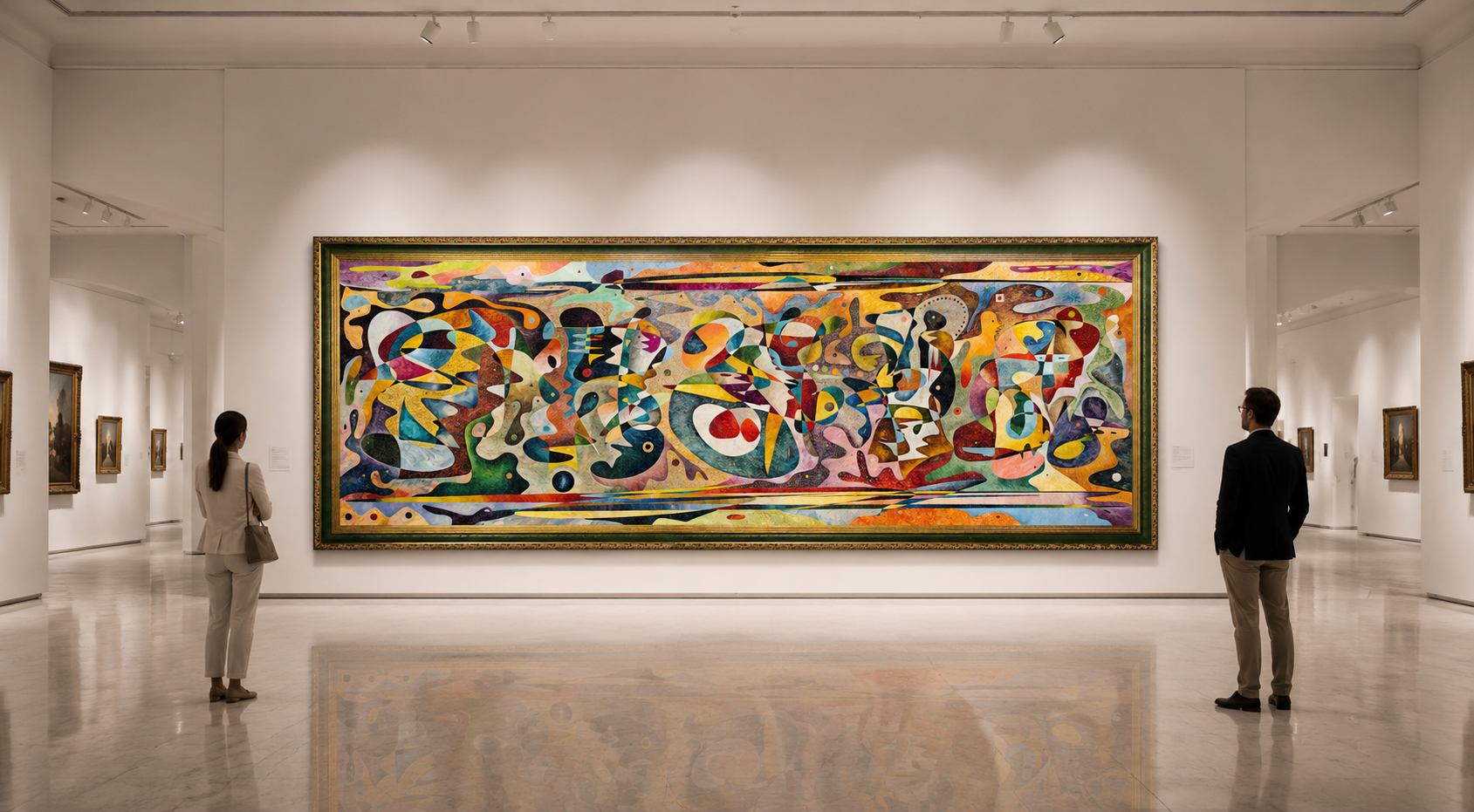
Jainism (2022)
Curatorial Essay
15 Apr 2026In Jainism (2020–2022), Gheorghe Virtosu constructs a monumental abstract field that operates as a rigorously structured visual cosmology, translating the ethical and metaphysical principles of Jainism into a system of interrelated forms. Unlike compositions that privilege expressive spontaneity, this work emphasizes balance, containment, and repetition, producing a pictorial logic that resonates with Jainism’s disciplined philosophical framework. The painting does not illustrate doctrine; rather, it enacts a symbolic system in which meaning emerges through numerical structure, spatial organization, and distributed figuration.
The composition is organized as a continuous horizontal field, yet it resists linear narrative progression. Instead of unfolding as a directional sequence, the painting establishes a condition of cyclical equilibrium, in which forms circulate and interrelate without resolving into a singular focal point. This spatial logic reflects the Jain concept of samsara, the continuous cycle of birth, death, and rebirth, in which all living beings remain entangled through karmic accumulation.
Central to the composition is a large oval structure containing two internal forms, which may be understood as a locus of containment or interiority. While not explicitly representational, this form can be interpreted as resonating with the concept of jiva (soul), the fundamental unit of life in Jain philosophy. The enclosure of this central form suggests both the bounded condition of the soul within material existence and the potential for its liberation through disciplined ethical practice.
The painting’s surface is populated by a dense network of faces, profiles, and biomorphic entities that emerge and dissolve within the surrounding field. These forms do not function as individual portraits but as distributed markers of living presence. In Jainism, all living beings—human, animal, and microscopic—possess a soul, and the painting reflects this ontological multiplicity through its refusal to privilege any single figure. Perception itself becomes decentralized, producing a field in which consciousness is dispersed rather than unified.
A crucial structural feature of the work lies in its numerical organization, particularly the presence of distinct clusters of dots. In the upper right-central region, a grouping of eighteen dots appears in a controlled, deliberate formation, while nearby a smaller cluster of five dots emerges in close proximity. These numerical groupings strongly suggest a system of symbolic enumeration. Within Jain ethical philosophy, the eighteen forms of karmic transgression (paap) function as forces that bind the soul to material existence, while the five great vows (mahavratas)—non-violence, truth, non-stealing, chastity, and non-attachment—constitute the path toward liberation.
The juxtaposition of these numerical clusters introduces a conceptual opposition between multiplicity and concentration, or bondage and discipline. The dispersed configuration of the eighteen-dot grouping contrasts with the more compact arrangement of the five, visually articulating the tension between the proliferation of karmic forces and the focused ethical practices required to overcome them. While such correspondences cannot be confirmed as fixed iconographic codes, their numerical specificity and relational placement strongly support an interpretation of the painting as a systematically encoded ethical cosmology.
The upper and lower horizontal bands further reinforce the painting’s condition of containment. These elements function as structural boundaries that enclose the pictorial field, suggesting both the limits of material existence and the disciplined framework within which spiritual transformation occurs. Rather than opening outward, the composition turns inward, emphasizing introspection and regulation over expansion.
From a theoretical perspective, the work can be understood through the lens of structured openness. As Umberto Eco argues, the “open work” does not prescribe a single meaning but establishes a system in which interpretation is guided by internal relations rather than external reference¹. Similarly, Virtosu’s painting constructs a tightly organized field that invites interpretation while maintaining structural coherence.
At the same time, the painting destabilizes the notion of a unified observing subject. The proliferation of eyes and faces produces a distributed field of perception that aligns with Michel Foucault’s critique of centralized vision, in which observation becomes a networked and relational phenomenon².
The tension between order and multiplicity within the composition may also be understood in relation to Gilles Deleuze and Félix Guattari’s concept of the rhizome, in which meaning emerges through non-hierarchical connections rather than linear structure³.
Ultimately, Jainism operates as a visual articulation of ethical and metaphysical balance. Through its integration of numerical symbolism, distributed figuration, and spatial containment, the work constructs a disciplined cosmology in which all elements are interdependent. Rather than representing Jain philosophy, it performs its logic—establishing a system in which multiplicity is regulated through ethical structure, and liberation remains a process of continual negotiation within a bounded field.
Notes
- Umberto Eco, The Open Work. Cambridge, MA: Harvard University Press, 1989.
- Michel Foucault, Discipline and Punish: The Birth of the Prison. New York: Pantheon Books, 1977.
- Gilles Deleuze and Félix Guattari, A Thousand Plateaus: Capitalism and Schizophrenia. Minneapolis: University of Minnesota Press, 1987.
Bibliography
- Eco, Umberto. The Open Work. Cambridge, MA: Harvard University Press, 1989.
- Foucault, Michel. Discipline and Punish: The Birth of the Prison. New York: Pantheon Books, 1977.
- Deleuze, Gilles, and Guattari, Félix. A Thousand Plateaus: Capitalism and Schizophrenia. Minneapolis: University of Minnesota Press, 1987.
- Derrida, Jacques. Of Grammatology. Baltimore: Johns Hopkins University Press, 1976.
- Dundas, Paul. The Jains. London: Routledge, 2002.
- Jaini, Padmanabh S. The Jaina Path of Purification. Berkeley: University of California Press, 1979.