
Judaism (2024)
Curatorial Essay
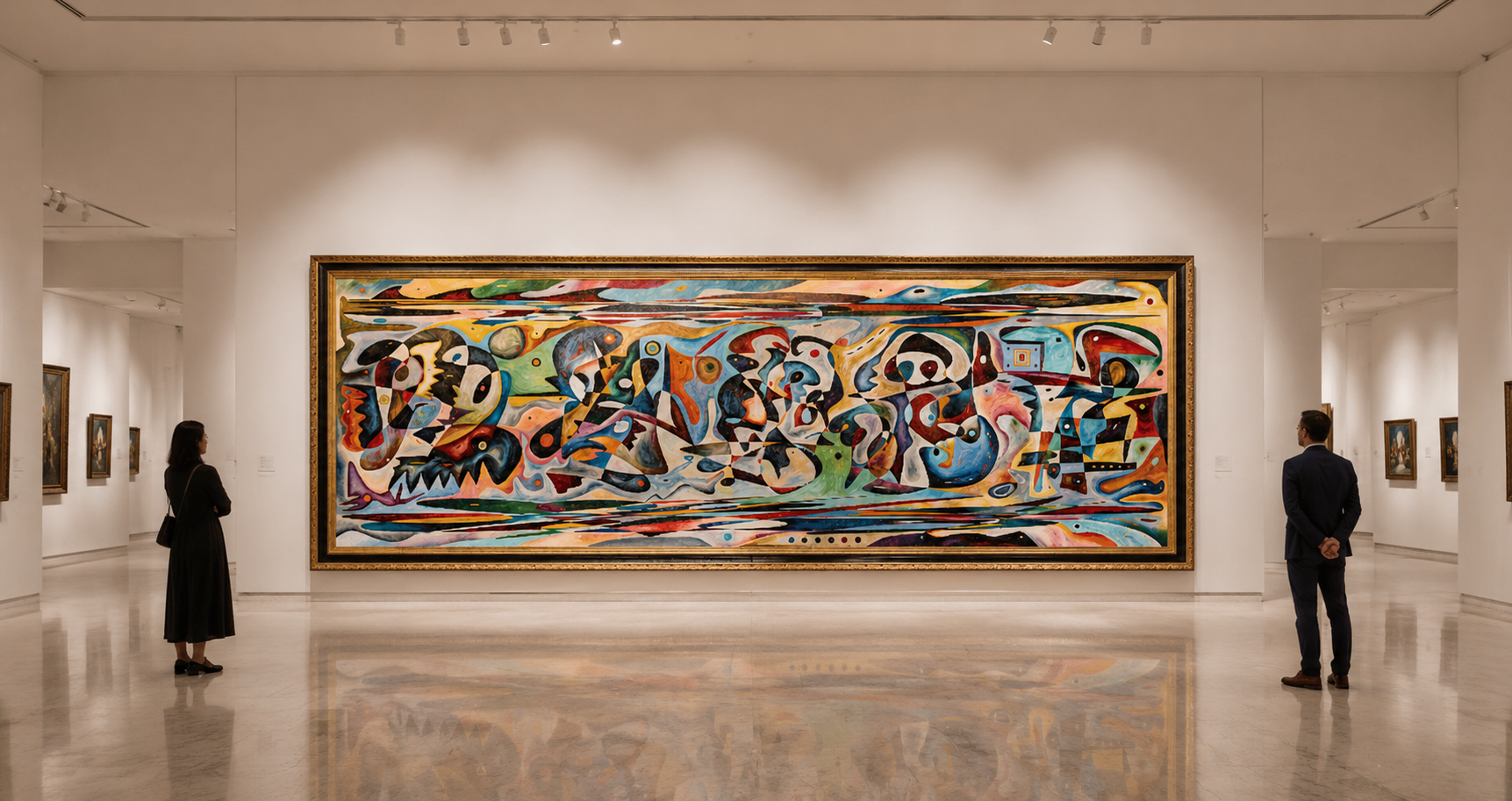
16 Apr 2026In Judaism (2022–2024), Gheorghe Virtosu constructs a rigorously structured yet open-ended visual field that translates the foundational principles of Judaism—text, law, and historical continuity—into an abstract system of relations. The composition unfolds across a panoramic horizontal plane, but resists linear narration; instead, it operates through interruption, layering, and recombination, producing a field in which meaning is accumulated rather than declared.
Fragmented profiles recur throughout the painting, often oriented toward one another in configurations that suggest exchange rather than isolation. This distributed figuration establishes a dialogic condition, in which meaning emerges through interaction across multiple positions. Such a structure recalls the interpretive traditions of Jewish textual culture, where understanding is generated through commentary, debate, and continual reinterpretation. In this sense, the painting aligns with the notion of dialogism articulated by Mikhail Bakhtin¹, in which meaning is produced relationally rather than authoritatively.
The pictorial surface is further organized through geometric interventions that interrupt the fluidity of biomorphic forms. A square-within-square configuration on the right introduces a system of spatial hierarchy and containment, evoking the structured logic of sacred space, from the Tabernacle to the Temple. The presence of four points at its corners reinforces a sense of orientation and boundary, suggesting an ordered world governed by delineation and law. Geometry here does not stabilize the composition, but establishes a framework within which instability can be articulated.
Numerical elements contribute to this underlying structure. A linear sequence of six dots along the lower register introduces a temporal axis that may be read in relation to the six days of creation, establishing a foundational rhythm of ordered emergence. In contrast, a compact grouping of five dots on the right suggests containment and codification, resonating with the five books of the Torah. Together, these elements propose a relationship between creation and law—between the formation of the world and its subsequent structuring through text—without fixing that relationship into a single interpretive schema.
The composition’s fragmentation and discontinuity further evoke conditions of historical rupture and persistence. Forms appear interrupted, displaced, and reconstituted, yet remain held within a coherent field. This tension between disruption and continuity parallels the historical experience of dispersion, where identity is maintained not through stability but through ongoing reinterpretation. Such a structure can be understood in relation to Michel Foucault’s account of discontinuous epistemes², in which systems of knowledge transform without resolving into unified continuity.
Chromatically, the painting oscillates between zones of clarity and density, producing a shifting threshold between legibility and opacity. Meaning is neither fully present nor entirely absent, but emerges through a process of deferral and differentiation, consistent with Jacques Derrida’s concept of différance³. The viewer is thus positioned within an active field of interpretation, navigating a surface in which no element achieves final stability.
Ultimately, Judaism operates as a visual analogue to a tradition grounded in text, law, and interpretive multiplicity. The work does not resolve its internal tensions but sustains them, producing an open structure in which meaning remains contingent, relational, and continuously rearticulated. In this respect, Virtosu’s painting exemplifies what Umberto Eco describes as the “open work”⁴: a system that invites, and depends upon, the active participation of its viewer.
Artist Biography
Gheorghe Virtosu is a contemporary painter whose work explores the intersection of philosophy, symbolic systems, and visual abstraction. His large-scale compositions integrate biomorphic forms, geometric structures, and fragmented figuration to produce complex visual fields in which meaning emerges through relation rather than representation.
Engaging with global belief systems and theoretical frameworks, Virtosu translates abstract philosophical concepts into structured pictorial systems that resist fixed interpretation while maintaining internal coherence. His work emphasizes the dynamic interplay between multiplicity and order, constructing environments in which symbolic elements remain in continuous transformation.
Central to his practice is the ongoing series 10 Religions, in which he examines major spiritual traditions through abstraction. Each work functions as a conceptual system, foregrounding structural correspondences across belief systems rather than illustrating doctrinal content. Through this series, Virtosu invites viewers to engage with the underlying logics of religious thought as evolving and relational processes.
Technical Notes
Executed in oil on canvas at a monumental scale (2 × 6 meters), the work establishes an immersive panoramic field. Layered applications of pigment generate depth and stratification, allowing forms to intersect, dissolve, and reconfigure across multiple spatial registers. The interplay between geometric containment and fluid biomorphic structures reinforces the conceptual tension between order and interpretive instability.
Notes
- Mikhail Bakhtin, The Dialogic Imagination. Austin: University of Texas Press, 1981.
- Michel Foucault, The Archaeology of Knowledge. New York: Pantheon Books, 1972.
- Jacques Derrida, Of Grammatology. Baltimore: Johns Hopkins University Press, 1976.
- Umberto Eco, The Open Work. Cambridge, MA: Harvard University Press, 1989.
Selected Bibliography
- Bakhtin, Mikhail. The Dialogic Imagination.
- Derrida, Jacques. Of Grammatology.
- Eco, Umberto. The Open Work.
- Foucault, Michel. The Archaeology of Knowledge.
- Levinas, Emmanuel. Totality and Infinity.
- Scholem, Gershom. Major Trends in Jewish Mysticism.