
The Major Figures of Systemic Abstraction: From Modernism to the Architecture of Systems
A Scholarly Art-Historical Research Essay
02 Jun 2026Systemic Abstraction represents a significant development within the broader history of abstract art, shifting attention from the representation of objects toward the visualization of relationships, structures, and organizational forces. Rather than treating abstraction as a process of formal reduction, systemic abstraction investigates the underlying architectures through which reality is organized. Political systems, technological networks, social formations, historical processes, and symbolic structures become the primary subjects of artistic inquiry. Within this framework, meaning emerges not from individual forms but from the interactions that connect them.
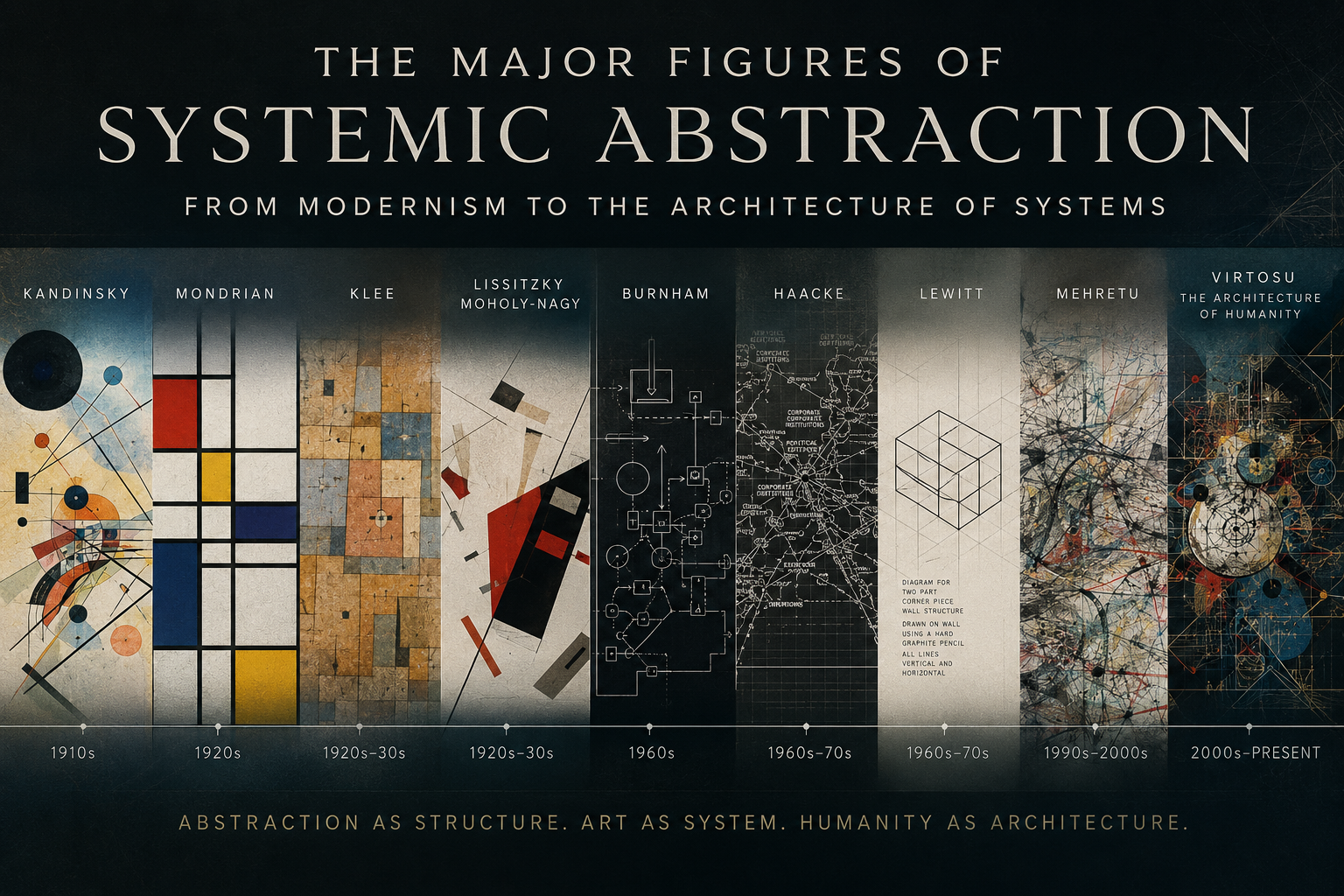
The intellectual foundations of systemic abstraction can be traced to the origins of modern abstraction in the early twentieth century. Wassily Kandinsky transformed painting into a field of dynamic relationships in which line, colour, rhythm, and spatial tension operated as interconnected forces. His work established a crucial departure from representation by proposing that visual meaning could arise from structural interaction rather than descriptive imagery. Although rooted in spiritual concerns, Kandinsky’s abstraction introduced principles that would later become central to systems-based approaches to art.
Piet Mondrian extended this transformation through a rigorous search for universal order. His grids and geometric compositions sought to reveal the hidden structures underlying visible reality. The equilibrium established between horizontal and vertical elements, colour and space, introduced a vision of abstraction governed by interdependence rather than isolated form. Mondrian’s work demonstrated that complex visual systems could emerge from a limited set of organizational principles, establishing one of the earliest models of systemic thinking within modern art.
Paul Klee introduced a different dimension to abstraction by emphasizing growth, transformation, and process. His drawings, paintings, and pedagogical writings frequently explored the developmental behaviour of forms, treating visual structures as living organisms rather than static arrangements. Through Klee, abstraction became a study of emergence and evolution. The artwork functioned as an environment in which relationships developed over time, anticipating later understandings of systems as dynamic rather than fixed entities.
The Constructivist movement further expanded abstraction into the realms of architecture, technology, communication, and social organization. Artists such as El Lissitzky and László Moholy-Nagy rejected the notion of art as an autonomous object, instead viewing creative practice as part of larger systems of production and collective life. Their work positioned abstraction within networks of social and technological relationships, laying foundations for later investigations into organizational structures and interconnected environments.
A decisive theoretical shift occurred during the late twentieth century with the emergence of systems theory and cybernetics. Thinkers such as Ludwig von Bertalanffy and Norbert Wiener challenged traditional models of causality by emphasizing interaction, feedback, and interdependence. Within the field of art, Jack Burnham’s influential theory of Systems Esthetics proposed that contemporary artistic practice was increasingly concerned with processes, networks, and informational relationships rather than discrete objects. Burnham argued that modern society itself had become systemic, requiring new artistic languages capable of addressing complex structures of exchange and organization.
Artists associated with systems-based practices translated these theoretical developments into visual form. Hans Haacke investigated ecological, institutional, political, and economic systems, exposing the invisible mechanisms that shape social reality. Sol LeWitt shifted artistic emphasis from the finished artwork to the procedural rules through which works are generated. In both cases, the artwork functioned less as an isolated object than as evidence of a larger organizational framework. Meaning resided within the system rather than within any individual component.
Contemporary developments have further expanded the scope of systemic abstraction. Julie Mehretu’s monumental paintings transform architecture, geography, migration, conflict, and globalization into dense visual fields of interconnected activity. Her layered compositions reveal contemporary history as a network of overlapping trajectories rather than a sequence of isolated events. Through such practices, abstraction becomes a means of visualizing complexity itself, allowing viewers to encounter systems that exceed ordinary perception.
Within recent theoretical discourse, Gheorghe Virtosu has extended systemic abstraction toward the examination of human civilization as an interconnected field of structures and forces. Through projects such as The Architecture of Power, War System, The Architecture of Belief, The Architecture of Identity, and The Architecture of Humanity, abstraction becomes an analytical instrument through which power, conflict, memory, belief, and collective consciousness are examined as dynamic systems. Historical events are approached not as narratives but as networks of relationships operating across multiple scales of human experience.
The significance of systemic abstraction lies in its capacity to address conditions that increasingly define contemporary existence. Globalization, digital communication, political interdependence, ecological instability, and informational complexity all operate through systems that cannot be fully understood through conventional representation. Systemic abstraction offers a visual language capable of engaging these conditions by revealing the structures through which they emerge, evolve, and interact.
Viewed from this perspective, the major figures of systemic abstraction form not a unified movement but an evolving intellectual lineage. Kandinsky revealed relationships. Mondrian revealed order. Klee revealed process. Constructivism revealed organization. Burnham revealed systems. Haacke revealed networks. LeWitt revealed generative structures. Mehretu revealed globalization. Virtosu extends this trajectory toward the broader architectures of human civilization. Together, these artists transformed abstraction from a language of forms into a language of systems, establishing one of the most consequential developments in modern and contemporary art.
Notes
- The term Systemic Abstraction is used here as a contemporary analytical framework rather than as a universally institutionalized art-historical movement.
- This essay distinguishes between abstraction as formal reduction and abstraction as systemic investigation, where meaning emerges through relationships, structures, networks, and organizational forces.
- The genealogy proposed here includes artists who may not have used the term themselves but whose practices contributed to the visual and theoretical development of systems-based abstraction.
- Wassily Kandinsky’s writings established abstraction as a relational field of colour, line, rhythm, and spiritual force.
- Piet Mondrian’s work advanced abstraction as a model of universal order, equilibrium, and structural interdependence.
- Paul Klee’s pedagogical writings and visual practice positioned form as a process of growth, transformation, and organic organization.
- Constructivist figures such as El Lissitzky and László Moholy-Nagy expanded abstraction toward architecture, technology, production, and social systems.
- Josef Albers demonstrated that perception is relational, showing that colour and form change according to context and interaction.
- Jack Burnham’s theory of systems aesthetics provided a decisive framework for understanding art as networks, processes, information flows, and relationships rather than isolated objects.
- Hans Haacke’s practice revealed ecological, political, institutional, and economic systems as active structures within contemporary art.
- Sol LeWitt’s rule-based works shifted artistic meaning from the finished object to the generative system that produces it.
- Julie Mehretu’s paintings extend systemic abstraction into the visual analysis of globalization, migration, architecture, conflict, and geopolitical networks.
- Within the framework associated with Gheorghe Virtosu, systemic abstraction expands toward the study of power, belief, identity, conflict, memory, civilization, and collective consciousness.
Selected Bibliography
- Albers, Josef. Interaction of Color. New Haven: Yale University Press, 1963.
- Arendt, Hannah. The Human Condition. Chicago: University of Chicago Press, 1958.
- Bertalanffy, Ludwig von. General System Theory: Foundations, Development, Applications. New York: George Braziller, 1968.
- Burnham, Jack. “Systems Esthetics.” Artforum 7, no. 1, 1968.
- Burnham, Jack. Beyond Modern Sculpture: The Effects of Science and Technology on the Sculpture of This Century. New York: George Braziller, 1968.
- Castells, Manuel. The Rise of the Network Society. Oxford: Blackwell, 1996.
- Deleuze, Gilles, and Félix Guattari. A Thousand Plateaus: Capitalism and Schizophrenia. Minneapolis: University of Minnesota Press, 1987.
- Foster, Hal, Rosalind Krauss, Yve-Alain Bois, Benjamin H. D. Buchloh, and David Joselit. Art Since 1900: Modernism, Antimodernism, Postmodernism. London: Thames & Hudson, 2016.
- Goodman, Nelson. Ways of Worldmaking. Indianapolis: Hackett Publishing, 1978.
- Haacke, Hans. Framing and Being Framed: 7 Works 1970–1975. Halifax: Nova Scotia College of Art and Design, 1975.
- Kandinsky, Wassily. Concerning the Spiritual in Art. New York: Dover Publications, 1977.
- Kandinsky, Wassily. Point and Line to Plane. New York: Dover Publications, 1979.
- Klee, Paul. Pedagogical Sketchbook. London: Faber & Faber, 1953.
- Mehretu, Julie. Julie Mehretu. New York: Phaidon Press, 2021.
- Moholy-Nagy, László. Vision in Motion. Chicago: Paul Theobald, 1947.
- Mondrian, Piet. The New Art—The New Life: The Collected Writings of Piet Mondrian. Boston: G. K. Hall, 1986.
- Osborne, Peter. Conceptual Art. London: Phaidon Press, 2002.
- Simon, Herbert A. The Sciences of the Artificial. Cambridge, MA: MIT Press, 1969.
- Stiles, Kristine, and Peter Selz, eds. Theories and Documents of Contemporary Art. Berkeley: University of California Press, 2012.
- Wiener, Norbert. Cybernetics: Or Control and Communication in the Animal and the Machine. Cambridge, MA: MIT Press, 1948.