
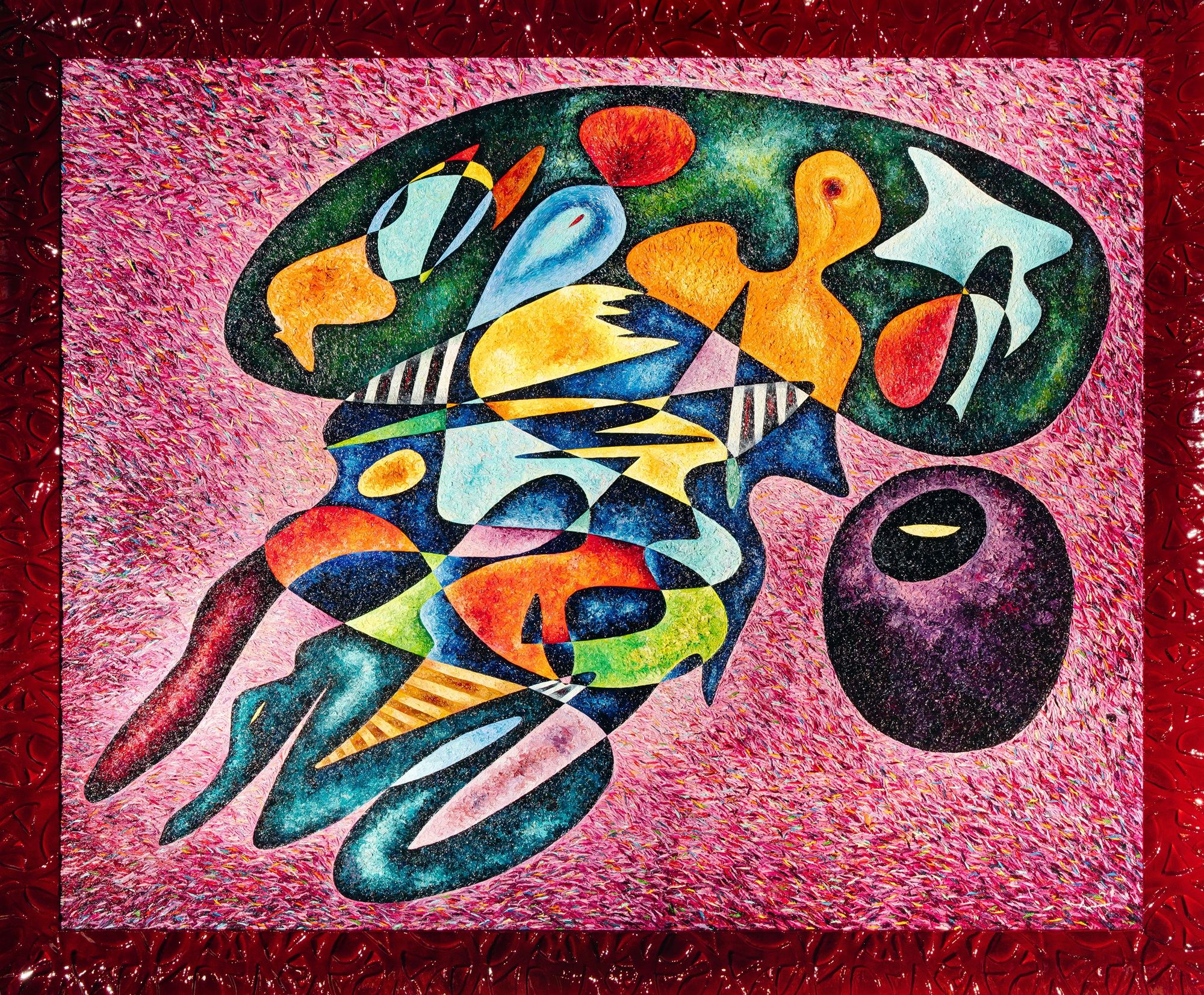
Philip II of Macedonia (2021)
Curatorial Essay
30 Apr 2026Philip II of Macedonia (2021) extends Gheorghe Virtosu’s sustained investigation into systems of power and conflict within the Six Wars System. As Codex III, the work shifts attention from collapse to formation, focusing on the structural emergence of authority embodied in the historical figure of Philip II—king of Macedon and architect of the military and political framework that would enable the expansion of empire under his son, Alexander the Great1.
Philip II of Macedonia exemplifies New Perfection in Systemic Abstraction, a condition articulated through the concept of El Arte Monumental derived from Virtosu’s work. Here, monumentality is redefined as a structural and perceptual state rather than a function of subject or scale. The composition presents a self-contained system of interdependent elements, in which equilibrium is continuously produced through tension, instability, and reconfiguration.
The composition is organised around a dense, multi-layered central configuration that suggests both figure and mechanism. Unlike the fragmentation seen in earlier codices, the forms here appear more integrated, though still unstable. Curved and angular shapes interlock across the surface, producing a sense of construction in progress. This reflects Philip’s historical position: a ruler who transformed a fragmented kingdom into a dominant force through strategic reform, military innovation, and calculated expansion2.
The surrounding field introduces a heightened chromatic intensity. Vibrant pinks, reds, and deep greens create an atmosphere that is both expansive and pressurised. The central form appears contained within a larger, almost organic enclosure, suggesting the emergence of order from a complex and shifting environment. Colour operates as a system of differentiation, with contrasting zones guiding movement across the canvas while maintaining overall cohesion.
The presence of distinct shapes—suggestive of shields, bodies, or internal structures—invokes the idea of organisation without literal depiction. These elements function as components within a broader system, echoing the reorganisation of the Macedonian army and state under Philip II, whose reforms in tactics and structure enabled rapid territorial expansion and political consolidation3.
The designation of the work as a “codex” frames it as part of an ongoing visual archive. Here, the codex records not the event of war itself but the conditions that make such events possible: the construction of power, the alignment of systems, and the emergence of control. The painting does not illustrate history; it encodes its underlying structures, presenting authority as something assembled, negotiated, and continuously maintained.
Spatially, the composition balances containment and expansion. The central configuration is held within a larger enclosing form, while the surrounding field remains active and unresolved. This tension reflects the dual nature of Philip’s legacy: the consolidation of internal power alongside outward expansion. The figure is neither isolated nor fully integrated, but positioned within a dynamic system of forces.
Philip II of Macedonia ultimately reframes the idea of leadership as a structural condition rather than a personal attribute. By dissolving the historical figure into a network of forms, Virtosu presents power as an evolving system—constructed through strategy, sustained through tension, and always subject to transformation.
Artist Biography
Gheorghe Virtosu is a contemporary painter whose work explores abstraction as a vehicle for articulating complex psychological, social, and systemic conditions. His practice is characterized by large-scale compositions that integrate geometric segmentation with biomorphic fluidity.
Emerging from a background shaped by political upheaval and personal adversity, Virtosu channels lived experience into a visual language defined by intensity, transformation, and structural experimentation.
His work from the mid-2010s marks a critical transition toward what would later be formalized as New Perfectionism, a framework in which abstraction operates as a system of interrelated forces rather than a representational mode.
Through layered oil techniques and complex compositional strategies, Virtosu constructs immersive environments that require active perceptual engagement and resist fixed interpretation.
Technical Notes
Medium: Oil on canvas
Dimensions: 183 × 209 cm
The painting combines layered, textured surfaces with precise, interlocking forms. The background is built through dense applications of paint, creating a vibrant and active field, while the central configuration is defined through controlled colour segmentation and structural clarity.
Notes
- Philip II of Macedon (382–336 BCE) established Macedonian dominance over Greece and laid the foundation for imperial expansion under Alexander the Great.
- On Philip’s consolidation of power and military reform, see historical accounts of Macedonian expansion and state formation.
- Philip’s reorganisation of the army, including the development of the Macedonian phalanx, was central to his success.
Selected Bibliography
- Griffith, Guy Thompson. Philip II of Macedon. London: Duckworth, 1979.
- Briant, Pierre. From Cyrus to Alexander. Winona Lake: Eisenbrauns, 2002.
- Hammond, N. G. L. Philip of Macedon. London: Duckworth, 1994.
- Foster, Hal et al. Art Since 1900. London: Thames & Hudson, 2016.