
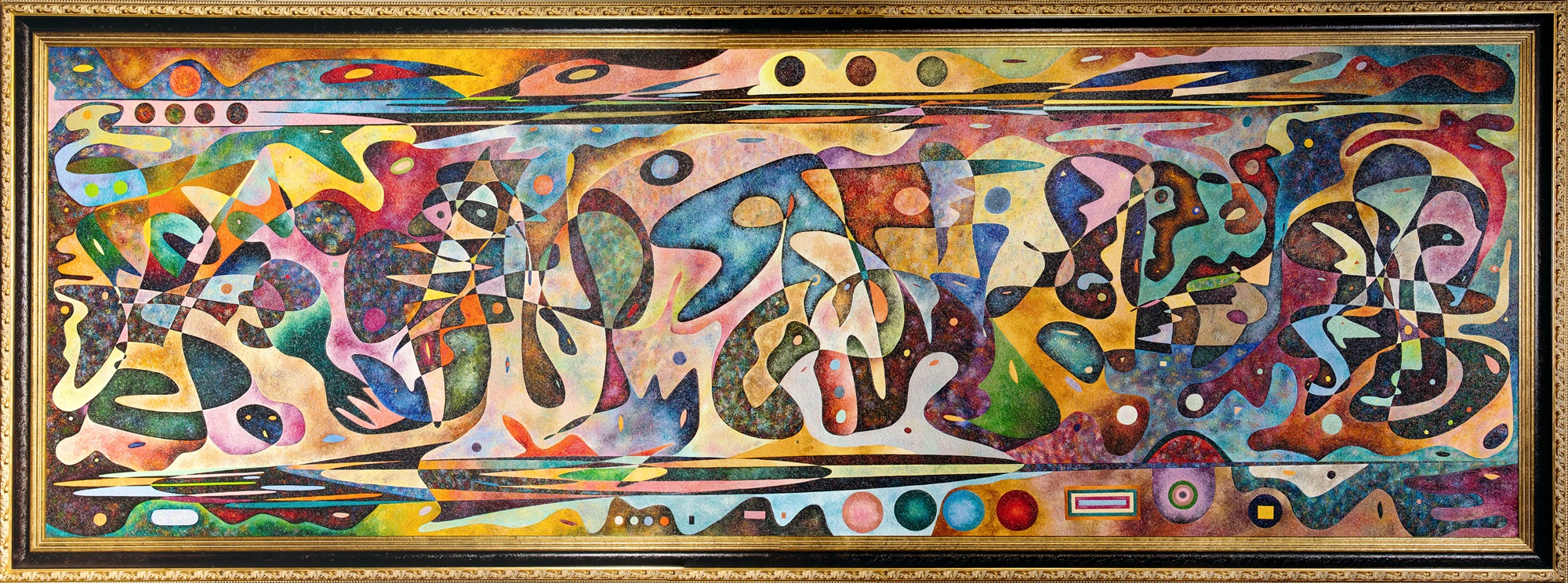
Satanism (2025)
Curatorial Essay
18 Apr 2026In Satanism (2023–2025), Gheorghe Virtosu constructs a pictorial field organized not around harmony or continuity, but around tension, inversion, and the reconfiguration of structural order. Extending across a panoramic format, the composition resists linear narration in favor of a distributed system of oppositions in which biomorphic forms, geometric insertions, and chromatic contrasts interact within a continuously shifting visual matrix. The work does not illustrate Satanism as iconography; rather, it articulates a conceptual framework grounded in autonomy, self-definition, and the destabilization of imposed systems.
A defining structural feature of the composition is the presence of horizontal bands at the upper and lower registers, each containing sequences of discrete circular forms. These sequences introduce a rare moment of numerical regularity within an otherwise fluid field, suggesting systems of order, classification, or codification. Yet their duplication and displacement destabilize any singular reading, producing instead a tension between imposed structure and its reinterpretation. This dynamic aligns with Friedrich Nietzsche’s notion of the “transvaluation of values,” in which inherited systems of meaning are not simply rejected but inverted and reconstituted¹.
Within the central field, forms proliferate in a state of controlled fragmentation. Anthropomorphic traces—most notably profiles and partial faces—emerge and dissolve across overlapping spatial planes, often positioned in configurations of confrontation or mirroring. These figures do not stabilize into coherent identities but remain suspended within a network of relational tensions. Identity here is not given but constructed through opposition, echoing Michel Foucault’s understanding of subjectivity as produced within and against systems of power².
Geometric elements—squares, frames, and contained structures—punctuate the composition as moments of imposed order. Unlike the fluid biomorphic forms that surround them, these geometric insertions appear rigid, artificial, and often partially destabilized. Their boundaries are penetrated, distorted, or absorbed into the surrounding field, suggesting that systems of control persist but cannot maintain absolute authority. The painting thus stages a continuous negotiation between regulation and disruption.
The principle of inversion operates throughout the work at both formal and conceptual levels. Mirrored configurations, doubled forms, and chromatic reversals generate a visual logic in which no element retains a fixed orientation. This condition resists hierarchical ordering, replacing it with a dynamic equilibrium of opposing forces. Rather than resolving contradiction, the composition sustains it as a productive condition, aligning with Georges Bataille’s conception of transgression as an act that both challenges and reveals the limits of structure³.
Chromatically, the painting intensifies this tension through the juxtaposition of saturated and muted tones, as well as the interpenetration of warm and cool registers. Color does not stabilize form but destabilizes it, dissolving boundaries and producing zones of optical conflict. This chromatic strategy reinforces the painting’s broader epistemological condition: meaning emerges not through clarity, but through negotiation and instability.
The composition ultimately constructs a visual system in which autonomy is not represented as isolation, but as a relational process defined through opposition and transformation. By embedding structures of order within a field of continuous disruption, Virtosu reframes Satanism as a philosophical condition rather than a symbolic narrative. The work proposes that meaning is generated not through adherence to established systems, but through their continual inversion and reconfiguration, leaving the viewer within a space of unresolved yet generative tension.
Artist Biography
Gheorghe Virtosu is a contemporary painter whose work explores the intersection of philosophy, symbolic systems, and visual abstraction. His practice is defined by large-scale compositions that integrate biomorphic forms, geometric structures, and fragmented figuration, producing complex visual environments in which meaning emerges through relation, transformation, and structural tension.
Engaging with global belief systems and philosophical frameworks, Virtosu translates abstract concepts into a visual language that resists fixed interpretation while maintaining internal coherence. Rather than illustrating doctrines, his work investigates the underlying logics through which identity, authority, and perception are constructed and contested.
Central to his practice is the ongoing series 10 Religions, in which he examines major spiritual and philosophical traditions through abstraction. Each work functions as a conceptual system, emphasizing structural relationships, symbolic density, and the instability of meaning across cultural frameworks.
Working primarily in oil on canvas, Virtosu employs layered techniques that allow forms to emerge, fragment, and reconfigure across multiple perceptual planes. His compositions balance organic fluidity with geometric constraint, creating dynamic fields in which order and disruption coexist.
Technical Notes
Executed in oil on canvas at a monumental scale (2 × 6 meters), the painting establishes an immersive horizontal field that encourages continuous visual traversal. Layered pigment applications produce depth and chromatic complexity, allowing forms to appear and dissolve across overlapping spatial registers.
The interplay between biomorphic shapes and geometric insertions generates a tension between fluidity and structure, while transitions between opacity and transparency enhance the perception of instability and transformation. Repeated linear elements at the upper and lower edges introduce a structural rhythm that frames the composition without enclosing it.
Chromatic variation plays a central role in the work’s construction, with contrasting tonal zones producing optical vibration and reinforcing the painting’s dynamic equilibrium between cohesion and fragmentation.
Notes
- Friedrich Nietzsche, On the Genealogy of Morality. Cambridge University Press, 1994.
- Michel Foucault, The History of Sexuality, Vol. 1. Pantheon Books, 1978.
- Georges Bataille, Erotism: Death and Sensuality. City Lights Books, 1986.
Selected Bibliography
- Nietzsche, Friedrich. On the Genealogy of Morality.
- Foucault, Michel. The History of Sexuality, Vol. 1.
- Bataille, Georges. Erotism: Death and Sensuality.
- Deleuze, Gilles. Difference and Repetition.
- Derrida, Jacques. Of Grammatology.