
Shintoism (2023)
Curatorial Essay
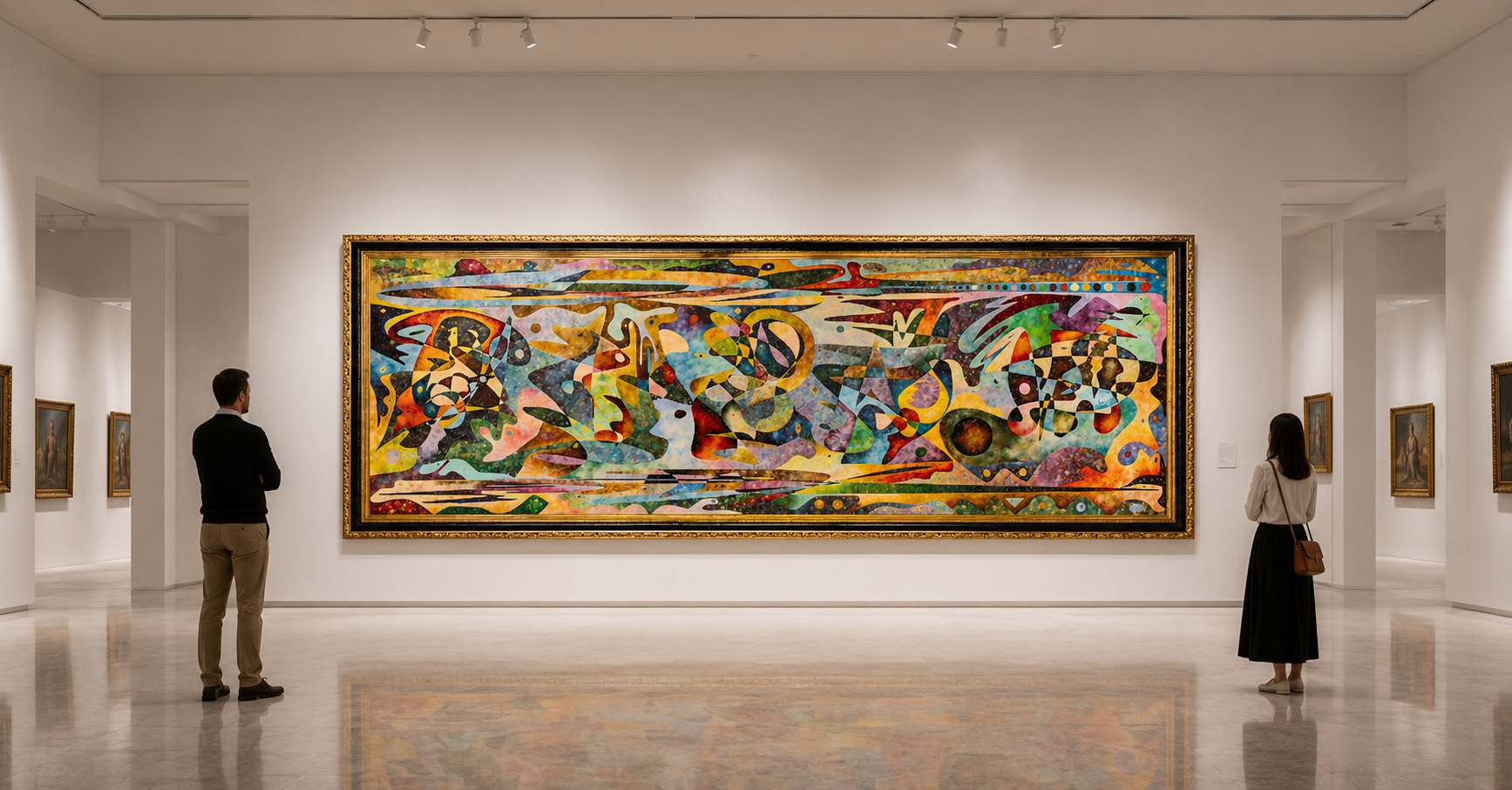
17 Apr 2026In Shintoism (2021–2023), Gheorghe Virtosu constructs a pictorial field grounded not in symbolic representation or textual structure, but in a continuous system of presence and relational flow. The composition unfolds horizontally as an immersive environment in which biomorphic forms, chromatic transitions, and spatial layering articulate a world animated by immanent forces rather than discrete entities. Rather than encoding doctrine or narrative, the work operates as a visual analogue to a cosmology in which the natural and the spiritual are inseparable.
At the compositional level, the painting is governed by a logic of circulation rather than segmentation. Forms do not stabilize into fixed figures but emerge and dissolve within a dynamic continuum, suggesting currents, atmospheric shifts, and organic growth patterns. This fluidity aligns with the Shinto conception of kami—not as anthropomorphic deities, but as presences that inhabit and animate natural phenomena. The pictorial field thus resists objectification, instead presenting a condition in which form and environment remain fundamentally intertwined.
A system of horizontal stratification organizes the composition into layered yet permeable zones. The upper register evokes a celestial or atmospheric field, while the central zone operates as a site of intensified activity, and the lower register suggests grounding or reflection. These divisions do not establish hierarchy but continuity, reflecting a cosmology in which multiple realms coexist and interpenetrate rather than remain discretely separated.
Within this fluid structure, recurring circular and nodal forms function as points of concentration, where chromatic density and spatial convergence suggest moments of heightened presence. These elements do not operate as fixed symbols but as thresholds within the field—zones in which the otherwise diffuse energy of the composition condenses into temporary coherence. Their repetition establishes a rhythm that guides perception without imposing a rigid order.
A sequence of small circular marks extending across the upper register introduces a subtle yet significant counterpoint to the painting’s overall fluidity. Unlike the surrounding forms, these elements suggest repetition and continuity, evoking cyclical rhythms rather than linear progression. This pattern may be understood in relation to ritual temporality, where recurrence and renewal structure experience without fixing it into a singular trajectory.
Chromatically, the work is defined by continuous modulation rather than contrast. Colors transition across the surface through gradual diffusion, producing an atmospheric effect in which boundaries dissolve and re-form. This chromatic permeability reinforces the painting’s underlying ontology: distinctions between figure and ground, object and environment, are not fixed but remain in constant negotiation. In this sense, perception itself becomes a process of attunement rather than recognition.
Ultimately, Shintoism articulates a visual system in which meaning is not constructed through symbolic representation or structural hierarchy, but through immersion in a field of relational presence. The painting invites the viewer to engage not by decoding fixed signs, but by navigating a continuously shifting environment in which form, color, and space operate as manifestations of an interconnected and animate world.
Artist Biography
Gheorghe Virtosu is a contemporary painter whose practice explores the intersection of philosophy, symbolic systems, and visual abstraction. His large-scale compositions construct immersive environments in which biomorphic and geometric elements interact within complex relational fields.
Engaging with global belief systems and conceptual frameworks, Virtosu translates abstract principles into visual languages that emphasize process, transformation, and interconnection. His work resists fixed interpretation, instead operating through systems in which meaning emerges through perception and relational structure.
Central to his practice is the ongoing series 10 Religions, in which he examines major spiritual traditions through abstraction. Each work functions as a conceptual environment, foregrounding the structural and ontological principles underlying different belief systems rather than illustrating their iconography.
Technical Notes
Executed in oil on canvas at a monumental scale (2 × 6 meters), the work establishes an expansive panoramic field. Layered applications of pigment produce chromatic depth and atmospheric diffusion, allowing forms to emerge and dissolve across multiple spatial registers.
The composition is structured through fluid transitions rather than fixed boundaries, with overlapping layers generating a sense of continuous movement. Subtle shifts in opacity and saturation create zones of varying intensity, reinforcing the painting’s rhythmic and immersive qualities.
The integration of biomorphic forms with minimal geometric intervention distinguishes this work within the series, emphasizing organic continuity over structural containment. This approach supports the painting’s conceptual focus on flow, presence, and environmental interconnection.
Notes
- Umberto Eco, The Open Work. Harvard University Press, 1989.
- Gilles Deleuze, Difference and Repetition. Columbia University Press, 1994.
- Maurice Merleau-Ponty, Phenomenology of Perception. Routledge, 1962.
Selected Bibliography
- Eco, Umberto. The Open Work.
- Deleuze, Gilles. Difference and Repetition.
- Merleau-Ponty, Maurice. Phenomenology of Perception.
- Kuroda, Toshio. Shinto in the History of Japanese Religion.
- Kasulis, Thomas. Shinto: The Way Home.