
Taoism (2024)
Curatorial Essay
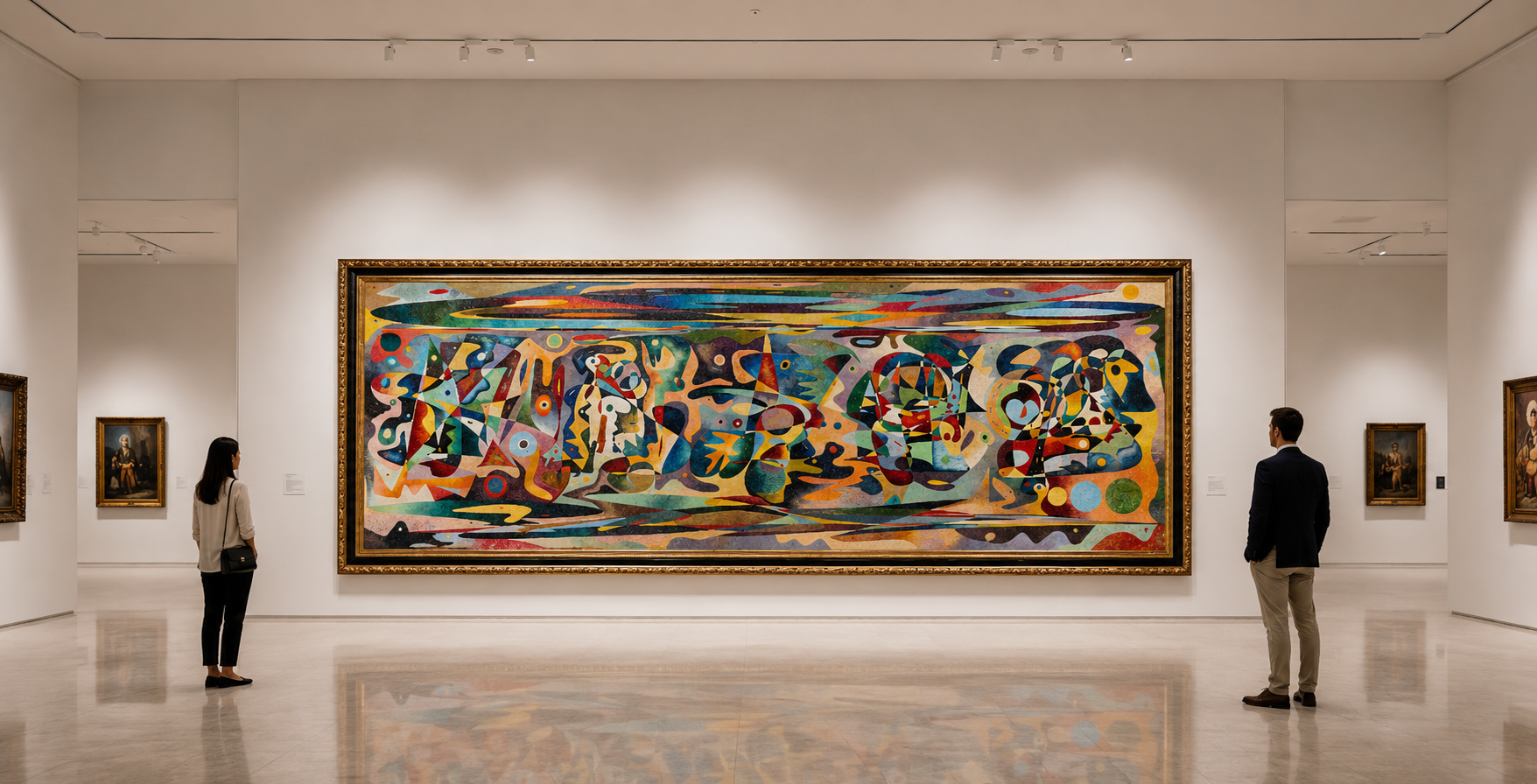
17 Apr 2026In Taoism (2022–2024), Gheorghe Virtosu constructs a dynamic pictorial field in which form, color, and spatial organization articulate a system of continuous transformation. The composition unfolds horizontally as an interconnected environment where biomorphic and geometric elements do not stabilize into fixed identities but remain in a state of perpetual transition. Rather than presenting symbolic representations, the work operates as a visual analogue to the Taoist conception of the Dao: an underlying generative process that cannot be directly represented but is expressed through relational movement and change1.
At the core of the composition lies a network of circular and semi-circular structures that evoke the logic of polarity without resolving into explicit iconography. These forms suggest the principle of yin and yang, not as static opposites but as interdependent forces that continuously generate and transform one another2. Dark and light zones, dense and open areas, and warm and cool chromatic fields interact across the surface, producing a condition of dynamic equilibrium. Balance is not achieved through symmetry but through ongoing negotiation between opposing yet complementary states.
The painting’s spatial organization resists hierarchical structuring. No single focal point dominates; instead, visual attention circulates across interlocking zones of activity. This decentralization reflects the Taoist understanding of the Dao as unlocatable and non-hierarchical, operating through the totality of relations rather than through a singular source1. Forms emerge, overlap, and dissolve, creating a continuous process of becoming in which boundaries remain provisional, aligning with philosophical models of difference and transformation3.
Interwoven biomorphic shapes generate fleeting suggestions of faces, animals, and hybrid figures, yet these never resolve into stable representations. Identity is treated as a transitional condition rather than a fixed state, aligning with the Taoist emphasis on fluidity and transformation2. These emergent forms function as perceptual events, produced through the interaction of contour, color, and spatial layering rather than through deliberate depiction.
A subtle system of mirroring operates between the upper and lower registers of the composition. The lower band, with its reflective and fluid qualities, suggests inversion and return, reinforcing the cyclical logic of transformation. This doubling effect echoes the Taoist principle that all states contain the potential for their opposite, and that movement between them is continuous rather than discrete4.
Chromatically, the work is structured through contrast and modulation. Zones of saturation and diffusion coexist, producing a rhythmic oscillation that guides the viewer’s perception without fixing it. Color operates not as a descriptive tool but as a relational force, intensifying the interplay between elements and reinforcing the painting’s underlying system of balance through variation. This instability of perceptual meaning may be further understood through the lens of différance, in which meaning is continuously deferred through relational difference5.
Ultimately, Taoism articulates a visual ontology grounded in process rather than permanence. The composition does not resolve into stable meaning but remains open, inviting the viewer to engage with a field in which all elements are defined by their relationships and their capacity for transformation. In this sense, the painting functions not as a representation of Taoist philosophy, but as an enactment of its fundamental principles.
Artist Biography
Gheorghe Virtosu is a contemporary painter whose work explores the intersection of philosophy, symbolic systems, and visual abstraction. His large-scale compositions integrate biomorphic forms, geometric structures, and layered spatial fields, producing complex visual environments in which meaning emerges through relational interaction and transformation.
Engaging with global belief systems and theoretical frameworks, Virtosu translates abstract philosophical principles into visual languages that resist fixed interpretation while maintaining structural coherence. His work emphasizes process, balance, and the instability of form, situating his practice within a broader dialogue between contemporary abstraction and philosophical inquiry.
Central to his practice is the ongoing series 10 Religions, in which he examines major spiritual traditions through abstraction. Each painting functions as a conceptual system, foregrounding the underlying logics of transformation, interconnection, and perception that define different belief structures.
Technical Notes
Executed in oil on canvas at a monumental scale (2 × 6 meters), the work establishes an expansive horizontal field that supports continuous visual movement. Layered pigment applications create depth and translucency, allowing forms to emerge, overlap, and dissolve across multiple perceptual planes.
The composition integrates fluid biomorphic shapes with controlled geometric interventions, producing a balance between organic movement and structural articulation. Subtle transitions in opacity and chromatic intensity generate zones of compression and release, reinforcing the painting’s rhythmic and processual character.
The absence of a fixed compositional center and the emphasis on distributed visual activity enhance the work’s immersive quality, encouraging sustained engagement and perceptual exploration.
Notes
- Laozi, Tao Te Ching, trans. D.C. Lau (London: Penguin Classics, 1963).
- Zhuangzi, The Complete Works of Zhuangzi, trans. Burton Watson (New York: Columbia University Press, 1968).
- Gilles Deleuze, Difference and Repetition (New York: Columbia University Press, 1994).
- François Jullien, The Propensity of Things (New York: Zone Books, 1995).
- Jacques Derrida, Of Grammatology (Baltimore: Johns Hopkins University Press, 1976).
Selected Bibliography
- Laozi. Tao Te Ching. Translated by D.C. Lau. Penguin Classics, 1963.
- Zhuangzi. The Complete Works of Zhuangzi. Translated by Burton Watson. Columbia University Press, 1968.
- Deleuze, Gilles. Difference and Repetition. Columbia University Press, 1994.
- Jullien, François. The Propensity of Things. Zone Books, 1995.
- Derrida, Jacques. Of Grammatology. Johns Hopkins University Press, 1976.