
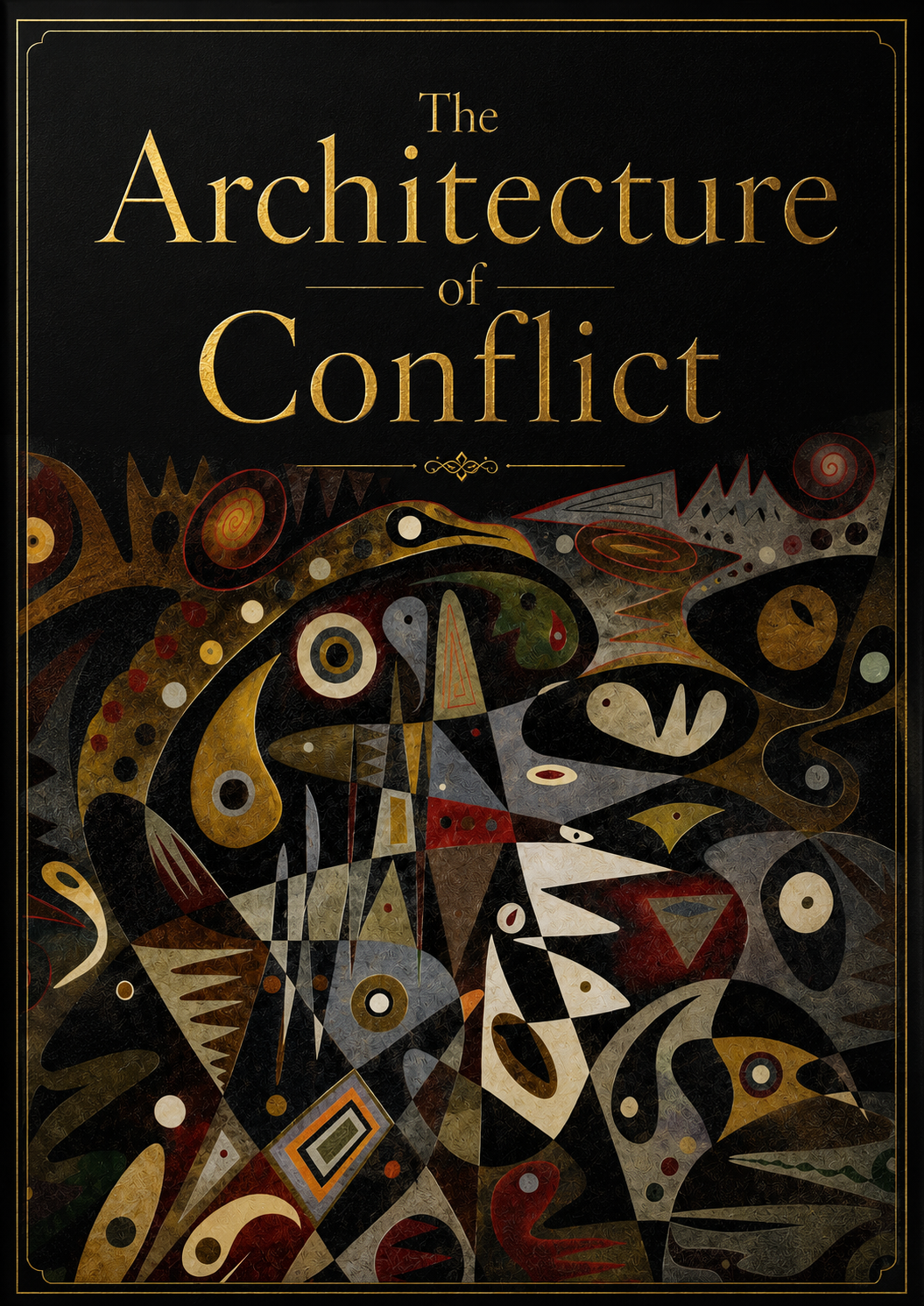
The Architecture of Conflict: Toward a Systemic Theory of War in Contemporary Art
A Theoretical Framework for Cultural Research
06 Jun 2026The history of war in art has largely been structured through representation. From antiquity to the present, conflict has been depicted through battles, leaders, victories, defeats, ruins, victims, and monuments. Whether celebratory, commemorative, critical, or documentary, these traditions share a common assumption: war exists as an event that can be represented. The image functions as a witness to history.
The Architecture of Conflict proposes a fundamentally different epistemological model. Rather than treating war as an event, it approaches conflict as a system. The project shifts attention away from the representation of historical episodes and toward the underlying structures through which conflict emerges, expands, stabilizes, fragments, and reproduces itself. In doing so, it relocates the study of war from the domain of narrative history to the domain of systemic analysis.
The distinction is significant. Events are visible; systems are not. Historical narratives typically organize conflict through chronology, causality, and identifiable actors. Systems, by contrast, operate through distributed relationships whose effects exceed individual intentions. Political institutions, military organizations, economic networks, technological infrastructures, ideological formations, territorial ambitions, and cultural identities interact simultaneously across multiple scales. War appears not as a singular occurrence but as the temporary manifestation of deeper organizational structures.
The six exhibitions comprising the 6 WARS project may therefore be understood not as discrete investigations of particular conflicts but as analyses of recurring systemic conditions. Gaugamela examines the concentration of power. Waterloo investigates the reconfiguration of political order. World War I explores systemic fragmentation. World War II addresses total mobilization and global integration. Hawai Sakusen examines the convergence of strategic doctrine and collective belief. Ukraine War investigates contemporary conflict as a distributed network operating simultaneously across military, technological, informational, economic, and humanitarian domains. Together, these systems form neither a chronology nor a taxonomy of wars. They constitute a morphology of conflict.
Within this framework, abstraction assumes a methodological rather than stylistic function. The paintings do not abandon representation in pursuit of formal autonomy. Instead, abstraction becomes an analytical instrument capable of revealing relationships that remain inaccessible to narrative depiction. Directional vectors, concentrations, ruptures, asymmetries, accumulations, and unstable equilibria operate as visual equivalents of systemic processes. The works do not represent conflict; they model its organizational logic.
This position situates The Architecture of Conflict within a broader intellectual lineage extending from systems theory and structural analysis to contemporary understandings of complexity. Conflict is approached as an emergent phenomenon produced through interactions between multiple actors, institutions, and infrastructures. No single element determines the whole. Agency is distributed. Effects exceed causes. Stability and instability coexist. The resulting structures are dynamic, adaptive, and continuously subject to reconfiguration. The project's central concern is therefore not violence itself but the architecture through which violence becomes possible.
The collection consequently functions as more than an accumulation of objects. It operates as a research structure. Individual works remain autonomous, yet their full significance emerges only through their relationships to one another. The collection produces knowledge through comparison. Recurring patterns become visible across historically distinct conflicts. The question shifts from what differentiates wars to what organizational principles they share.
The exhibition model extends this logic into space. Meaning is not contained within individual paintings but distributed across the installation. Scale, orientation, hierarchy, distance, and spatial configuration become epistemological tools. The exhibition functions as a relational system in which knowledge emerges through navigation rather than observation alone. Viewers do not encounter representations of conflict; they enter fields of interaction structured by tension, convergence, opposition, and transformation.
What ultimately distinguishes The Architecture of Conflict is its attempt to establish conflict as a field of artistic inquiry in its own right. The project does not approach war as subject matter. It approaches conflict as an organizing principle capable of producing social, political, cultural, and spatial formations. In this sense, the work occupies a position between contemporary abstraction, historical investigation, systems theory, and exhibition architecture.
Its broader contribution lies in proposing that art can function not merely as a medium of representation but as a mode of structural analysis. Conflict becomes legible not through depiction but through the construction of relational systems. The image no longer records history; it reveals the conditions through which history is produced. The result is a shift from the aesthetics of war toward an architecture of conflict—a framework in which representation gives way to structure, narrative gives way to relation, and the event gives way to the system.
Related Resources
Collection: The Architecture of Conflict
Catalogue: The Architecture of Conflict — Exhibition Catalogue
Notes
- The term Architecture of Conflict is used here as an analytical framework through which war is examined as a system of interacting forces rather than as a sequence of isolated historical events.
- This essay distinguishes between the representation of conflict and the investigation of conflict as structure. The project approaches war through relationships, networks, systems, and organizational conditions rather than narrative reconstruction.
- The six exhibitions comprising the 6 WARS project are treated as interconnected studies of recurring systemic conditions rather than as independent historical subjects.
- Gaugamela examines the concentration and formation of power within emergent political and military systems.
- Waterloo investigates the reconfiguration of authority and the transformation of historical order through conflict.
- World War I explores fragmentation, systemic instability, and the collapse of established structures.
- World War II examines total mobilization and the integration of political, military, economic, technological, and ideological systems into a global field of conflict.
- Hawai Sakusen investigates the convergence of strategic doctrine, cultural identity, imperial authority, and collective belief.
- Ukraine War examines contemporary conflict as a distributed network operating simultaneously across military, informational, technological, economic, political, and humanitarian domains.
- Within this framework, abstraction functions as an analytical methodology rather than a stylistic departure from representation.
- The project draws upon systems theory, strategic studies, political philosophy, contemporary historiography, and exhibition architecture as parallel fields of inquiry.
- The collection functions as a research structure in which meaning emerges through comparison between conflicts rather than through the interpretation of individual works in isolation.
- The exhibition model extends this logic spatially, treating scale, orientation, hierarchy, and spatial configuration as analytical instruments through which systemic relationships become perceptible.
- The central proposition of The Architecture of Conflict is that war may be understood as a recurring organizational condition through which civilizations produce, negotiate, distribute, and transform power.
Selected Bibliography
- Applebaum, Anne. Red Famine: Stalin's War on Ukraine. New York: Anchor Books, 2018.
- Bishop, Claire. Installation Art: A Critical History. London: Tate Publishing, 2005.
- Clausewitz, Carl von. On War. Princeton: Princeton University Press, 1989.
- Deleuze, Gilles, and Félix Guattari. A Thousand Plateaus: Capitalism and Schizophrenia. Minneapolis: University of Minnesota Press, 1987.
- Foster, Hal. The Return of the Real. Cambridge, MA: MIT Press, 1996.
- Freedman, Lawrence. Strategy: A History. Oxford: Oxford University Press, 2013.
- Foucault, Michel. Society Must Be Defended. New York: Picador, 2003.
- Kaldor, Mary. New and Old Wars: Organized Violence in a Global Era. Stanford: Stanford University Press, 2012.
- Krauss, Rosalind. The Originality of the Avant-Garde and Other Modernist Myths. Cambridge, MA: MIT Press, 1985.
- Latour, Bruno. Reassembling the Social: An Introduction to Actor-Network-Theory. Oxford: Oxford University Press, 2005.
- Luhmann, Niklas. Social Systems. Stanford: Stanford University Press, 1995.
- Plokhy, Serhii. The Gates of Europe: A History of Ukraine. New York: Basic Books, 2021.
- Snyder, Timothy. The Road to Unfreedom: Russia, Europe, America. New York: Tim Duggan Books, 2018.
- Virilio, Paul. War and Cinema: The Logistics of Perception. London: Verso, 1989.
- El Arte Monumental. 6 WARS: The Architecture of Conflict. Exhibition Catalogue, 2026.