
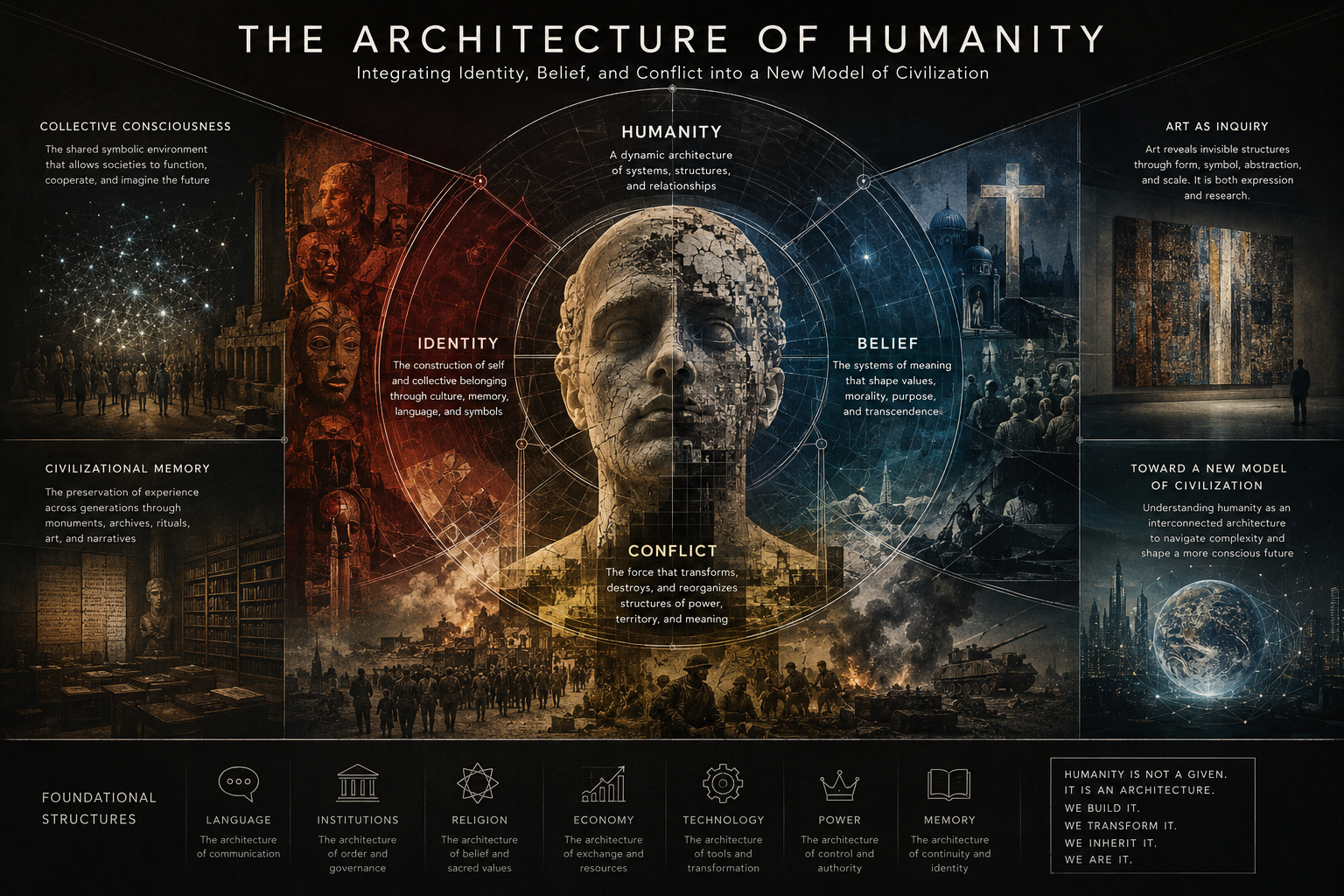
The Architecture of Humanity
A Theoretical Framework for Cultural Research
29 May 2026Integrating Identity, Belief, and Conflict into a New Model of Civilization
Contemporary art has spent much of the last century investigating the individual. Questions of identity, memory, race, nationality, gender, religion, sexuality, and personal experience became central frameworks through which artists sought to understand the human condition. This transformation reflected broader intellectual developments across philosophy, sociology, psychology, and political theory. As traditional structures of authority weakened and democratic participation expanded, the individual increasingly emerged as the primary subject through which culture interpreted itself.
The significance of this shift cannot be overstated. Identity-based inquiry transformed cultural discourse by exposing hidden structures of power, challenging dominant historical narratives, and creating space for voices that had often been excluded from representation. Museums, universities, and cultural institutions increasingly embraced identity as one of the defining frameworks of contemporary thought. Entire disciplines emerged around the investigation of belonging, difference, memory, and representation.
Yet the twenty-first century presents humanity with a different set of challenges. Climate change, artificial intelligence, planetary migration, digital communication networks, geopolitical instability, economic interdependence, and technological governance operate on scales that exceed individual experience. These forces shape civilizations through systems whose complexity cannot be fully understood through the examination of identity alone.
This observation does not diminish the importance of identity. Rather, it suggests that identity itself exists within larger structures. The challenge facing contemporary culture is no longer simply understanding who we are, but understanding how we are organized. The question shifts from individual experience toward collective systems, from isolated categories toward interconnected relationships, and from representation toward structure.
It is from this shift that the research framework developed through El Arte Monumental emerges. The Architecture of Humanity proposes that humanity itself can be understood as an architectural phenomenon. This proposition does not refer to architecture in the conventional sense of buildings or physical construction. Instead, architecture is understood as the organization of relationships. Humanity becomes visible as a dynamic structure composed of symbolic systems, beliefs, institutions, conflicts, technologies, memories, and collective forms of consciousness operating across time.
Beyond the Study of the Individual
The modern era elevated the individual to an unprecedented position within cultural and intellectual life. Political systems increasingly emphasized individual rights and freedoms. Economic theories focused upon individual choice and behavior. Psychology investigated the mechanisms of individual consciousness. Contemporary art explored the complexities of personal identity. These developments contributed significantly to the expansion of human freedom and cultural diversity.
Yet individuals never exist in isolation. Every person enters a world already structured by institutions, languages, values, traditions, technologies, and historical narratives. Before individuals define themselves, they encounter systems that influence perception, behavior, and understanding. Identity itself emerges within environments that precede the individual and continue beyond them.
Human societies therefore possess dimensions that cannot be fully understood through individual experience alone. Financial systems influence billions of lives through networks few individuals can fully perceive. Digital platforms shape communication across entire populations. Environmental transformations emerge from accumulated collective activity. Artificial intelligence operates through technological infrastructures extending beyond any single user, creator, or institution.
These conditions require a broader cultural framework. Humanity must be examined not only as a collection of individuals but as an interconnected system. The individual remains essential, but the individual becomes meaningful within larger architectures of memory, belief, conflict, authority, technology, and collective consciousness.
Why Architecture?
The concept of architecture offers a powerful model for understanding civilization because architecture is fundamentally concerned with organization. A building is not simply an accumulation of materials. It is a structured relationship between spaces, functions, movements, and meanings. Architecture establishes order. It creates boundaries, connections, hierarchies, passages, and systems of orientation.
When extended beyond physical construction, architecture becomes a way of understanding culture itself. Languages function as architectures of communication. Religions operate as architectures of belief. Governments establish architectures of authority. Educational systems construct architectures of knowledge. Economies generate architectures of exchange. Technologies create architectures of interaction. Memory forms an architecture of historical continuity.
Humanity can therefore be approached as an architecture of interdependent structures. These structures are not always visible, yet they organize civilization at every level. They determine how societies remember, how they believe, how they govern, how they conflict, how they communicate, and how they imagine the future.
This architectural perspective allows El Arte Monumental to move beyond the study of isolated cultural categories. It creates a framework through which identity, belief, conflict, memory, and technology can be understood as interacting systems rather than separate subjects.
Identity, Belief, Power, and Conflict
The Architecture of Humanity developed from a sequence of interconnected investigations examining the fundamental structures through which civilizations organize themselves.
The Architecture of Identity explored how individuals and communities construct meaning through belonging, memory, difference, and symbolic recognition. Identity was approached not as a fixed category but as a dynamic structure shaped by history, culture, language, and representation.
The Architecture of Belief examined the systems through which societies organize meaning itself. Religion, mythology, ideology, ritual, and collective narratives were understood as architectural forces capable of shaping civilizations across centuries. Belief was not treated merely as private conviction but as a structural framework through which societies define reality, legitimacy, morality, and purpose.
The Architecture of Power investigated the mechanisms through which authority is established, distributed, maintained, challenged, and transformed. Political institutions, sovereignty, governance, diplomacy, leadership, and symbolic legitimacy were approached as interconnected systems that organize collective life. Power emerged not simply as control, but as one of the principal architectures through which civilizations coordinate action and sustain order.
The Architecture of Conflict examined conflict as a recurring force of transformation within human history. Conflict was understood not only as destruction or rupture, but as a process through which institutions, territories, technologies, identities, and systems of power are continuously reorganized.
Together, these investigations revealed that identity, belief, power, and conflict cannot be fully understood in isolation. Beliefs shape identities. Identities influence structures of power. Power generates cooperation as well as conflict. Conflict transforms institutions. Institutions preserve memory. Memory influences future beliefs. The resulting structure resembles an interconnected network rather than a collection of separate themes.
The Architecture of Humanity emerges from this realization. It proposes that identity, belief, power, and conflict are not independent subjects but foundational dimensions within a larger architectural system: civilization itself.
Collective Consciousness and Civilizational Memory
If humanity is an architectural system, collective consciousness is one of its primary foundations. Civilizations are sustained not only by institutions, technologies, economies, and laws, but by shared symbolic environments. These environments allow individuals to participate in realities larger than themselves.
Collective consciousness does not imply a single unified mind. It refers to the network of shared meanings through which societies organize experience. Languages, myths, historical narratives, religious traditions, cultural values, and social expectations all contribute to this structure. Individuals may disagree, compete, or belong to different groups, yet they often operate within symbolic systems that make communication and collective life possible.
Memory plays a central role in this process. Civilizations remember through monuments, archives, artworks, rituals, literature, education, and public narratives. These forms of memory do not merely preserve the past. They shape the present by determining which events, values, traumas, and achievements become culturally significant.
Memory is therefore architectural. It organizes time. It connects generations. It creates continuity between the dead, the living, and the future. What a civilization remembers influences what it becomes. What it forgets also shapes its development.
Within The Architecture of Humanity, collective consciousness and civilizational memory are understood as invisible structures that sustain human organization. They are not secondary to political or economic systems. They are among the foundations upon which those systems depend.
Art as a Method of Cultural Research
Contemporary art occupies a unique position within this framework because visual language can reveal relationships that remain difficult to describe through ordinary analysis. Political theory can explain authority. Sociology can examine institutions. Economics can model exchange. Yet art can make invisible structures perceptible through form, scale, symbol, color, rhythm, and abstraction.
Art does not merely illustrate civilization. It investigates civilization. Through abstraction, artists can represent systems that cannot be depicted literally. Through monumental scale, they can create environments in which viewers encounter complexity physically and psychologically. Through symbolic composition, they can expose relationships between memory, belief, conflict, and identity.
This is why contemporary art is especially suited to the study of humanity as an architectural system. It can move between the visible and the invisible, between individual experience and collective structure, between historical memory and future imagination. It can reveal the frameworks through which civilization organizes meaning.
Within El Arte Monumental, art is therefore approached not only as aesthetic production but as cultural research. The artwork becomes a site of investigation. The artist becomes a researcher of symbolic systems. The exhibition becomes a space where civilization can be examined as structure.
The Architecture of Memory
Memory is often understood as an individual capacity through which experiences are preserved and recalled. Yet civilizations also possess memory. Societies remember wars, migrations, revolutions, achievements, catastrophes, myths, and origins. These memories become embedded within institutions, monuments, literature, education, religion, and artistic production. Civilizational memory functions as a mechanism through which collective consciousness extends beyond individual lifetimes.
Unlike personal memory, collective memory is distributed across cultural systems. It exists within archives, museums, rituals, monuments, public spaces, historical narratives, and symbolic traditions. Memory is therefore not simply stored. It is organized. It possesses structure. It has architecture.
What societies choose to remember often becomes as important as the events themselves. Every civilization constructs narratives that explain its origins, justify its institutions, and define its identity. These narratives shape collective behavior by establishing frameworks through which the present is interpreted. Memory therefore operates not only as preservation of the past but also as a force influencing the future.
The architectural perspective reveals memory as an active component of civilization rather than a passive record of history. Collective memory organizes relationships between generations. It determines which events become culturally significant and which disappear from public consciousness. Through this process, memory becomes one of the primary structures through which civilizations maintain continuity across time.
Monuments, Archives, and Cultural Continuity
Throughout history, societies have developed mechanisms for preserving collective memory. Monuments commemorate events, individuals, victories, tragedies, and foundational myths. Archives preserve documents, records, and knowledge. Religious traditions transmit narratives across centuries. Educational institutions reproduce cultural memory through successive generations.
These mechanisms perform a similar function. They stabilize meaning. They create continuity between past and present. They allow societies to maintain a sense of identity despite constant change.
Monuments are particularly significant because they transform memory into physical form. A monument is never merely an object. It is a symbolic structure through which a civilization expresses what it considers worthy of remembrance. Every monument represents a decision regarding historical significance. Every monument reflects a relationship between memory, power, identity, and collective consciousness.
Yet memory is not preserved exclusively through physical structures. Literature, mythology, music, visual culture, and artistic production often exert greater influence than monuments themselves. Civilizations remember through stories as much as through stone. The symbolic dimensions of memory frequently prove more durable than their material expressions.
Art and the Preservation of Collective Consciousness
Art occupies a unique position within the architecture of memory because it preserves dimensions of human experience that cannot easily be reduced to historical documentation. While archives record events, artworks preserve perceptions, emotions, symbols, aspirations, fears, and collective imaginaries. Art reveals how civilizations experience themselves.
Throughout history, artistic production has functioned as one of humanity's most powerful memory technologies. Cave paintings, religious icons, monumental sculpture, historical painting, literature, architecture, photography, and contemporary installation practices have all contributed to the preservation of collective consciousness.
Art does more than record memory. It actively shapes it. By selecting symbols, narratives, and forms, artists influence how societies interpret their past and imagine their future. Artistic production therefore participates directly in the construction of collective consciousness. It becomes one of the mechanisms through which civilizations understand themselves.
Within The Architecture of Humanity, art is approached not merely as representation but as a form of cultural investigation. Through abstraction, symbolism, scale, and visual structure, artistic practice can reveal relationships that remain hidden within political, economic, or sociological analysis. Art becomes a method for exploring the invisible architectures through which collective consciousness operates.
Toward a New Field of Cultural Research
The Architecture of Humanity proposes that humanity itself should become a distinct field of artistic and cultural investigation. Such a proposal does not seek to replace existing disciplines. Rather, it seeks to establish a framework capable of connecting insights that often remain separated by disciplinary boundaries.
Human civilization has traditionally been examined through specialized perspectives. Historians study historical processes. Sociologists analyze social structures. Anthropologists investigate cultural systems. Political theorists examine power. Economists study exchange. Religious scholars explore belief systems. Artists create symbolic interpretations of human experience.
Each of these perspectives contributes valuable knowledge. Yet the increasing complexity of contemporary civilization reveals the need for frameworks capable of examining how these dimensions interact. Humanity is not merely historical, political, economic, religious, technological, or cultural. It is simultaneously all of these things. Its complexity emerges from relationships between systems rather than from any single system in isolation.
The Architecture of Humanity therefore proposes a shift in perspective. Rather than treating identity, belief, conflict, memory, technology, institutions, and collective consciousness as separate subjects, it approaches them as interconnected structures operating within a larger civilizational framework. The objective is not to eliminate distinctions between these fields but to understand how they interact.
This approach reflects broader transformations occurring throughout contemporary knowledge. Increasingly, researchers recognize that complex systems cannot be fully understood through isolated categories. Ecological systems, technological networks, global economies, communication infrastructures, and political structures all demonstrate forms of interconnectedness that require new analytical approaches. Humanity itself may be understood in similar terms.
Within this framework, civilization becomes visible as an evolving architecture composed of symbolic, institutional, technological, historical, and psychological structures. These structures continuously interact, reinforce one another, transform one another, and occasionally come into conflict. Human history emerges not simply from individual actions but from the dynamic relationships between these overlapping systems.
The Architecture of Humanity seeks to establish a conceptual space in which such relationships can be examined. It encourages a movement beyond isolated categories toward systemic understanding. It invites artistic practice to participate directly in the investigation of civilization. It proposes that visual culture can contribute to the study of humanity in ways that complement traditional academic disciplines.
Most importantly, it recognizes that the central challenge of the twenty-first century may not be understanding individual structures in isolation but understanding the architectures connecting them. Climate change, technological transformation, migration, geopolitical instability, artificial intelligence, and cultural fragmentation all reveal the consequences of living within increasingly interconnected systems. Understanding these systems requires new forms of inquiry capable of operating across scales and disciplines.
The Architecture of Humanity represents one attempt to contribute to this task. It begins with the proposition that humanity can be understood as an architectural phenomenon and proceeds by examining the structures through which human civilization organizes meaning, memory, belief, conflict, authority, and collective existence.
Conclusion
The history of contemporary culture has been shaped by an increasing awareness of the individual. The challenges of the present century, however, suggest the need for a complementary perspective: an understanding of the systems through which individuals become part of larger structures. Humanity is not simply a collection of identities. It is an evolving architecture composed of relationships, memories, beliefs, institutions, conflicts, technologies, and symbolic systems.
To study humanity from this perspective is to move beyond isolated categories toward the investigation of structure itself. It is to ask how civilizations are organized, how they sustain continuity, how they transform across time, and how invisible systems influence visible realities.
The Architecture of Humanity emerges from this inquiry. It proposes that civilization can be approached as a dynamic architectural phenomenon and that contemporary art possesses unique capacities for revealing its underlying structures. By integrating identity, belief, conflict, collective consciousness, memory, and artistic research into a shared framework, this approach seeks to contribute to a broader understanding of humanity as one of the most complex systems ever created.
The task remains ongoing. Humanity continues to construct itself through new technologies, new conflicts, new forms of cooperation, and new symbolic environments. The architectures shaping civilization are constantly evolving. Understanding them may become one of the defining cultural challenges of our time.
Research Series
Acknowledgments
Presented by El Arte Monumental
Curatorial Team: Daniel Varzari
Photography: Courtesy of El Arte Monumental
Special Thanks: Daniel Varzari
This essay forms part of the ongoing research initiatives developed through El Arte Monumental. The framework presented here emerged through a sequence of interconnected studies including The Architecture of Identity, The Architecture of Belief, The Architecture of Power, and The Architecture of Conflict. These studies collectively contributed to the development of The Architecture of Humanity as a broader framework for examining civilization through systems of identity, belief, power, conflict, memory, and collective consciousness.
Notes
The term “architecture” is used throughout this essay in an expanded cultural sense. It refers not only to physical construction but to the organization of relationships, systems, structures, and symbolic environments through which human societies operate.
The concept of collective consciousness is discussed here as a cultural and sociological framework rather than a metaphysical or supernatural proposition.
The Architecture of Humanity should be understood as an interdisciplinary research framework drawing from art, history, sociology, anthropology, philosophy, systems theory, memory studies, and visual culture.
Selected Bibliography
- Anderson, Benedict. Imagined Communities: Reflections on the Origin and Spread of Nationalism. London: Verso, 1983.
- Assmann, Jan. Cultural Memory and Early Civilization: Writing, Remembrance, and Political Imagination. Cambridge University Press, 2011.
- Durkheim, Émile. The Division of Labor in Society. New York: Free Press, 1893.
- Durkheim, Émile. The Elementary Forms of Religious Life. London: George Allen & Unwin, 1912.
- Foucault, Michel. The Archaeology of Knowledge. New York: Pantheon Books, 1972.
- Halbwachs, Maurice. On Collective Memory. Chicago: University of Chicago Press, 1992.
- Harari, Yuval Noah. Sapiens: A Brief History of Humankind. London: Harvill Secker, 2014.
- Jung, Carl Gustav. The Archetypes and the Collective Unconscious. Princeton University Press, 1969.
- Lévi-Strauss, Claude. Structural Anthropology. New York: Basic Books, 1963.
- Nora, Pierre. Realms of Memory: Rethinking the French Past. Columbia University Press, 1996.
- Turchin, Peter. Ultrasociety: How 10,000 Years of War Made Humans the Greatest Cooperators on Earth. Beresta Books, 2016.