
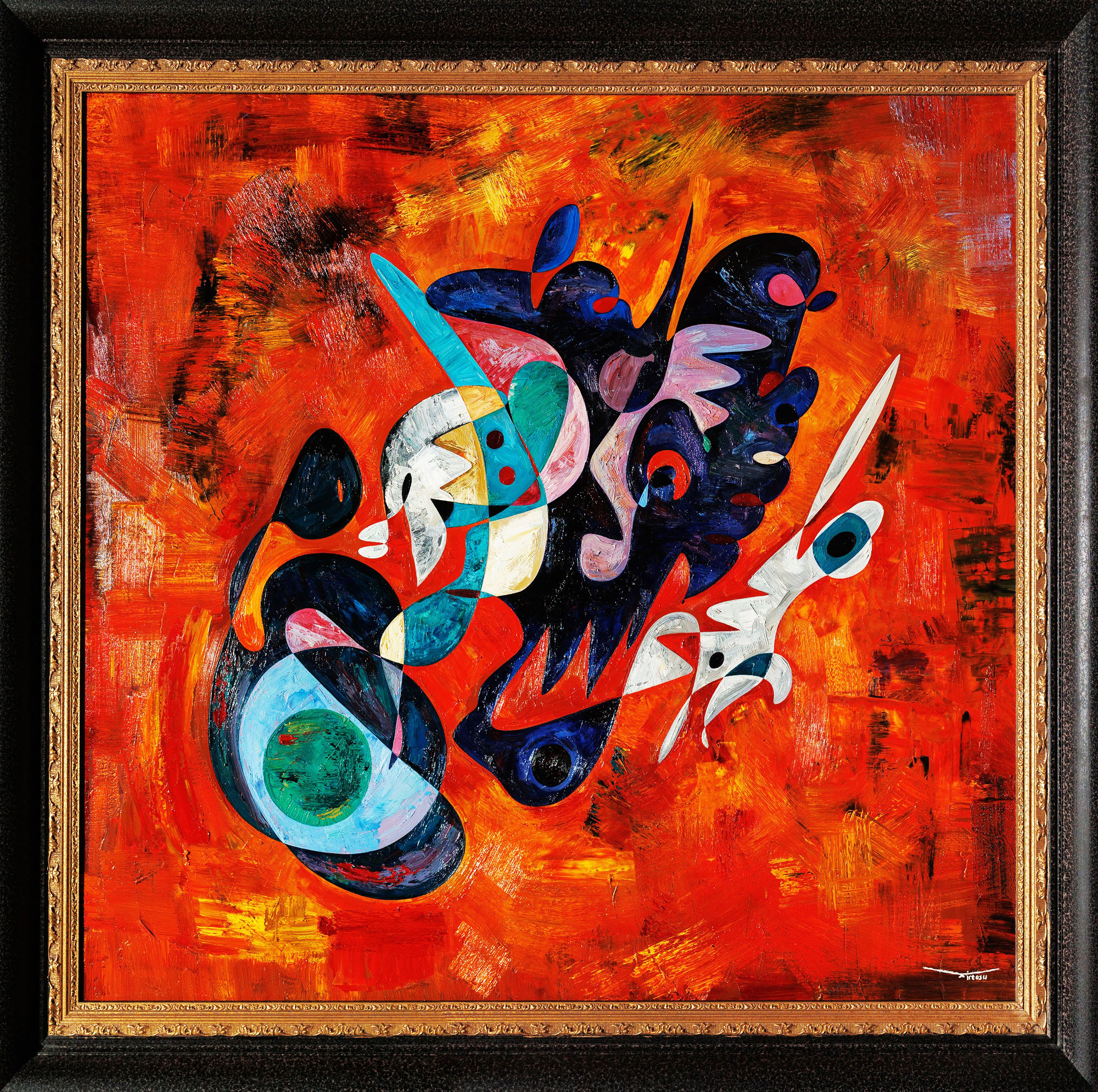
The couple of the universe (2016)
Curatorial Essay
26 Apr 2026In The Couple of the Universe (2006), Gheorghe Virtosu articulates a cosmological abstraction in which relationality, rather than individuality, becomes the fundamental unit of meaning. The painting does not depict a couple in any literal or anthropomorphic sense; instead, it constructs a dynamic field of interpenetrating forms that operate as a visual metaphor for duality, attraction, and systemic interdependence. Set against a saturated red ground of extraordinary intensity, the composition establishes an environment of energetic charge, within which forms collide, merge, and differentiate in a state of perpetual transformation.1
The pictorial structure is organized around a central agglomeration of biomorphic and geometric elements whose boundaries remain deliberately unstable. These forms resist closure: contours fracture, reassemble, and overlap, producing a condition in which identity is never singular but always co-constituted. The notion of “couple” thus expands beyond human pairing into a broader ontological principle—one that encompasses opposition and complementarity, fusion and tension, symmetry and disruption. The painting becomes a site where dual forces—light and dark, organic and geometric, expansion and compression—enter into a continuous negotiation.2
Spatially, the work rejects perspectival depth in favor of a compressed, all-over field that situates the viewer within a non-hierarchical system. Foreground and background are indistinguishable; instead, forms appear to oscillate between states of emergence and submergence. This instability generates a perceptual condition in which the act of viewing becomes temporal and iterative. The eye is compelled to move across the surface, tracing connections and ruptures, assembling provisional relationships that dissolve upon closer inspection. The “couple,” in this sense, is not fixed but continually reconstituted through perception.3
Chromatically, the painting is dominated by a high-frequency red field that operates not merely as background but as an active force. This red saturates the entire composition, functioning as both atmospheric condition and energetic substrate. Against it, cooler tones—turquoise, deep blue, white, and black—articulate zones of condensation and differentiation. These chromatic contrasts establish a rhythmic interplay between heat and coolness, intensity and restraint, suggesting a cosmological polarity akin to opposing energies in equilibrium. Color, therefore, is not descriptive but structural, generating the very conditions through which form emerges and interacts.1
Figural suggestion persists in fragmented form. Eyes, profiles, and gestural contours appear fleetingly within the composite structure, hinting at sentient presence without resolving into identifiable subjects. These perceptual fragments function as anchors within the abstraction, inviting recognition while simultaneously undermining it. The viewer encounters not a stable pair of figures but a multiplicity of possible couplings, each contingent upon the shifting organization of the visual field. Identity is thus dispersed, distributed across the network of forms rather than localized within discrete bodies.2
The scale of the painting reinforces its immersive quality. At nearly square dimensions exceeding one and a half meters, the canvas envelops the viewer, transforming observation into spatial engagement. The absence of a fixed focal point requires sustained navigation, mirroring the conceptual premise of relationality as an ongoing process rather than a resolved state. The viewer does not stand outside the system but becomes implicated within its perceptual and conceptual dynamics.3
Ultimately, The Couple of the Universe proposes a redefinition of unity—not as fusion into homogeneity, but as a complex, dynamic interplay of difference. Virtosu constructs a visual system in which coupling is generative rather than reductive, producing multiplicity rather than closure. The painting aligns with philosophical models that understand reality as a network of relations, where entities exist only through their interactions. In this sense, the work transcends its title, offering not a depiction of a couple but a cosmological schema of interconnected becoming.
Artist Biography
Gheorghe Virtosu is a contemporary painter whose practice engages with abstraction as a means of exploring philosophical, cosmological, and historical systems. His work is characterized by complex compositional structures in which biomorphic and geometric forms intersect within dynamically charged fields.
Virtosu’s paintings frequently investigate relationality, fragmentation, and the dissolution of stable identity, translating these concepts into layered visual environments. Rather than representing external reality, his work constructs systems in which meaning emerges through interaction and perception.
Working primarily in oil on canvas, he employs stratified pigment application and gestural modulation to produce surfaces that oscillate between depth and flatness. His large-scale compositions invite immersive viewing, situating the spectator within the conceptual and perceptual dynamics of the work.
Through his exploration of abstraction, Virtosu contributes to contemporary dialogues on the nature of systems, identity, and the conditions of visual experience.
Technical Notes
Executed in oil on canvas (1.69 × 1.66 meters), the painting adopts a near-square format that reinforces its centripetal compositional logic. The surface is built through layered applications of pigment, combining broad gestural fields with more controlled, sharply defined forms.
The dominant red ground is achieved through multiple strata of paint, creating a textured, luminous field that remains active across the entire surface. Over this ground, contrasting forms are articulated with varying degrees of opacity and saturation, producing zones of density and diffusion.
The interplay between curvilinear biomorphic elements and angular geometric intrusions generates a structural tension that animates the composition. Edges are alternately crisp and dissolved, allowing forms to oscillate between clarity and ambiguity.
The absence of a fixed focal point and the distribution of visual weight across the canvas encourage continuous perceptual movement, reinforcing the painting’s conceptual emphasis on relational dynamics.
Notes
- Gilles Deleuze and Félix Guattari, A Thousand Plateaus. University of Minnesota Press, 1987.
- Martin Buber, I and Thou. Scribner, 1970.
- Maurice Merleau-Ponty, Phenomenology of Perception. Routledge, 1962.
Selected Bibliography
- Deleuze, Gilles, and Félix Guattari. A Thousand Plateaus.
- Buber, Martin. I and Thou.
- Merleau-Ponty, Maurice. Phenomenology of Perception.
- Simondon, Gilbert. Individuation in Light of Notions of Form and Information.
- Krauss, Rosalind. The Originality of the Avant-Garde and Other Modernist Myths.