
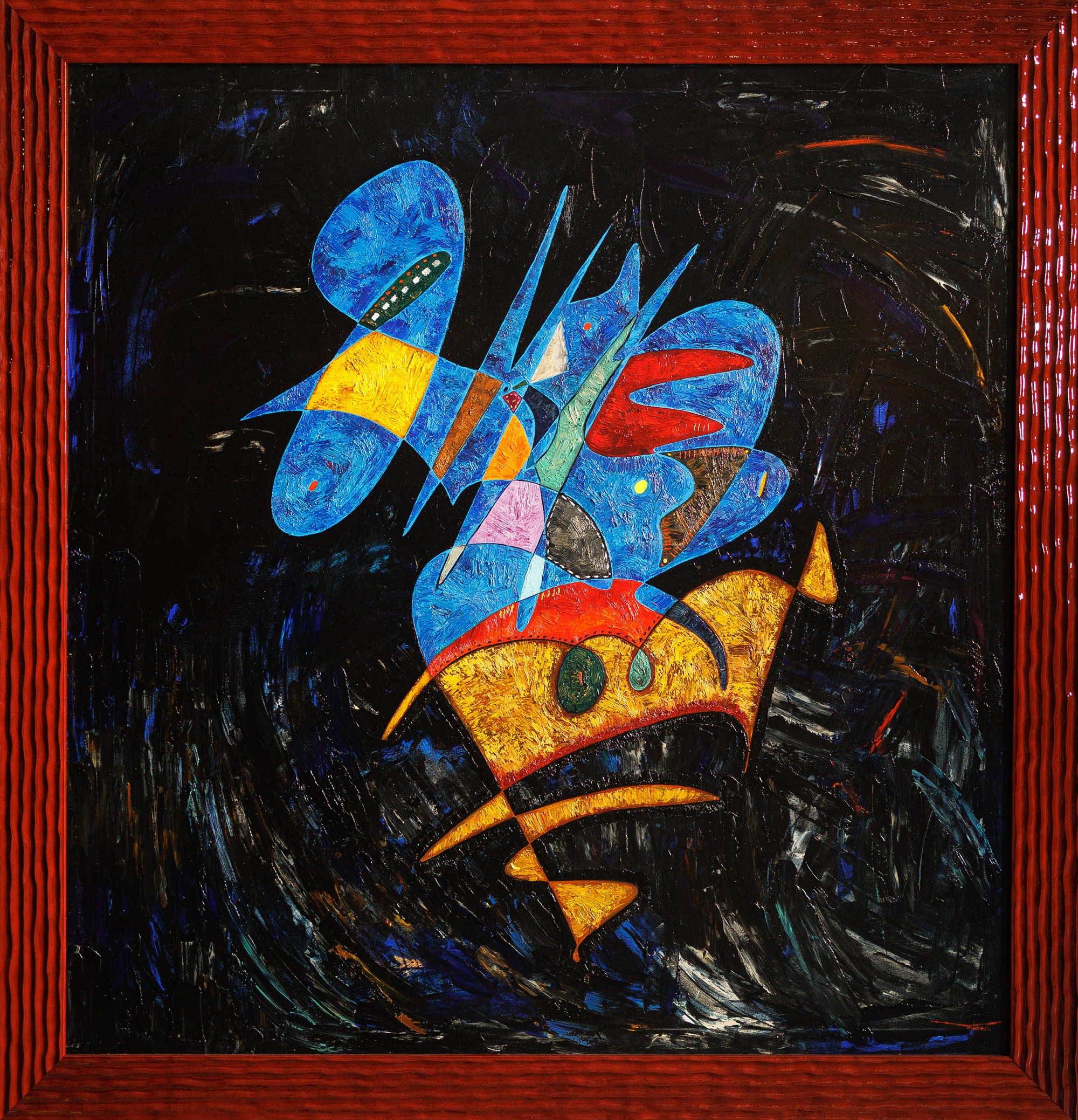
The Crown Holder (2017)
Curatorial Essay
22 May 2026The Crown Holder (2017) occupies a central position within Gheorghe Virtosu’s investigation of power as a symbolic and institutional condition. Presented within The Architecture of Power, the painting functions as a meditation on legitimacy itself, examining the moment when authority moves beyond instinct and becomes embodied within systems of recognition, continuity, and governance.
The Crown Holder exemplifies New Perfection in Systemic Abstraction, a condition articulated through the concept of El Arte Monumental derived from Virtosu’s work. Here, monumentality emerges through structural concentration rather than physical scale alone. The composition operates as an interconnected visual system in which symbolic meaning is generated through relationships between form, colour, hierarchy, and spatial organisation.
The composition is organised around a monumental golden crown positioned at the foundation of the image. Above it rises a dense configuration of geometric and biomorphic forms rendered primarily in blue, producing a visual architecture that suggests authority, memory, and institutional continuity simultaneously. The work does not depict a ruler; instead, it investigates the symbolic structure through which rulership becomes possible.
Throughout history, the crown has functioned as one of the most powerful instruments of political representation. Its authority derives not from material value alone but from collective recognition. Political legitimacy depends upon symbols capable of transforming power into a visible and socially accepted reality. Virtosu isolates this emblem from historical specificity and reconstructs it through abstraction, allowing the crown to operate as a universal sign of sovereignty rather than as an object belonging to any particular culture or period.
The surrounding black field functions as an active conceptual space rather than a conventional background. It isolates the central structure while amplifying its visual and symbolic presence. The tension between the luminous crown and the surrounding darkness establishes the painting’s principal spatial dynamic, positioning sovereignty against a condition of uncertainty and indeterminacy. Authority appears not as a natural state, but as a fragile structure emerging from an environment of instability.
Colour operates as a system of hierarchy and differentiation. Gold establishes the symbolic foundation of legitimacy, while blue forms introduce associations with permanence, order, and institutional structure. Red, green, yellow, and white accents activate the composition, creating movement across the surface and reinforcing relationships between individual elements. These chromatic zones function structurally rather than descriptively, organising the painting’s internal logic and directing perceptual attention through the image.
The relationship between the crown and the abstract structure above suggests a distinction between authority as symbol and authority as system. The crown provides legitimacy, while the forms rising from it evoke the institutions, narratives, traditions, and collective memories through which sovereignty is sustained. The composition therefore presents power as an evolving network of interdependent forces rather than as the possession of an individual figure.
Within The Architecture of Power, The Crown Holder functions as a foundational statement on symbolic authority. If Hunter investigates the emergence of power through instinct, pursuit, and survival, this work explores the mechanisms through which power acquires permanence and social recognition. The transition is significant: force becomes legitimacy, and impulse becomes institution.
Spatially, the composition balances stability and transformation. The crown anchors the image while the structure above remains dynamic and adaptive. This tension reflects Virtosu’s broader understanding of power as a system sustained through continuous negotiation rather than fixed permanence. Sovereignty appears simultaneously enduring and vulnerable, dependent upon the ongoing maintenance of symbolic order.
The Crown Holder ultimately reframes authority as a cultural construction rather than an inherent condition. By dissolving one of history’s most recognizable political symbols into a network of abstract relationships, Virtosu reveals legitimacy as an architecture of belief: a system continuously produced through recognition, representation, and collective memory. The painting transforms the crown from an emblem of rule into a meditation on the structures that make rule conceivable.
Artist Biography
Gheorghe Virtosu is a contemporary painter whose work investigates the relationships between abstraction, power, historical memory, and collective consciousness. Working primarily in large-scale oil painting, he has developed a distinctive visual language that combines geometric segmentation, biomorphic structures, and symbolic complexity to examine the systems that shape human civilization.
Central to Virtosu’s practice is the concept of New Perfection in Systemic Abstraction, a framework in which paintings operate as interconnected structures rather than representations of isolated subjects. Through this approach, authority, conflict, identity, and cultural transformation are translated into dynamic visual systems that emphasize process, tension, and continuous reconfiguration.
His works have been exhibited internationally and form part of several long-term research-based projects exploring themes including political power, warfare, mythology, diplomacy, migration, and the evolution of social structures. Across these bodies of work, abstraction functions as a means of revealing the underlying architectures that govern historical and contemporary experience.
Through layered oil techniques, monumental compositions, and an interdisciplinary engagement with philosophy, anthropology, and political thought, Virtosu constructs immersive environments that challenge fixed interpretation while inviting critical reflection on the forces that shape human perception and collective reality.
Technical Notes
Medium: Oil on canvas
Dimensions: 136 × 131 cm
The painting combines a luminous symbolic foundation with a highly articulated abstract superstructure. Layered oil applications generate depth within the dark field, while geometric segmentation and biomorphic forms establish structural coherence. Contrasting chromatic zones create hierarchy and movement, transforming the composition into a dynamic system of symbolic relationships.
Notes
- The crown is among the most enduring symbols of political authority, historically functioning as an instrument of legitimacy, sovereignty, and dynastic continuity across numerous civilizations.
- Within The Architecture of Power, The Crown Holder represents the transition from instinctual power to recognized authority, examining the symbolic mechanisms through which power acquires permanence and social acceptance.
- The painting exemplifies Gheorghe Virtosu’s framework of New Perfection in Systemic Abstraction, in which symbolic subjects are transformed into interconnected visual systems rather than narrative representations.
- The relationship between the crown and the abstract structure above may be understood as an exploration of the distinction between authority as symbol and authority as institution.
Selected Bibliography
- Kantorowicz, Ernst H. The King's Two Bodies: A Study in Medieval Political Theology. Princeton: Princeton University Press, 1957.
- Lefort, Claude. Democracy and Political Theory. Minneapolis: University of Minnesota Press, 1988.
- Cassirer, Ernst. The Myth of the State. New Haven: Yale University Press, 1946.
- Foster, Hal, Rosalind Krauss, Yve-Alain Bois, Benjamin H. D. Buchloh, and David Joselit. Art Since 1900: Modernism, Antimodernism, Postmodernism. London: Thames & Hudson, 2016.
- Panofsky, Erwin. Meaning in the Visual Arts. Chicago: University of Chicago Press, 1982.
- Gombrich, E. H. Symbolic Images: Studies in the Art of the Renaissance. London: Phaidon Press, 1972.
- Arnheim, Rudolf. Art and Visual Perception: A Psychology of the Creative Eye. Berkeley: University of California Press, 1974.