
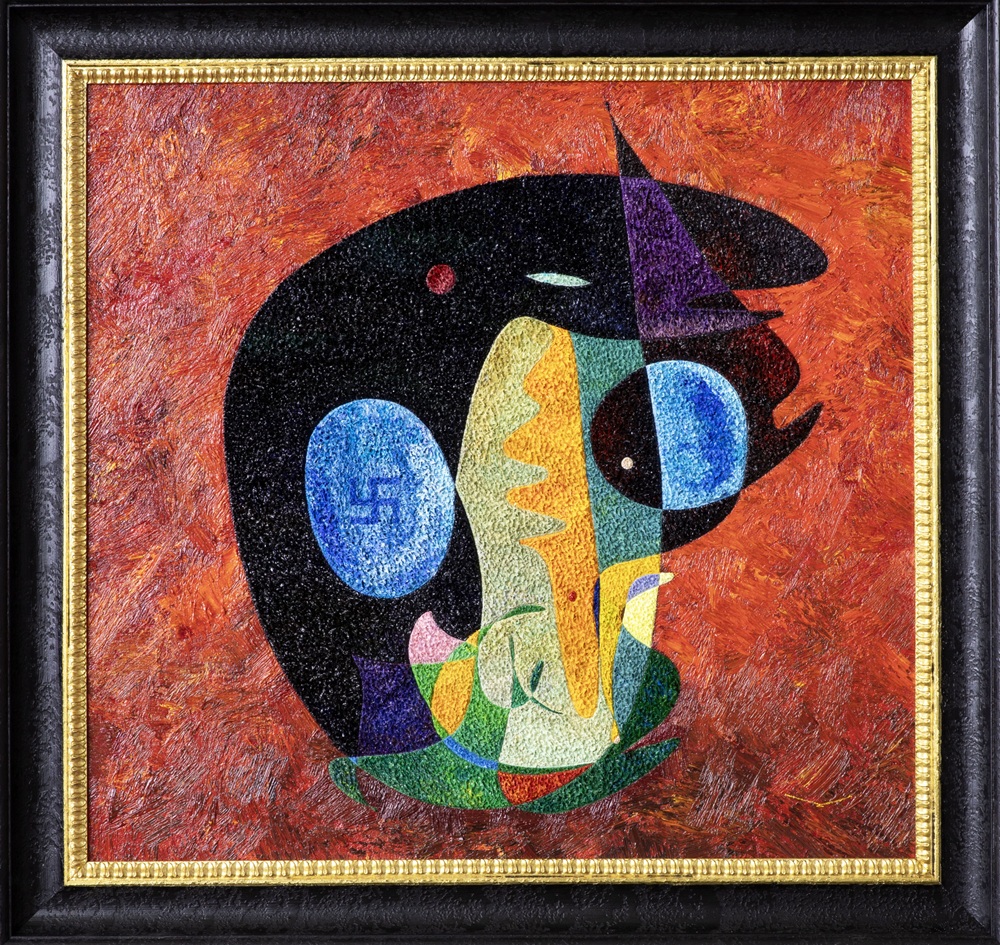
THE KING OF DEMOCRACY (2018)
Curatorial Essay
28 Mar 2026In an era marked by the increasing fragility of democratic institutions, the rise of populist movements, and the normalization of authoritarian tendencies, Gheorghe Virtosu’s The King of Democracy (2018) presents a critical interrogation of the mechanisms and contradictions inherent in contemporary governance. The work does not offer prescriptive answers but rather functions as a site of reflection, where the complexities, vulnerabilities, and ambiguities of democracy are laid bare.
Virtosu situates his practice within a lineage of politically engaged abstraction. Form is employed as a medium of critique: fragmented structures, layered textures, and symbolic motifs serve to both conceal and reveal the forces shaping the sociopolitical landscape. The painting echoes Michel Foucault’s understanding of power as dispersed and embedded within institutional networks rather than centralized¹, while also resonating with Hannah Arendt’s observations on the erosion of truth and responsibility as precursors to authoritarian normalization². Furthermore, Guy Debord’s conception of the “society of the spectacle”³ is relevant here, as the work confronts the mediation of political authority through image, representation, and performative acts. Carl Schmitt’s notion of the inherent instability of liberal democracy under internal antagonisms⁴ underscores the urgency of Virtosu’s visual critique.
The composition centers on a figure that oscillates between recognition and abstraction, bifurcated into dual “epostasys” that embody the competing logics and contradictions of democracy. The first is a pig-like visage, subtly articulated with two eyes and a faintly suggested snout. One eye contains a swastika, serving as an internalized symbol of ideological corruption rather than an external imposition. This aligns with Louis Althusser’s theory that ideology operates internally within social structures, reproduced through lived experience⁵. The pig motif underscores the moral and ethical corruption that can infiltrate democratic systems.
The second epostasys is a profile marked by a stylized contemporary coiffure, reminiscent of prominent political figures, suggesting the personalization of democratic authority and the conflation of institutional legitimacy with individual charisma. The two identities are unified and partially obscured by a dominant black mass, evoking hidden mechanisms of power that operate beneath the surface, invisible yet constitutive of the system—a visual embodiment of Foucault’s notion of concealed power networks¹.
The red background functions as an active societal field, charged with tension and layered with latent forms. A shouting human silhouette represents public outcry, protest, or resistance, while a wolf’s head introduces a primal, instinctual element of aggression. Together, these embedded figures suggest a society in dynamic tension with the structures of governance. A small red mark within the composition oscillates between an ear and a wound, symbolizing the fragile interface between communication and harm, perception and violence.
Above the pig’s snout, a zigzag formation resolves into two opposing profiles, evoking dialogue that is both present and unstable. This motif reflects the fragility and performative nature of democratic discourse, calling into question whether such exchanges are substantive or merely symbolic.
Through this complex interplay of form, symbol, and color, Virtosu constructs a critical lens onto contemporary democracy, revealing it as a system at once fragmented, internally conflicted, and ideologically contested. The painting functions as both visual analysis and ethical provocation, inviting viewers to confront the latent contradictions that shape political life and to reflect on their own positionality within these structures.
Artist Biography
Gheorghe Virtosu is a contemporary painter whose work explores the intersection of political ideology, identity, and systems of power. Combining abstraction with symbolic figuration, he constructs compositions that are conceptually rigorous and visually layered. Virtosu’s practice engages the viewer as an active participant in the interpretation of meaning, emphasizing observation, reflection, and critical engagement.
Technical Notes
The work is executed in oil and acrylic on linen canvas, allowing for both depth of texture and precise control. Layered applications of paint create a tactile, materially complex surface that reinforces the conceptual tension and visual density of the composition.
Acknowledgments
Presented by El Arte Monumental
Curatorial Team: Daniel Varzari
Photography: Courtesy of El Arte Monumental
Special Thanks: Daniel Varzari
Notes
- Michel Foucault, Discipline and Punish: The Birth of the Prison (New York: Pantheon Books, 1977).
- Hannah Arendt, The Origins of Totalitarianism (New York: Harcourt, Brace & Company, 1951).
- Guy Debord, The Society of the Spectacle (New York: Zone Books, 1994).
- Carl Schmitt, The Concept of the Political (Chicago: University of Chicago Press, 2007).
- Louis Althusser, “Ideology and Ideological State Apparatuses,” in Lenin and Philosophy and Other Essays (New York: Monthly Review Press, 1971).
Selected Bibliography
- Althusser, Louis. Lenin and Philosophy and Other Essays. New York: Monthly Review Press, 1971.
- Arendt, Hannah. The Origins of Totalitarianism. New York: Harcourt, Brace & Company, 1951.
- Debord, Guy. The Society of the Spectacle. New York: Zone Books, 1994.
- Foucault, Michel. Discipline and Punish: The Birth of the Prison. New York: Pantheon Books, 1977.
- Schmitt, Carl. The Concept of the Political. Chicago: University of Chicago Press, 2007.
- El Arte Monumental, “New Perfection and Systemic Abstraction in Contemporary Painting.” 2026.