
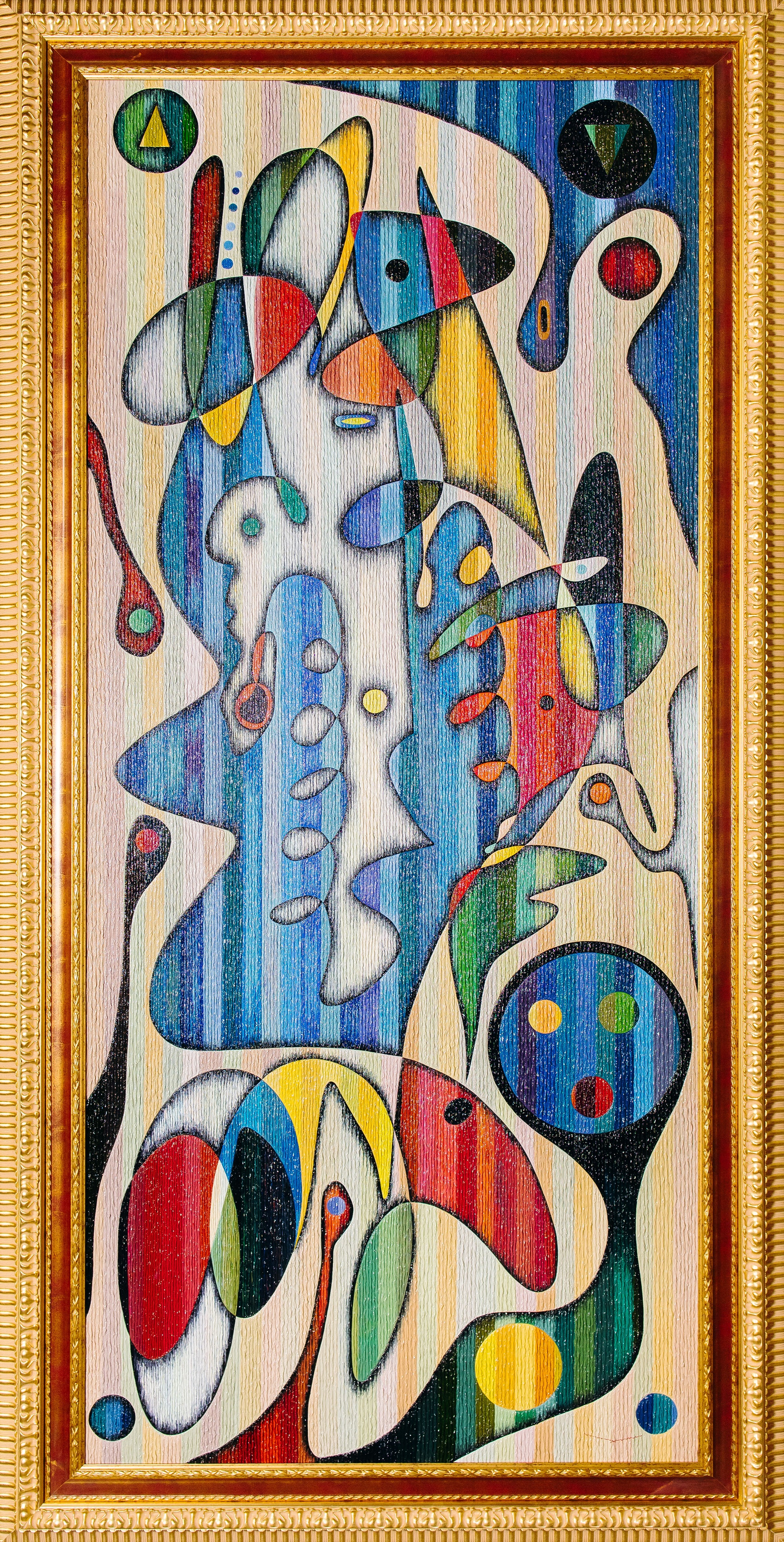
The Protector of Humanity (2017)
Curatorial Essay
26 Apr 2026In The Protector of Humanity (2017), Gheorghe Virtosu articulates an early but decisive formulation of what would later be theorized as New Perfectionism—a systemic abstraction in which the pictorial field operates as an integrated network of interdependent forces rather than a site of representation. Executed in a vertical monumental format, the painting establishes a stratified yet fluid composition where biomorphic curvature, geometric segmentation, and chromatic distribution coalesce into a continuous field of relational dynamics. The work does not present a singular figure of protection; instead, it constructs protection as a distributed condition—emergent from the interaction of structural elements rather than embodied in an identifiable subject.1
A defining characteristic of the composition is its vertical chromatic striation, which functions as both a temporal register and a structural scaffold. These linear bands introduce a latent order across the surface, suggesting continuity, flow, and systemic persistence. However, this order is persistently interrupted by superimposed forms—elliptical, angular, and curvilinear—that traverse the vertical axis and destabilize any fixed reading. The result is not disintegration but a dynamic equilibrium in which structure and disruption coexist, reflecting a core principle of New Perfectionism: the system is not static perfection, but adaptive coherence under continuous transformation.2
Figuration emerges as a perceptual phenomenon rather than a compositional premise. The viewer may discern vestiges of faces, eyes, or bodily contours embedded within the overlapping forms, yet these elements never stabilize into a singular identity. Instead, they oscillate between recognition and abstraction, dissolving as quickly as they appear. This instability repositions the human figure from a central subject to a distributed presence within the system, implying that “humanity” itself is not localized but dispersed across networks of interaction. Protection, in this context, is not an act but a condition arising from systemic balance.3
Spatially, the painting can be interpreted as a vertical continuum of operational zones. The upper register is characterized by sharper contrasts and concentrated forms, suggesting zones of perception, surveillance, or cognitive structuring. The central field, dense with overlapping shapes and chromatic intersections, functions as a site of active negotiation, where forces converge, collide, and recalibrate. In the lower register, forms expand and elongate, producing a sense of release, diffusion, and regenerative continuity. These zones do not unfold sequentially but coexist simultaneously, reinforcing a non-linear conception of time and process consistent with systemic abstraction.1
Chromatically, the work operates through a highly calibrated interplay of saturation and contrast. Primary colors—red, blue, and yellow—anchor the composition, functioning as nodes of intensity within a broader field of modulation. These are interwoven with secondary and neutral tones that mediate transitions and sustain visual continuity. Black contours delineate and compress forms, while lighter grounds open zones of perceptual relief. Color here is not descriptive but operative: it organizes the field while simultaneously introducing points of tension and instability, reinforcing the painting’s systemic logic.2
The absence of a central focal point compels continuous visual navigation. The viewer’s gaze is drawn into a circuit of movement, traversing the canvas through shifting alignments of form and color. This condition transforms perception into an active process, in which meaning is not given but constructed through engagement. The painting thus resists closure, sustaining a state of perpetual reconfiguration that mirrors the adaptive nature of complex systems.3
Within the framework of New Perfectionism, The Protector of Humanity can be understood as a prototype for systemic abstraction. It proposes that protection—whether social, biological, or conceptual—is not the function of isolated agents but the emergent property of relational structures. By dissolving figuration into a network of interacting forces, Virtosu redefines the role of painting as a model of systemic coherence. The work does not depict humanity; it enacts the conditions through which humanity persists, adapts, and stabilizes itself within an ever-changing field of relations.
Artist Biography
Gheorghe Virtosu is a contemporary painter whose work investigates abstraction as a systemic and philosophical structure. His practice is centered on the translation of complex relational networks into visual form, integrating biomorphic and geometric vocabularies.
Working primarily at large scale, Virtosu constructs immersive pictorial environments in which perception becomes an active process of navigation and interpretation.
His theoretical framework, New Perfectionism, defines abstraction as a condition of structured complexity, where coherence emerges through interaction rather than fixed order.
Through layered oil techniques, his compositions evolve as dynamic systems in which forms continuously emerge, dissolve, and reconfigure across multiple perceptual levels.
Technical Notes
Executed in oil on canvas (239 × 134 cm), the painting adopts a vertical format that reinforces its stratified compositional logic. The surface is structured through vertical chromatic bands, establishing an active framework that is subsequently disrupted by superimposed abstract forms.
The interplay between precise contours and fluid shapes generates a tension between control and spontaneity. Layered pigment applications create depth through accumulation rather than linear perspective, emphasizing surface interaction and systemic complexity.
Chromatic distribution functions as both an organizing principle and a destabilizing force, with high-saturation regions acting as points of visual energy within a decentralized composition.
Notes
- Gilles Deleuze, Difference and Repetition. Columbia University Press, 1994.
- Umberto Eco, The Open Work. Harvard University Press, 1989.
- Rosalind Krauss, The Originality of the Avant-Garde and Other Modernist Myths. MIT Press, 1985.
Selected Bibliography
- Deleuze, Gilles. Difference and Repetition.
- Eco, Umberto. The Open Work.
- Krauss, Rosalind. The Originality of the Avant-Garde and Other Modernist Myths.
- Derrida, Jacques. Of Grammatology.
- Virilio, Paul. The Vision Machine.
- El Arte Monumental, “New Perfection and Systemic Abstraction in Contemporary Painting.” 2026.