
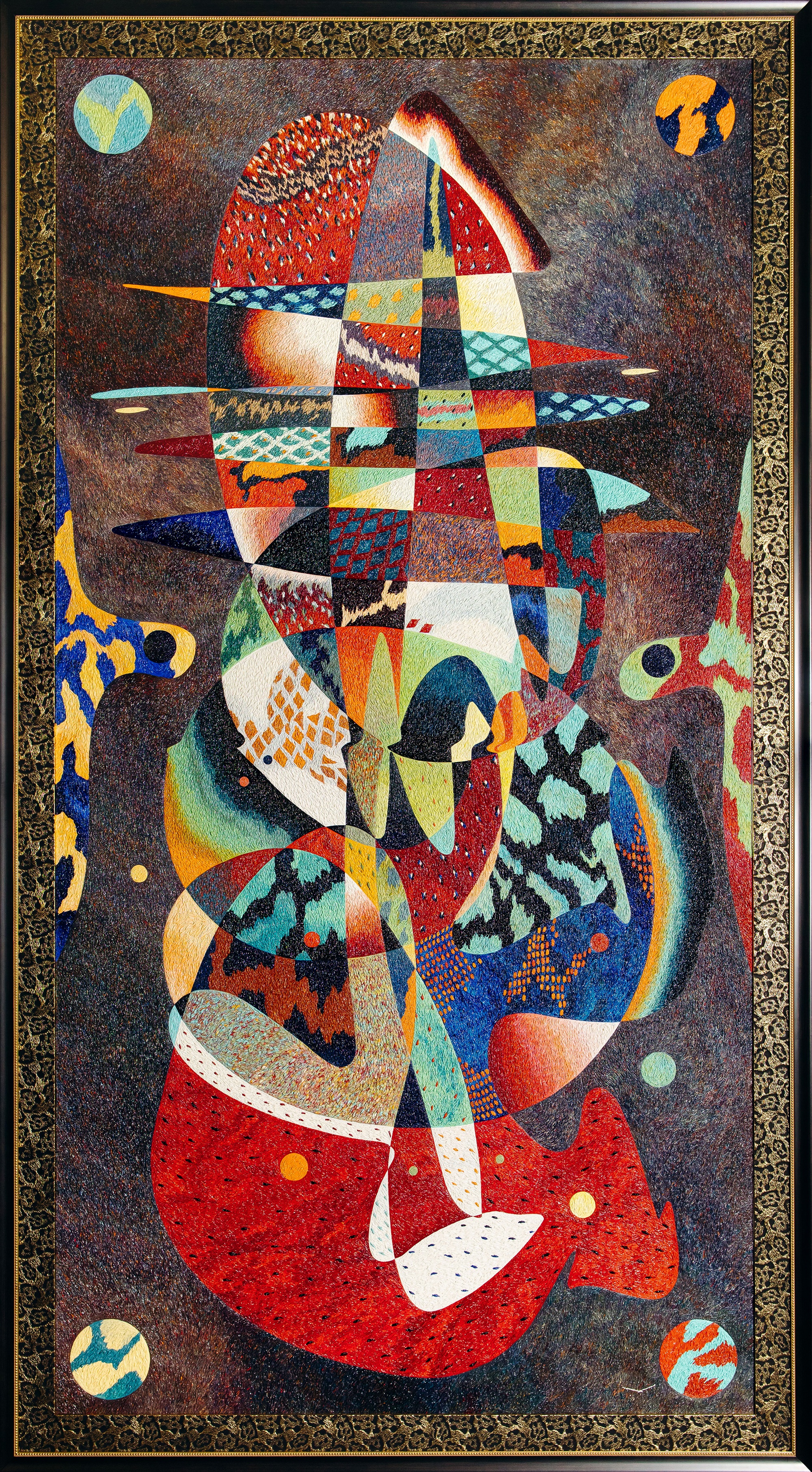
The Protector of the Souls (2015)
Curatorial Essay
26 Apr 2026In The Protector of the Souls (2015), Gheorghe Virtosu constructs a pivotal articulation of proto–New Perfectionist logic, in which the pictorial field operates as a site of psychic and systemic convergence. Unlike later works that stabilize relational abstraction into distributed coherence, this composition foregrounds tension, fragmentation, and internal multiplicity as the primary conditions through which meaning emerges. The painting does not depict “souls” as discrete entities; instead, it configures them as interwoven strata of perception, memory, and affect, embedded within a dynamically unstable system of forms.1
The central vertical axis functions as a structural spine, dividing the composition into mirrored yet asymmetrical fields. This axial division introduces a latent order, recalling both anatomical symmetry and metaphysical dualism—body and soul, interior and exterior, self and other. However, this apparent symmetry is continuously disrupted by lateral protrusions and layered geometries that extend outward, producing a condition of systemic disequilibrium. The axis thus operates not as a stabilizing center, but as a site of tension where opposing forces are held in provisional alignment.2
A defining feature of the work is its grid-like segmentation across the upper register, where chromatic blocks and patterned textures intersect to form a matrix of visual information. This grid does not impose rigid order; rather, it functions as a permeable structure through which forms pass, overlap, and mutate. The interplay between patterned units and organic contours suggests a negotiation between coded systems and lived experience, aligning with broader theories of abstraction as a field of relational data rather than fixed representation.3
Biomorphic curvature dominates the lower and central regions, where forms expand, contract, and fold into one another. These shapes evoke corporeal and visceral associations—organs, limbs, or embryonic structures—yet remain resistant to stable identification. The body, in this context, is not depicted but implied as a mutable topology, a site of transformation rather than a fixed entity. This aligns with Virtosu’s broader exploration of human experience as a fluid and often contradictory condition shaped by internal and external pressures.1
Chromatically, the painting is structured around a high-intensity interplay of saturated reds, deep blues, and luminous yellows, set against a dense, textured ground. The background, composed of finely modulated tonal variations, creates a field of atmospheric ضغط that both contains and amplifies the central forms. Red zones dominate the lower register, suggesting accumulation, كثافة, and emotional ભાર, while cooler tones mediate transitions and introduce רגעים of दूरी and reflection. Color operates here as an active force, structuring perception while simultaneously destabilizing spatial coherence.2
The title, The Protector of the Souls, introduces a conceptual paradox that is central to the work’s interpretation. Protection is not visualized as enclosure or defense, but as exposure within a complex system of forces. The “protector” is not a figure but a condition: the capacity of the system to sustain multiplicity without collapse. This notion resonates with Virtosu’s own reflections on art as a channel for human experience, where painting becomes a medium through which internal संघर्ष and resilience are externalized and reconfigured.3
Within the trajectory of New Perfectionism, this work can be understood as a formative stage in the evolution from expressive fragmentation toward systemic coherence. While later paintings achieve a more stabilized relational balance, The Protector of the Souls retains a heightened sense of volatility, emphasizing the processes through which systems emerge rather than their resolved states. The painting thus operates as both a conceptual and formal threshold, marking the transition from abstraction as expression to abstraction as system—where the “soul” is no longer an interior essence, but a distributed phenomenon within a field of continuous transformation.
Artist Biography
Gheorghe Virtosu is a contemporary painter whose work explores abstraction as a vehicle for articulating complex psychological, social, and systemic conditions. His practice is characterized by large-scale compositions that integrate geometric segmentation with biomorphic fluidity.
Emerging from a background shaped by political upheaval and personal adversity, Virtosu channels lived experience into a visual language defined by intensity, transformation, and structural experimentation.
His work from the mid-2010s marks a critical transition toward what would later be formalized as New Perfectionism, a framework in which abstraction operates as a system of interrelated forces rather than a representational mode.
Through layered oil techniques and complex compositional strategies, Virtosu constructs immersive environments that require active perceptual engagement and resist fixed interpretation.
Technical Notes
Executed in oil on canvas (317 × 191 cm), the painting adopts a monumental vertical format that reinforces its axial and stratified organization. The composition is structured through a central विभाजन, complemented by a grid-like upper register and expansive biomorphic forms in the lower field.
The surface is densely worked with layered pigment, producing a tactile गुणवत्ता that enhances the painting’s spatial ambiguity. Patterned textures and chromatic segmentation interact with fluid contours, generating a sustained tension between order and organic transformation.
The background’s సూక్ష్మ tonal modulation creates an atmospheric field that envelops the composition, intensifying the interaction between foreground elements and reinforcing the painting’s systemic complexity.
Notes
- Alina Livneva, “Great Energy, Colors, and Motion – Gheorghe Virtosu’s Abstract Art,” 2018, discusses the artist’s use of interwoven tensions and dynamic abstraction.
- Virtosu Art Gallery, artist descriptions and works (2015–2016), outlining the compositional strength and symbolic use of color and structure in his abstract paintings.
- Robert McIntosh, “Finding Light in the Darkness,” 2018, interprets Virtosu’s work as a channel for human experience and emotional transformation.
Selected Bibliography
- Livneva, Alina. “Great Energy, Colors, and Motion – Gheorghe Virtosu’s Abstract Art.”
- McIntosh, Robert. “Finding Light in the Darkness.”
- Virtosu Art Gallery. Collected Works and Descriptions.
- Deleuze, Gilles. Difference and Repetition.
- Eco, Umberto. The Open Work.
- Bertalanffy, Ludwig von. General System Theory.
- El Arte Monumental, “New Perfection and Systemic Abstraction in Contemporary Painting.” 2026.