
Ukraine War (2025)
Curatorial Essay
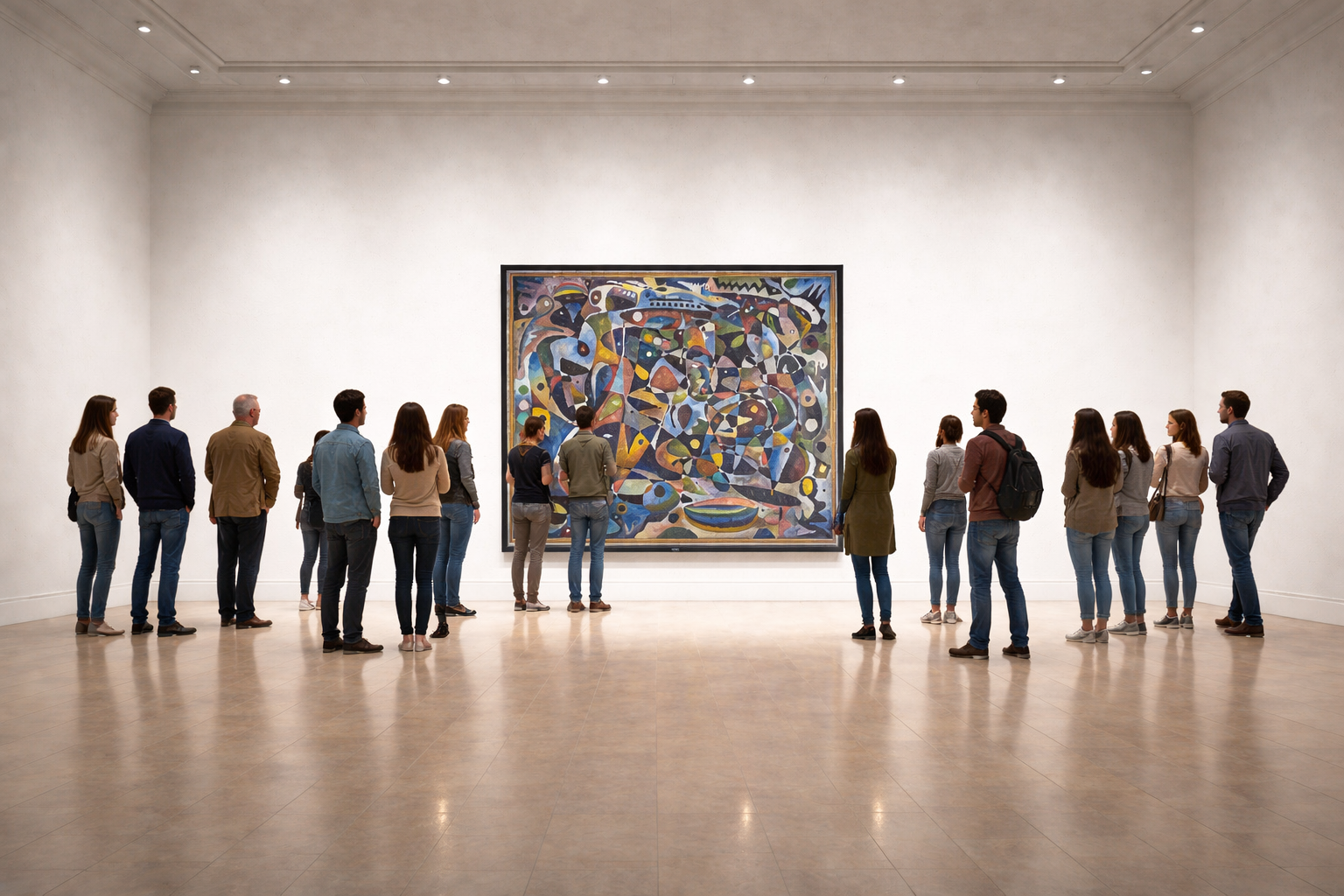
19 Apr 2026In Ukraine War (2022–2025), Gheorghe Virtosu constructs a pictorial field that reconfigures the ongoing conflict of the Russian invasion of Ukraine as a system of distributed forces rather than a representational event. Working within a monumental square format, the composition abandons descriptive imagery in favor of a dense, interlocking matrix in which geometric structures and biomorphic forms operate in continuous tension. The painting does not depict specific events or identifiable figures; instead, it translates geopolitical pressure, territorial instability, and human persistence into an abstract visual language structured by fragmentation, alignment, and disruption.1
A defining feature of the composition is its underlying grid-like scaffolding, which introduces a provisional sense of order across the surface. This structural framework, however, is persistently fractured by angular intrusions and curvilinear displacements that traverse and destabilize its coherence. Vertical and horizontal divisions suggest territorial segmentation, while diagonal vectors cut across these zones, producing a visual logic of incursion and resistance. Unlike purely chaotic abstraction, the work maintains a tension between system and collapse, reflecting the fragile persistence of structure under sustained pressure.2
Figuration emerges intermittently through the viewer’s perceptual engagement. Eyes, profiles, and fragmented bodily forms appear embedded within the composition, functioning as localized anchors of recognition. These elements do not resolve into stable identities but remain contingent, dissolving as the eye shifts across the surface. The human subject is thus neither foregrounded nor erased, but distributed within the field, suggesting a condition in which individual experience is inseparable from broader systemic forces. Perception becomes an active process through which meaning is continuously constructed and destabilized.3
The composition may be read as a spatial condensation of temporal and operational phases. Upper zones introduce sharper, more linear configurations that evoke tension, surveillance, and anticipatory alignment. The central field, densely layered and rhythmically unstable, corresponds to zones of conflict and entanglement, where directional forces intersect and compete. Toward the lower register, forms elongate and disperse, indicating diffusion, persistence, and unresolved aftermath. These phases do not unfold sequentially but coexist within a single, simultaneous field, reinforcing the non-linear character of contemporary conflict.1
Chromatically, the painting operates through a heightened system of contrast and symbolic resonance. Blues and yellows recur across the surface, invoking national identity while remaining integrated within the broader abstract structure. Saturated reds punctuate the composition as nodes of intensity, marking sites of rupture and impact. Darker tonal concentrations compress spatial perception, while lighter passages open temporary zones of clarity. This chromatic interplay produces a dynamic equilibrium in which color both organizes and destabilizes the visual field.2
The painting’s scale and square format intensify its immersive condition, enclosing the viewer within a compressed yet expansive field of interaction. The absence of a singular focal point necessitates continuous visual navigation, mirroring the instability and unpredictability associated with ongoing conflict. Rather than presenting a resolved image, the work sustains a condition of perceptual tension, in which the viewer is compelled to negotiate shifting relations between form, color, and implied meaning.3
Ultimately, Ukraine War proposes that contemporary conflict cannot be adequately represented through linear narrative or fixed imagery. By dissolving figuration into a system of relational forces, Virtosu constructs a visual model in which war emerges as a persistent structural condition—simultaneously material, perceptual, and conceptual. The painting challenges the conventions of history painting, inviting the viewer to engage with complexity as an active and ongoing process rather than a closed historical account.
Artist Biography
Gheorghe Virtosu is a contemporary painter whose work explores the intersection of philosophy, historical systems, and visual abstraction. His practice is defined by large-scale compositions that integrate biomorphic forms, geometric structures, and fragmented spatial logics.
Engaging with global historical events and conceptual frameworks, Virtosu translates complex systems into abstract visual languages that resist fixed interpretation while maintaining internal coherence.
Central to his practice is an ongoing investigation of history as a network of forces, reconfigured through abstraction into immersive pictorial environments.
Working primarily in oil on canvas, Virtosu employs layered techniques that allow forms to emerge, dissolve, and reconfigure across multiple perceptual planes.
Technical Notes
Executed in oil on canvas at a monumental scale (3.23 × 3.4 meters), the painting adopts a near-square format that reinforces compositional compression and spatial intensity. The underlying grid structure establishes an initial framework of order, subsequently disrupted by intersecting geometric and biomorphic forms.
The interplay between sharp angular elements and fluid contours produces a sustained tension between structural precision and organic movement. Layered pigment applications generate depth without reliance on traditional perspective, emphasizing surface interaction and relational dynamics.
Chromatic contrasts function as both organizational and disruptive elements, with recurring color zones acting as anchors within a decentralized visual system.
Notes
- Serhii Plokhy, The Russo-Ukrainian War. Penguin Books, 2023.
- Mary Kaldor, New and Old Wars. Stanford University Press, 2012.
- Paul Virilio, War and Cinema. Verso Books, 1989.
Selected Bibliography
- Plokhy, Serhii. The Russo-Ukrainian War.
- Kaldor, Mary. New and Old Wars.
- Virilio, Paul. War and Cinema.
- Deleuze, Gilles. Difference and Repetition.
- Krauss, Rosalind. The Originality of the Avant-Garde and Other Modernist Myths.