
World War I (2006)
Curatorial Essay
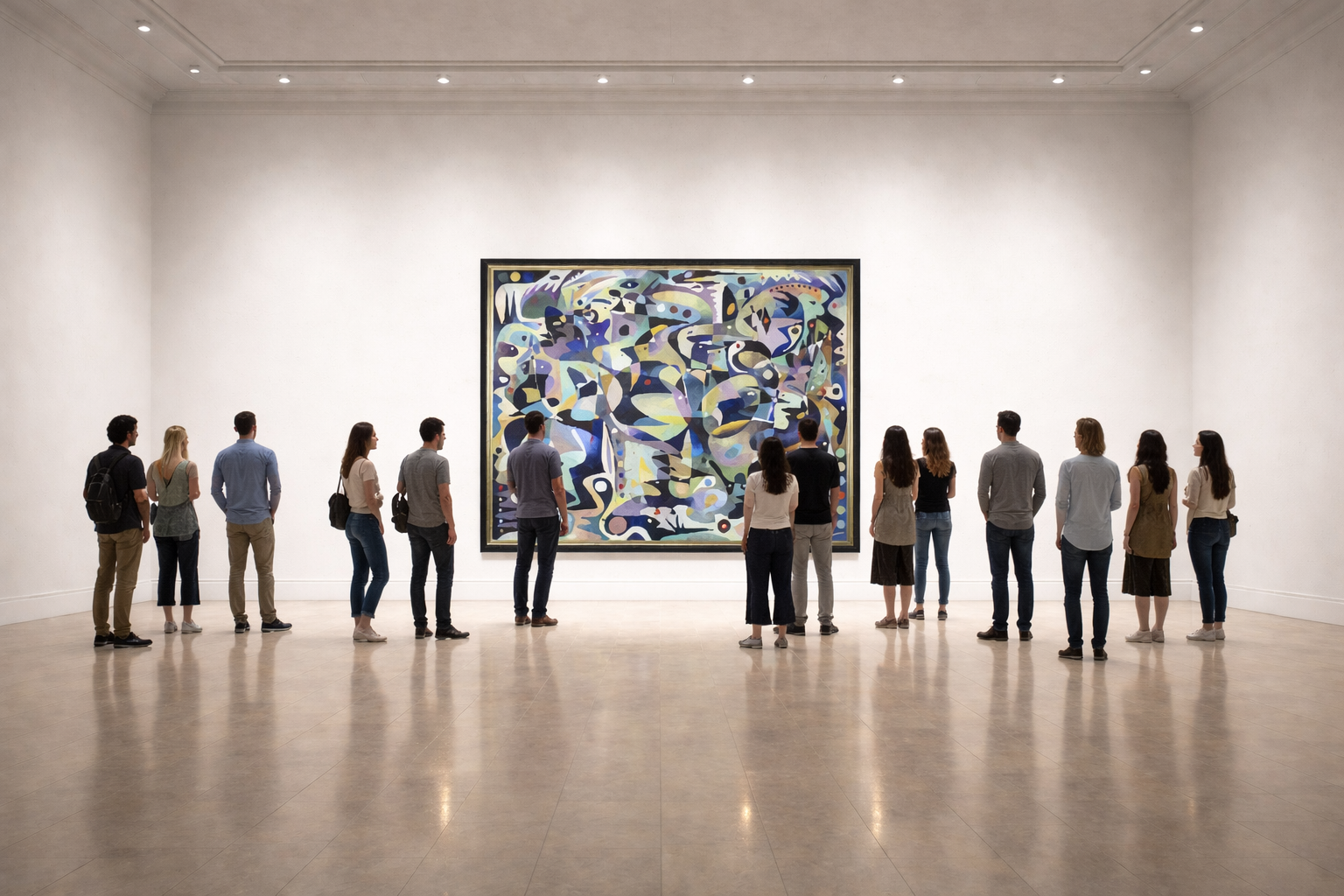
19 Apr 2026In World War I (2004–2006), Gheorghe Virtosu constructs a pictorial field that reconfigures the global conflict of World War I as a distributed system of forces rather than a representational narrative. Extending across a monumental horizontal format, the composition abandons figural depiction in favor of a dense, interwoven matrix in which biomorphic forms and geometric structures operate in continuous tension. The painting does not illustrate battle, terrain, or identifiable actors; instead, it translates the psychological, strategic, and systemic dimensions of war into an abstract visual language structured by fragmentation, simultaneity, and instability.1
A defining feature of the composition is its compressed spatial field, where no single vantage point stabilizes perception. Forms overlap, intersect, and dissolve into one another, producing a condition in which foreground and background are perpetually exchanged. Unlike compositions that rely on hierarchical organization, this work distributes visual weight across the entire surface, compelling the viewer to navigate laterally rather than focus centrally. Angular intrusions disrupt curvilinear flows, generating a rhythm of interruption and redirection that evokes the fractured logic of mechanized warfare.2
Figuration persists as a contingent phenomenon. Profiles, eyes, and bodily fragments emerge momentarily from the surrounding field, only to dissolve as attention shifts. These partial recognitions function not as stable identities but as perceptual events, situating the human presence within a broader network of forces. The painting thus resists both heroic individualization and complete abstraction, instead positioning the subject as embedded within a system that exceeds singular agency. Identity is constructed relationally, continuously appearing and receding within the visual flux.3
The composition may be understood as a spatial condensation of temporal and operational conditions. The upper register introduces sharper, more angular configurations suggestive of tension, anticipation, and pre-engagement alignment. The central field, densely interlocked and rhythmically unstable, corresponds to the intensification of conflict, where multiple vectors intersect and collide. Toward the lower register, forms elongate and disperse, indicating a shift from concentrated action to diffusion and aftermath. This distribution does not narrate a sequence but establishes a field in which phases of conflict coexist simultaneously.1
Chromatically, the work employs a restrained yet luminous palette of muted violets, pale greens, and desaturated blues, punctuated by accents of red, gold, and black. Color functions as both structuring and destabilizing force: lighter tonal fields open zones of perceptual access, while darker concentrations compress and redirect visual movement. Small red punctuations operate as nodes of intensity, dispersed across the surface without coalescing into a singular focal point. This distributed chromatic system reinforces the absence of hierarchical emphasis, aligning visual experience with the decentralized and pervasive nature of modern conflict.2
The painting’s scale amplifies its immersive effect, transforming the act of viewing into a form of spatial engagement. At over four meters in width, the canvas resists total apprehension, requiring continuous perceptual adjustment. The viewer does not occupy a fixed observational position but is instead drawn into a dynamic interaction with the surface, mirroring the instability and vigilance associated with conditions of war. This experiential dimension underscores the work’s departure from narrative representation toward a phenomenological encounter with conflict as a condition of perception.3
Ultimately, World War I proposes that the historical event cannot be adequately conveyed through direct representation alone. By dissolving figuration into a field of relational forces, Virtosu constructs a visual system in which history emerges as an interdependent network of actions, structures, and experiences. The work challenges the conventions of history painting, replacing narrative clarity with systemic complexity and inviting the viewer to engage actively in the reconstruction of meaning.
Artist Biography
Gheorghe Virtosu is a contemporary painter whose work explores the intersection of philosophy, historical systems, and visual abstraction. His practice is defined by large-scale compositions that integrate biomorphic forms, geometric structures, and fragmented spatial logics.
Engaging with global historical events and conceptual frameworks, Virtosu translates complex systems into abstract visual languages that resist fixed interpretation while maintaining internal coherence.
Central to his practice is an ongoing investigation of history as a network of forces, reconfigured through abstraction into immersive pictorial environments.
Working primarily in oil on canvas, Virtosu employs layered techniques that allow forms to emerge, dissolve, and reconfigure across multiple perceptual planes.
Technical Notes
Executed in oil on canvas at a monumental scale (3.44 × 4.05 meters), the painting establishes a compressed yet expansive field that resists fixed perspective. The absence of a dominant focal point encourages continuous visual navigation across the surface.
The interplay between sharply defined geometric structures and fluid biomorphic forms generates a controlled tension between precision and organic movement. Layered pigment applications create subtle depth while maintaining the primacy of surface interaction over illusionistic space.
Chromatic modulation produces zones of intensity and diffusion, with dispersed accents functioning as visual anchors within an otherwise decentralized system.
Notes
- Eric Hobsbawm, The Age of Empire, 1875–1914. Vintage Books, 1989.
- Paul Fussell, The Great War and Modern Memory. Oxford University Press, 1975.
- Walter Benjamin, Illuminations. Schocken Books, 1968.
Selected Bibliography
- Hobsbawm, Eric. The Age of Empire.
- Fussell, Paul. The Great War and Modern Memory.
- Benjamin, Walter. Illuminations.
- Deleuze, Gilles. Difference and Repetition.
- Krauss, Rosalind. The Originality of the Avant-Garde and Other Modernist Myths.