
World War II (2008)
Curatorial Essay
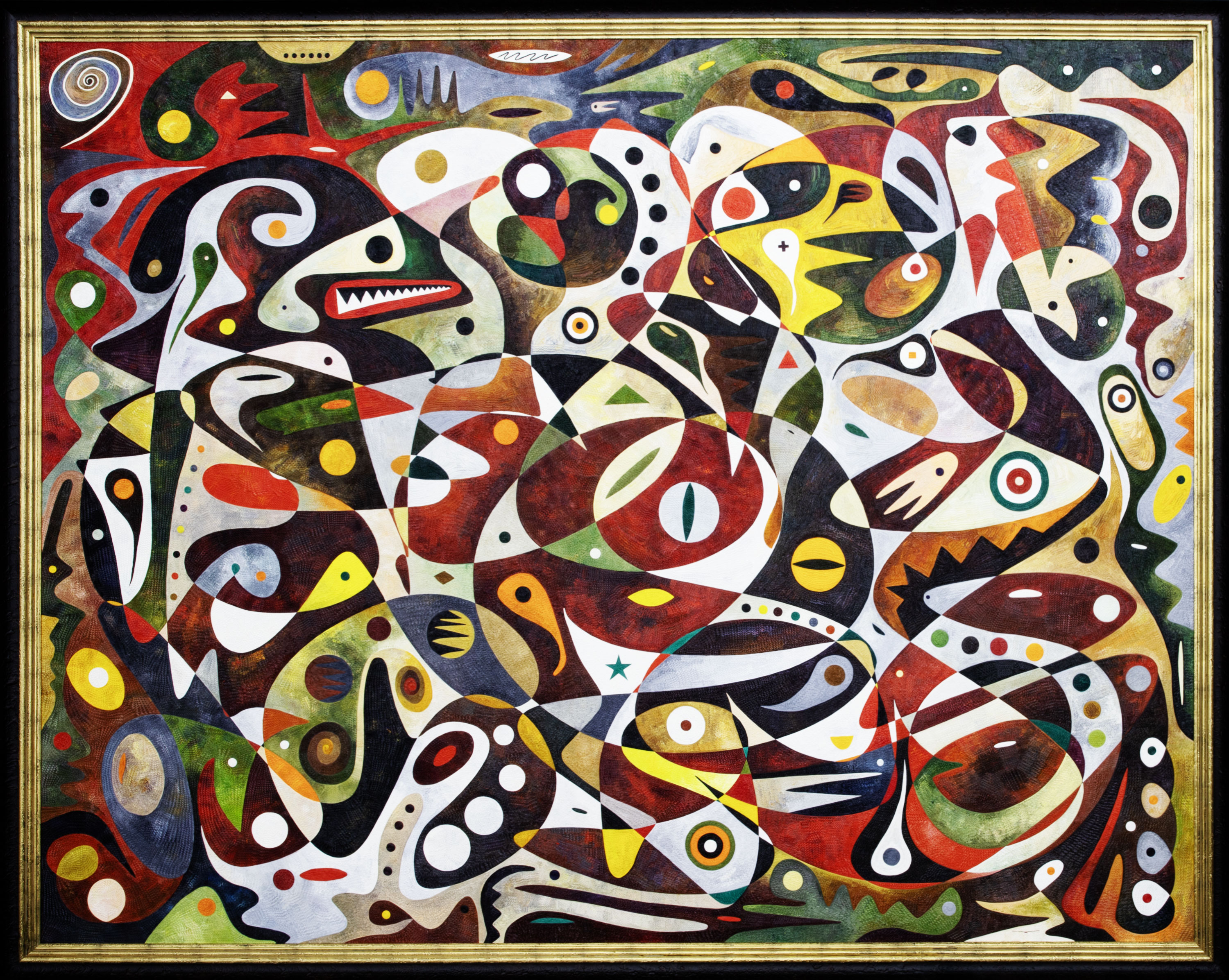
19 Apr 2026In World War II (2006–2008), Gheorghe Virtosu constructs a pictorial field that reconfigures the global conflict as a system of simultaneous, interacting forces rather than a representational event. Extending across a monumental format, the composition abandons figural narration in favor of a distributed visual matrix in which geometric density and biomorphic fragmentation operate in continuous tension. The painting does not depict battles, leaders, or geography; instead, it translates the multiplicity of global warfare into an abstract language structured by collision, simultaneity, and systemic overload.1
A defining structural condition of the work is the absence of a stable compositional hierarchy. Unlike earlier paintings organized through directional axes or focal convergence, this composition activates the entire surface uniformly, producing a condition in which no single zone governs perception. Forms proliferate across the canvas in overlapping configurations, generating a visual field that resists containment. This saturation reflects the expanded scale of modern warfare, in which multiple theaters operate concurrently and no singular perspective can encompass the whole.2
Figuration persists but remains structurally unstable. Silhouettes—constructed through eye-like motifs and fragmentary contours—emerge only provisionally before dissolving into adjacent forms. Faces overlap, share boundaries, and fragment under pressure, producing a condition in which identity cannot stabilize. The painting thus displaces the traditional subject of history painting, replacing coherent figures with transient configurations that exist only within a field of competing forces.3
Spatially, the composition may be understood as a condensation of multiple theaters of war. The dense, compressed forms along the left register evoke conditions of proximity and entanglement associated with the European theater, where civilian and military identities collapse into one another under sustained pressure. In contrast, the more expansive yet internally fractured forms toward the right suggest the Pacific theater, characterized by mobility, distance, and technologically mediated engagement. These zones do not separate geographically but coexist within the same visual field, producing a condition of simultaneous spatial logics.1
The central red field operates as a critical node within the composition. While it initially appears to anchor the painting, its internal fragmentation destabilizes any sense of coherence. Multiple embedded forms and competing directional forces transform it into a site of concentrated tension rather than resolution. This zone may be understood as an analogue to systems of global coordination, in which authority is distributed, contested, and unable to fully organize the field it occupies.2
Peripheral regions extend the painting’s structural logic into additional domains. The upper zones, populated by repeated and partially formed profiles, suggest systems of replication and abstraction aligned with industrial and bureaucratic processes. In the lower register, forms elongate and dissolve, indicating a shift from active engagement to residual motion and dissipation. These transitions reinforce the instability of roles, in which distinctions between civilian, soldier, state, and machine collapse into a continuum of shifting conditions.3
The monumental scale of the canvas (3.23 × 3.4 meters) is essential to the work’s perceptual effect. At a distance, the painting presents a unified yet unstable field; at close range, it disintegrates into granular marks and discontinuous edges. This oscillation compels sustained bodily movement, requiring the viewer to navigate the surface in order to construct provisional coherence. Perception becomes an active process, mirroring the painting’s internal dynamics of emergence and fragmentation.
Chromatically, the dominance of saturated reds, punctuated by greens, yellows, and stark whites, intensifies the sense of instability. Color operates not as a unifying element but as a force of differentiation and disruption, generating zones of visual heat and interruption. The surface functions as an energetic field in which chromatic contrasts drive movement and destabilize form.
Ultimately, World War II constructs a visual system in which history is no longer articulated as a linear sequence of events but as an interdependent network of forces. By dissolving the stability of figures, roles, and spatial divisions, Virtosu redefines the possibilities of history painting, proposing a model in which meaning emerges through engagement with complexity, simultaneity, and structural instability.
Artist Biography
Gheorghe Virtosu is a contemporary painter whose work explores the intersection of philosophy, historical systems, and visual abstraction. His practice is defined by large-scale compositions that integrate biomorphic forms, geometric structures, and fragmented spatial logics.
Engaging with global historical events and conceptual frameworks, Virtosu translates complex systems into abstract visual languages that resist fixed interpretation while maintaining internal coherence.
Central to his practice is an ongoing investigation of history as a network of forces, reconfigured through abstraction into immersive pictorial environments.
Working primarily in oil on canvas, Virtosu employs layered techniques that allow forms to emerge, dissolve, and reconfigure across multiple perceptual planes.
Technical Notes
Executed in oil on canvas at a monumental scale (3.23 × 3.4 meters), the painting establishes an immersive field that resists singular vantage points. Layered pigment applications create a complex surface in which forms appear and dissolve across overlapping spatial registers.
The interplay between dense geometric fragmentation and fluid biomorphic elements generates a tension between structure and disintegration, while the absence of a central compositional hierarchy reinforces the painting’s distributed logic.
Chromatic contrasts produce zones of intensity and optical vibration, guiding the viewer’s movement while maintaining the overall instability of the field.
Notes
- Antony Beevor, The Second World War. Little, Brown, 2012.
- John Keegan, The Second World War. Penguin Books, 1989.
- Richard Overy, Why the Allies Won. W.W. Norton, 1995.
Selected Bibliography
- Beevor, Antony. The Second World War.
- Keegan, John. The Second World War.
- Overy, Richard. Why the Allies Won.
- Deleuze, Gilles. Difference and Repetition.
- Krauss, Rosalind. The Originality of the Avant-Garde and Other Modernist Myths.