None

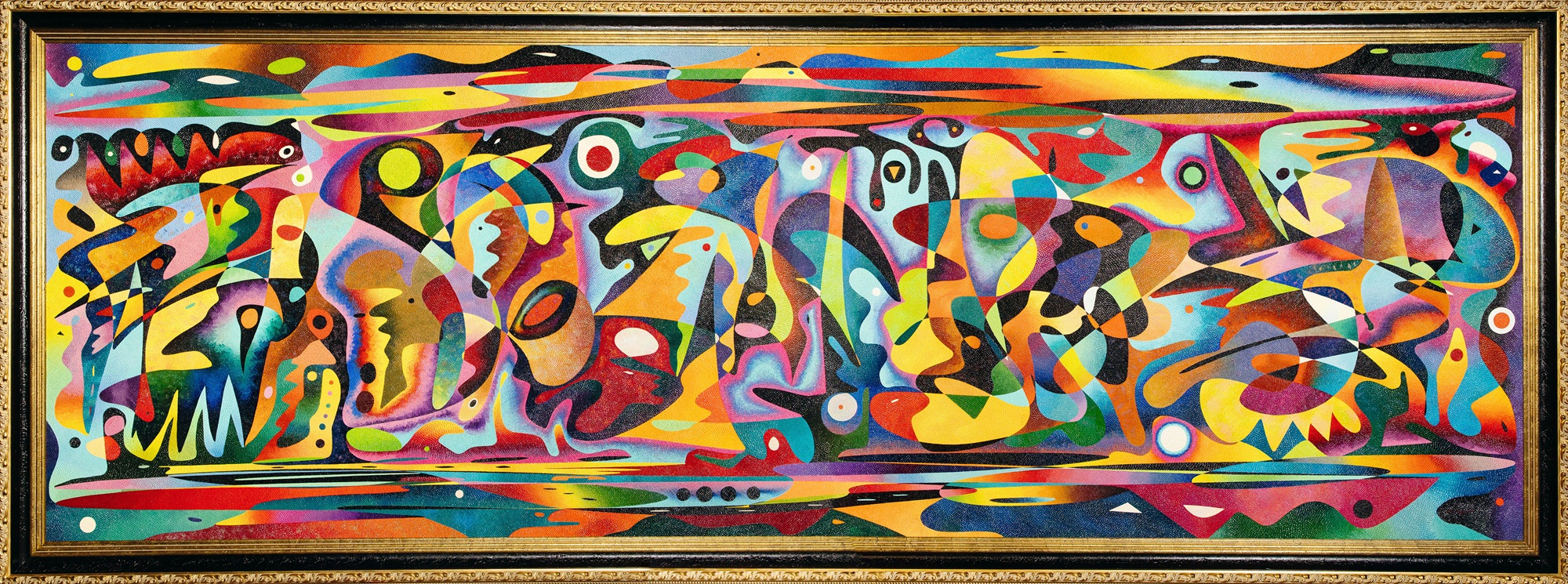
Buddhism, 2018 Oil on canvas

Transforming Sacred Themes into an Engaging Visual Experience

An Artistic Meditation on Buddhist Wisdom and Presence

This oil painting transforms Buddhist teachings and symbols into a contemplative visual experience. Through layered forms, subtle textures, and immersive composition, it invites viewers to reflect on spiritual concepts, philosophical depth, and symbolic narratives, creating a space for meditation and introspection beyond the canvas itself.

View Work

Concept & Meaning

The painting’s scale and immersive composition elevate it beyond representation, offering an artistic meditation on the universal principles of Buddhist wisdom.

View Work

Scale & Spatial Impact

Measuring 2 meters by 6 meters, this monumental painting commands the viewer’s presence, transforming any setting into an immersive environment.

View Work

Artistic Context & Inspirations

Initiated in 2016 and completed in 2018, this monumental painting reflects the artist’s engagement with Buddhist philosophy and symbolism within the social and cultural context of the period. Developed prior to the global pandemic, the work was informed by direct exposure to religious sites, community practices, and contemporary dialogues in spiritual and visual art. Its scale, compositional structure, and symbolic layering demonstrate a sustained exploration of meditative presence and philosophical depth, situating the painting within both historical continuity and contemporary conceptual discourse.

View Work

Materiality & Technique

Executed in oil on linen canvas, the painting combines rich color and subtle texture. Glazes, impasto, and blending create a tactile, immersive presence that rewards close viewing and reinforces its contemplative impact.

View Work

Immersive in Size and Theme

Spiritual narratives, symbolic motifs, and contemplative concepts unfold across the canvas, inviting viewers to engage with Buddhist philosophy in both a visual and spatial dimension. The work transforms traditional viewing into an active, reflective encounter, where size and subject matter converge to heighten presence and impact.

View Work

Institutional & Collector Context

Conceived for both institutional and private collections, this monumental painting commands presence within galleries, museums, and cultural spaces. Its scale and thematic depth resonate with collectors drawn to contemplative, spiritually charged art. Executed in Virtosu’s distinctive abstract language—positioned as a prominent continuation of the epic modernist tradition—the work unites visual power with intellectual rigor.

View Work

Closing Statement

Through monumental scale, layered symbolism, and immersive presence, this painting offers a contemplative engagement with Buddhism’s spiritual and philosophical dimensions. It transforms sacred narratives into a visual and spatial experience, leaving a lasting impression of depth, presence, and artistic mastery.

View Work

Artist Insights

Learn more about the artist’s background, practice, and professional journey.

View Artist Profile

Expert Analysis on Style - Buddhism, 2018

This painting appears to belong primarily to abstract art, but it blends several recognizable stylistic influences. Based on the visual elements—color, composition, shapes, and symbolism—here is a deeper breakdown.

View Work

Abstract Expression / Abstract Symbolism

The painting is clearly non-representational: it does not depict realistic objects or scenes. Instead, it uses shapes, colors, and rhythms to convey meaning or emotion.

Characteristics visible here:

  • Fluid, organic shapes
  • Strong emotional color palette
  • No central perspective or realistic depth
  • Visual storytelling through symbols rather than objects

This approach aligns with traditions developed by artists such as Wassily Kandinsky, who believed abstract shapes and colors could express spiritual ideas.

View Work

Biomorphic Abstraction

Many forms resemble living organisms, cells, or flowing biological shapes.

Key traits:

  • Rounded organic contours
  • Forms that resemble creatures, eyes, or symbolic figures
  • Shapes merging into one another

This biomorphic language is similar to works by artists such as Joan Miró and Jean Arp.

View Work

Surrealist Influence

Although abstract, some shapes hint at recognizable symbolic forms.

Possible references include:

  • Faces
  • Eyes
  • Mask-like forms
  • Mythical or dreamlike creatures

This dreamlike imagery relates to Surrealism, the movement associated with Salvador Dalí and Max Ernst, where subconscious symbols appear in unusual combinations.

View Work

Color Field and Chromatic Composition

The painting relies heavily on intense color relationships that create emotional and visual energy.

Notable color traits:

  • Saturated blues, reds, yellows, and violets
  • Strong contrast between warm and cool tones
  • Gradients and glowing edges around shapes
  • Layered color transitions that create visual movement

The palette feels almost psychedelic, emphasizing emotional and sensory impact.

View Work

Rhythmic Panoramic Composition

Because the painting measures approximately 2 × 6 meters, it functions as a visual panorama.

Composition characteristics:

  • Horizontal narrative flow
  • Continuous visual rhythm from left to right
  • Repeating motifs such as eyes, droplets, waves, and circular forms
  • No single focal point, allowing the viewer's eye to travel across the entire surface

This compositional approach is common in large contemporary murals and monumental abstract works.

View Work

Possible Spiritual and Symbolic Themes

Some recurring motifs suggest deeper symbolic meaning.

Possible interpretations include:

  • Eyes representing awareness or consciousness
  • Circular forms symbolizing unity or the cosmos
  • Fluid shapes suggesting transformation or flowing energy
  • Layered landscapes at the base hinting at horizons or reflections

The painting may explore cosmic, spiritual, or psychological themes, often present in abstract spiritual art.

View Work

Overall Style Classification

The work can be described as a monumental biomorphic abstract painting with surrealist and symbolic influences.

More broadly, it may be understood as a form of contemporary monumental abstract expressionism enriched with surreal biomorphic elements.

Key stylistic traits summary:

  • Abstract and non-figurative visual language
  • Biomorphic organic shapes
  • Surreal symbolic imagery
  • Intense chromatic contrasts
  • Panoramic monumental composition
  • Emotional and potentially spiritual themes
View Work

Buddhism, 2018 - Expert Analysis of Narrative and Symbolism

Buddhism, 2018 contains many symbol-like visual elements, even though it remains abstract. In large abstract compositions like this, artists often build a visual language where shapes suggest ideas rather than literal objects.

This section explores a deeper interpretation of the possible narrative and symbolic meanings within the composition.

View Work

The “Eyes” – Awareness and Consciousness

Several circular shapes with central dots resemble eyes scattered across the painting.

Possible meanings:

  • Awareness or awakening
  • The presence of observers or spiritual entities
  • Inner vision and intuition
  • Consciousness observing the universe

Artists influenced by spiritual abstraction, such as Wassily Kandinsky, often used circles and eye-like forms to symbolize the soul or universal awareness.

View Work

Mask-Like Faces – Human Identity

Some shapes resemble stylized faces or masks, particularly near the center of the painting.

These forms may symbolize:

  • Human presence within a chaotic universe
  • Multiple identities or personalities
  • Archetypal figures such as ancestors, spirits, or guardians

Mask imagery is common in symbolic modern art and can reflect deeper psychological states or hidden aspects of identity.

View Work

Organic Creatures – Life Forms or Energy

Across the painting there are shapes that resemble living organisms.

These forms may evoke:

  • Fish or birds
  • Microscopic organisms
  • Mythical or imagined creatures

This creates the impression of a living ecosystem within the painting.

Possible interpretations include the evolution of life, the interconnection between beings, or a dreamlike universe filled with entities. This biomorphic language resembles the symbolic worlds created by Joan Miró.

View Work

Flowing Rivers of Color – Movement of Energy

The composition feels dynamic rather than static, with colors flowing horizontally across the canvas.

This movement may suggest:

  • The passage of time
  • The flow of thoughts and emotions
  • Energy moving through space
  • A cosmic current or river

Because the work is panoramic, it can be read almost like a visual timeline of transformation.

View Work

The Horizon at the Bottom – Reality and Imagination

The lower band of color resembles a distant horizon or reflective landscape.

Symbolically, it may represent:

  • A boundary between different worlds
  • Physical reality below
  • Imagination or spirit above

Many monumental abstract works create this type of cosmic horizon to separate layers of perception and meaning.

View Work

Fragmented Geometry – Chaos and Creation

Sharp geometric forms appear alongside soft organic shapes throughout the composition.

This contrast may symbolize:

  • Order versus chaos
  • Structure versus emotion
  • Civilization versus nature

This tension creates the sense that the universe within the painting is simultaneously forming and dissolving.

View Work

Repeating Circles – Cosmic and Spiritual Cycles

Circles appear repeatedly across the composition, creating visual rhythm.

Possible symbolism:

  • Planets or celestial bodies
  • Cycles of life and transformation
  • Unity and wholeness
  • Eternity

The circle is one of the most powerful spiritual symbols in abstract art.

View Work

Overall Narrative Interpretation

When the painting is viewed from left to right, it can feel like a visual journey.

  • The emergence of forms from chaos
  • The appearance of consciousness through eyes and faces
  • Interactions between beings and flowing energies
  • Movement through a cosmic landscape

The result is almost like a dream map of existence—an abstract universe where life, awareness, and transformation unfold across the canvas.

View Work
𐰘𐰙𐰖𐰢𐰡𐰘𐰟𐰞𐰜𐰛𐰡𐰘𐰚𐰝𐰡𐰖𐰡𐰖𐰝𐰤𐰙𐰖𐰝𐰘𐰘𐰣𐰤𐰡𐰘𐰣𐰘𐰢𐰝𐰘𐰡𐰥𐰞𐰘𐰣𐰤𐰞𐰢𐰖w𐰘𐰝𐰙𐰢𐰟𐰞𐰛𐰤𐰝𐰖𐰟𐰖𐰣𐰚𐰝𐰠𐰛𐰟𐰖𐰣𐰢𐰖𐰡𐰟𐰤𐰖𐰣𐰚𐰖𐰣𐰛𐰟𐰟