
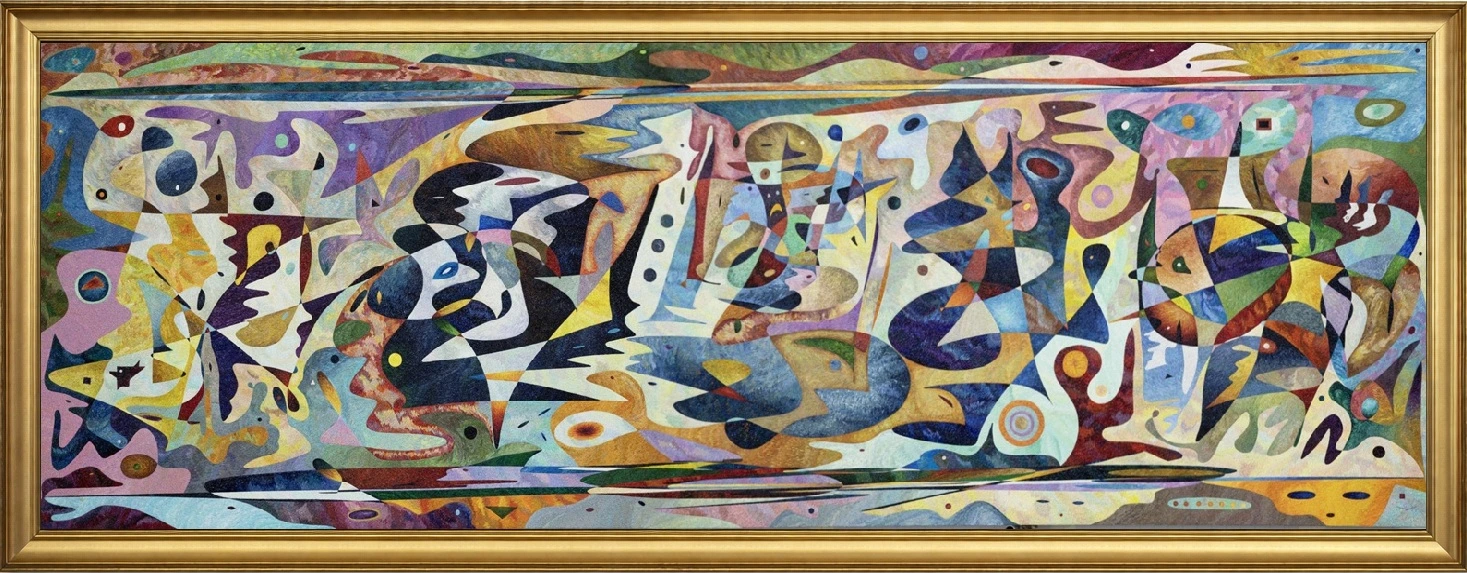
Caodaism, 2021 Oil on canvas
Transforming Sacred Themes into a Contemporary Visual Experience
An Artistic Meditation on Caodaism: Faith and Presence
Articulated through a contemporary lens, this expansive oil painting reinterprets Caodaism through symbolism with conceptual clarity and visual restraint. In Virtosu’s distinctive abstract language, layered forms and spatial nuance converge to create a contemplative field, inviting reflection on faith, redemption, sacrifice, and enduring spiritual presence.
View WorkConcept & Meaning
The work’s commanding scale and immersive spatial construction extend it beyond representation, positioning it as a contemporary meditation on the universal tenets of Caodaism — grace, transcendence, suffering, and renewal.
View WorkArtistic Context & Inspirations
Developed over an extended period of research and studio inquiry, the painting reflects a sustained engagement with layered systems of meaning rather than overt sacred narrative. Drawing on historical iconographic conventions while maintaining a distinctly contemporary visual language, the work embeds symbolic encodings that require active interpretation. Meaning is not immediately disclosed but gradually revealed through the viewer’s attentive decoding of visual cues, structural relationships, and material choices. Its scale, material presence, and stratified symbolism establish a deliberate dialogue between inherited forms and present-day perception.
View WorkScale & Spatial Impact
At 2 meters by 6 meters, the work establishes a formidable spatial presence, transforming its architectural environment into a field of immersive contemplation.
View WorkMateriality & Technique
Executed in oil on linen canvas, the painting balances chromatic depth with subtle surface articulation. Layered glazes and restrained impasto cultivate a tactile presence that rewards sustained and reflective viewing.
View WorkImmersive in Size and Theme
Through layered symbolism and spiritual narrative, the work articulates a contemporary reflection on Caodaism philosophy. Scale and spatial orchestration transform the act of viewing into a contemplative and immersive encounter.
View WorkInstitutional & Collector Context
Equally suited to ecclesiastical, institutional, or distinguished private collections, the painting combines scale, conceptual rigor, and immersive presence, offering enduring visual authority and intellectual depth.
View WorkClosing Statement
Monumental in scale and rich in theological resonance, the abstract piece transforms Caodaism narratives into a contemporary visual meditation, leaving a profound and lasting spiritual impression.
View WorkArtist Insights
Learn more about the artist’s background, practice, and professional journey.
View Artist ProfileExpert Analysis on Style - Caodaism, 2021
This painting appears to belong primarily to abstract art, but it blends several recognizable stylistic influences. Based on the visual elements—color, composition, shapes, and symbolism—here is a deeper breakdown.
View Work1. Panoramic Metaphysical Composition
The painting is organized as an expansive horizontal panorama, transforming the canvas into a continuous symbolic landscape rather than a single visual scene. The elongated format encourages the viewer’s eye to move gradually across the composition, discovering clusters of forms that appear to evolve from one region to another.
This panoramic structure resembles a symbolic mural or philosophical frieze in which visual ideas unfold sequentially. Instead of isolating a central subject, the artist distributes visual energy across the entire surface, producing a sense of conceptual movement and narrative flow.
The result is an immersive visual environment where the viewer experiences the painting as a journey through interconnected symbolic spaces.
View Work2. Biomorphic and Fluid Abstraction
A defining stylistic feature of the work is its use of biomorphic abstraction. The composition is filled with fluid shapes that resemble living organisms, organic growths, or evolving natural forms.
These shapes evoke marine creatures, embryonic structures, and flowing anatomical contours. Rather than appearing rigid or geometric, the forms behave like living entities that stretch, merge, and transform across the canvas.
This organic vocabulary places the painting within the tradition of surreal biomorphic abstraction, where abstract forms convey vitality and transformation rather than fixed representation.
View Work3. Chromatic Architecture
Color plays a structural role within the composition. Instead of functioning merely as surface decoration, the palette organizes spatial relationships and visual rhythm throughout the painting.
Dominant chromatic zones include deep indigos, vibrant reds, mineral greens, warm ochres, and luminous yellows. These color families interlock and overlap, producing a layered atmosphere that suggests depth and movement.
The chromatic system creates emotional and symbolic resonance, transforming color into a guiding force that directs the viewer’s perception across the canvas.
View Work4. Integration of Geometric Motifs
Amid the organic shapes, the composition incorporates numerous geometric elements including circles, triangles, segmented discs, and polygonal structures.
These geometric motifs punctuate the flowing forms, introducing moments of structural clarity within the fluid environment. The interaction between organic and geometric systems creates a visual dialogue between spontaneity and order.
This balance between geometry and fluidity suggests an underlying metaphysical framework, where natural evolution and symbolic structure coexist.
View Work5. Archetypal Faces and Symbolic Figures
Subtle human profiles and facial fragments appear embedded within the abstract forms. These figures are partially concealed and integrated into the surrounding shapes rather than presented as isolated portraits.
The presence of these faces introduces a psychological dimension to the painting. They function as archetypal presences that suggest human consciousness within a broader cosmic environment.
Their fragmented appearance reinforces the idea that identity emerges from complex relationships between form, perception, and symbolic meaning.
View Work6. Reflective Horizon and Spatial Division
A prominent horizontal band traverses the painting, creating the impression of a reflective surface or mirrored horizon. This structural device visually separates upper and lower zones while simultaneously connecting them.
The reflective band resembles atmospheric layers, water reflections, or cosmic boundaries between realms. Its mirrored qualities introduce the idea of duality within the composition.
By repeating visual structures above and below the horizon line, the artist suggests parallel dimensions or symbolic reflections of reality.
View Work7. Visual Density and Layered Complexity
The painting exhibits a high degree of visual density. Rather than relying on empty space, the surface is filled with overlapping forms, intricate textures, and interwoven symbolic fragments.
This density encourages prolonged observation. As the viewer’s gaze travels across the canvas, new shapes and visual relationships continually emerge.
The composition therefore functions as a slow-reading image—an artwork designed to reveal its complexity gradually over time.
View Work8. Rhythmic Visual Movement
Despite the complexity of the imagery, the composition maintains a clear rhythmic structure. Repeating motifs guide the eye through a sequence of visual pulses across the canvas.
Curved contours, circular elements, and color clusters appear and reappear in varied forms, creating a visual cadence similar to musical variation.
This rhythmic organization produces a dynamic equilibrium in which the painting feels simultaneously energetic and harmoniously balanced.
View Work9. Contemporary Metaphysical Abstraction
Stylistically, the painting belongs to a category that may be described as contemporary metaphysical abstraction. Rather than representing specific objects, the artist constructs a symbolic environment where abstract forms convey philosophical ideas.
The work synthesizes several artistic traditions, including surreal biomorphic abstraction, expressive color painting, and symbolic geometric composition.
Through this synthesis, the painting builds an imaginative visual universe in which abstract forms become carriers of metaphysical meaning.
View WorkExpert Summary
This large-scale panoramic composition represents a sophisticated form of contemporary abstract painting in which biomorphic imagery, geometric symbolism, and chromatic architecture converge within a unified visual system.
Through its layered complexity and rhythmic structure, the painting constructs an immersive symbolic cosmos. The viewer is invited to move through a dynamic field of evolving forms where abstraction becomes a language for exploring philosophical and spiritual ideas about existence, perception, and transformation.
View WorkCaodaism, 2021 - Expert Analysis of Narrative and Symbolism
Caodaism, 2021 by Gheorghe Virtosu unfolds as a panoramic symbolic narrative rather than a linear scene. The work operates like a visual cosmology—layering spiritual, cultural, and metaphysical motifs that reflect the syncretic nature of Caodaism, a Vietnamese faith that blends elements of Buddhism, Taoism, Confucianism, Christianity, and other traditions.
This section explores a deeper interpretation of the possible narrative and symbolic meanings within the composition.
View Work1. Cosmological Narrative Structure
The composition reads as a flowing continuum across the horizontal axis. Rather than separating scenes, the artist creates a stream-like progression of forms suggesting the unfolding of the universe and spiritual evolution.
Left side: emergence and primordial energy. Abstract biomorphic shapes resemble seeds, cells, or cosmic particles, evoking creation and the birth of consciousness.
Central section: transformation and movement. Fluid figures and overlapping forms imply the dynamic interaction between the spiritual and material worlds.
Right side: transcendence and synthesis. More structured geometries and symbolic motifs suggest spiritual order and enlightenment.
This progression mirrors Caodaism’s worldview: the unity of all religions within a single divine framework.
View Work2. Symbolic Visual Language
The painting communicates through symbolic abstraction, where recognizable motifs dissolve into metaphoric forms.
Eyes and circular motifs
The circular forms and eye-like shapes reference the Divine Eye, the central symbol of Caodaism representing the omniscient presence of God.
Organic figures
The flowing creature-like silhouettes resemble animals, spirits, or mythological beings, symbolizing the interconnected hierarchy of life and spiritual realms.
Geometric fragments
Triangles, arcs, and crystalline shapes represent cosmic order, suggesting the harmonization of spiritual doctrines.
3. The Syncretic Narrative
The painting visually echoes Caodaism’s unique spiritual philosophy: religious convergence.
Rather than depicting specific religious figures such as Buddha, Confucius, or Jesus Christ, the artist abstracts their presence into a shared symbolic language.
This abstraction emphasizes the idea that all spiritual traditions originate from the same universal truth.
View Work4. Movement and Spiritual Flow
The composition’s rhythm—created through sweeping curves and interlocking shapes—generates a sense of constant spiritual motion.
This visual flow suggests:
• the circulation of cosmic energy
• cycles of reincarnation and spiritual growth
• the unity between humanity, nature, and the divine
The viewer’s eye travels across the painting much like a pilgrimage through different states of awareness.
View Work5. Chromatic Symbolism
Color plays a major narrative role:
Gold and warm tones: divine illumination and sacred authority
Deep blues: cosmic depth and spiritual mystery
Pastel violets and greens: harmony between earthly and celestial realms
The palette reinforces the theme of balance between opposites—a concept rooted in Taoist cosmology and central to Caodaism.
View Work6. Mythic Landscape Interpretation
The painting can also be read as a mythic landscape of the soul.
The shapes evoke:
• mountains and rivers
• celestial beings
• spiritual portals
These elements create a symbolic terrain where the human spirit travels toward enlightenment.
View Work7. Narrative Without Figures
One of the most compelling aspects of the work is its absence of literal storytelling figures.
Instead of depicting saints or prophets, the artist constructs a universal symbolic environment.
This choice transforms the painting into a spiritual map rather than a religious illustration, allowing viewers from different traditions to interpret the imagery through their own metaphysical frameworks.
View WorkSummary
The narrative of Caodaism is not told through characters but through symbolic ecosystems.
Flowing organic forms, cosmic geometries, and eye-like motifs combine to express the central Caodaist message: the ultimate unity of all spiritual paths within a single divine order.
View Work𐰘𐰙𐰖𐰢𐰡𐰘𐰟𐰞𐰜𐰛𐰡𐰘𐰚𐰝𐰡𐰖𐰡𐰖𐰝𐰤𐰙𐰖𐰝𐰘𐰘𐰣𐰤𐰡𐰘𐰣𐰘𐰢𐰝𐰘𐰡𐰥𐰞𐰘𐰣𐰤𐰞𐰢𐰖w𐰘𐰝𐰙𐰢𐰟𐰞𐰛𐰤𐰝𐰖𐰟𐰖𐰣𐰚𐰝𐰠𐰛𐰟𐰖𐰣𐰢𐰖𐰡𐰟𐰤𐰖𐰣𐰚𐰖𐰣𐰛𐰟𐰟