None

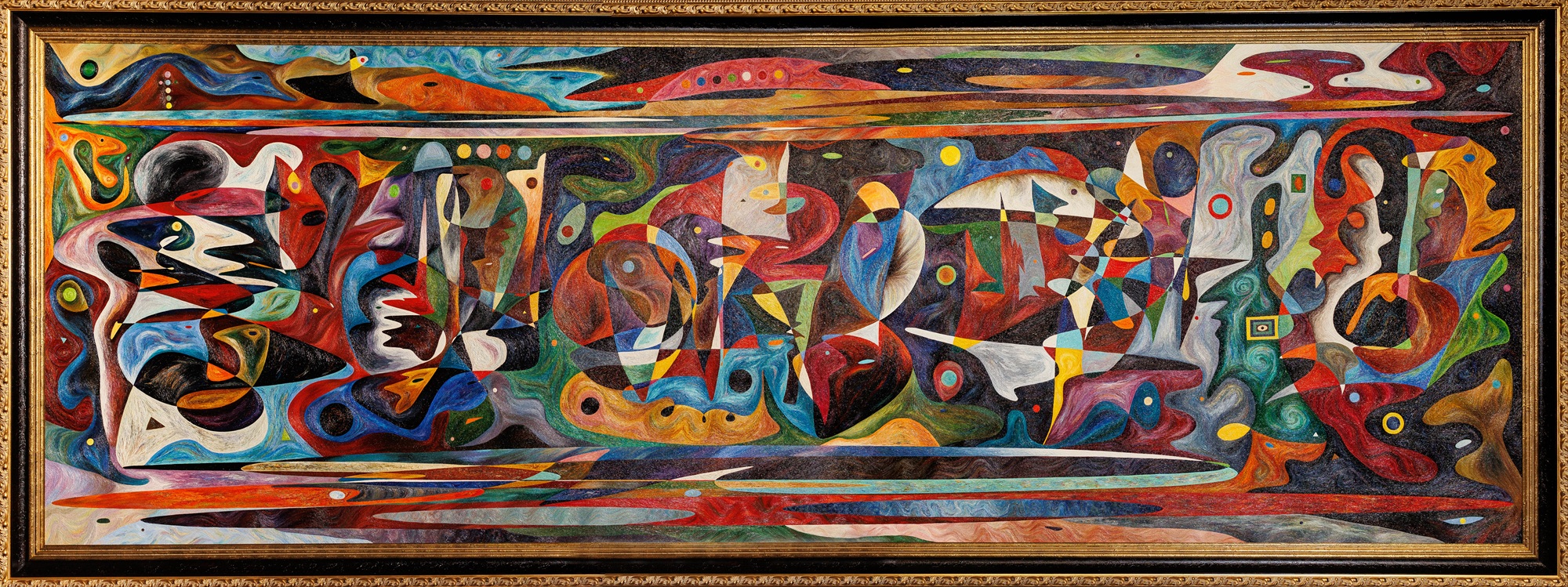
Christianity, 2010 Oil on canvas

Transforming Sacred Themes into a Contemporary Visual Experience

An Artistic Meditation on Christian Faith and Presence

Articulated through a contemporary lens, this monumental oil painting reinterprets Christianity in symbolism with conceptual clarity and visual restraint. Layered forms and spatial nuance converge to create a contemplative field, inviting reflection on faith, redemption, sacrifice, and enduring spiritual presence.

View Work

Concept & Meaning

The work’s commanding scale and immersive spatial construction extend it beyond representation, positioning it as a contemporary meditation on the universal tenets of Christianity — grace, transcendence, suffering, and renewal.

View Work

Artistic Context & Inspirations

Developed over an extended period of research and studio inquiry, the painting reflects a sustained engagement with layered systems of meaning rather than overt sacred narrative. Drawing on historical iconographic conventions while maintaining a distinctly contemporary visual language, the work embeds symbolic encodings that require active interpretation. Meaning is not immediately disclosed but gradually revealed through the viewer’s attentive decoding of visual cues, structural relationships, and material choices. Its scale, material presence, and stratified symbolism establish a deliberate dialogue between inherited forms and present-day perception.

View Work

Scale & Spatial Impact

At 2 meters by 6 meters, the work establishes a formidable spatial presence, transforming its architectural environment into a field of immersive contemplation.

View Work

Materiality & Technique

Executed in oil on linen canvas, the painting balances chromatic depth with subtle surface articulation. Layered glazes and restrained impasto cultivate a tactile presence that rewards sustained and reflective viewing.

View Work

Immersive in Size and Theme

Through layered symbolism and spiritual narrative, the work articulates a contemporary reflection on Christian philosophy. Scale and spatial orchestration transform the act of viewing into a contemplative and immersive encounter.

View Work

Institutional & Collector Context

Equally suited to ecclesiastical, institutional, or distinguished private collections, the painting combines scale, conceptual rigor, and immersive presence, offering enduring visual authority and intellectual depth.

View Work

Closing Statement

Monumental in scale and rich in theological resonance, the painting transforms Christian narratives into a contemporary visual meditation, leaving a profound and lasting spiritual impression.

View Work

Artist Insights

Learn more about the artist’s background, practice, and professional journey.

View Artist Profile

Expert Analysis on Style - Christianity, 2010

This painting appears to belong primarily to abstract art, but it blends several recognizable stylistic influences. Based on the visual elements—color, composition, shapes, and symbolism—here is a deeper breakdown.

View Work

1. Monumental Panoramic Abstraction

The most immediate stylistic characteristic of this painting is its extreme horizontal format, which transforms the canvas into a panoramic visual field. Rather than organizing the composition around a single focal point, the artist constructs a continuous visual narrative that unfolds across the entire width.

This approach resembles a symbolic frieze or cosmological mural, where visual events appear sequentially. The eye travels from left to right encountering evolving clusters of shapes, colors, and symbolic fragments. This panoramic strategy creates the sensation of movement through conceptual space, rather than the observation of a static scene.

View Work

2. Biomorphic and Organic Abstraction

A defining stylistic element is the prevalence of biomorphic forms—organic shapes that resemble living organisms, cells, or fluid natural processes.

Across the composition we see shapes that suggest marine organisms, embryonic or cellular structures, plant-like growths, and flowing anatomical contours.

These forms evoke the surreal organic vocabulary associated with Joan Miró, where abstract shapes behave like living entities rather than geometric constructions. However, the density and complexity of the forms here create a more elaborate visual ecosystem.

View Work

3. Chromatic Complexity and Color Architecture

Color plays a structural and symbolic role in organizing the composition. Instead of being applied uniformly, colors appear in layered and interlocking zones that guide the viewer's perception.

Dominant color families include deep indigo and cosmic blues, earthy reds and burnt sienna, luminous yellows and mineral greens, and pale neutrals and atmospheric whites.

These colors form a chromatic architecture, defining depth, rhythm, and symbolic emphasis. This use of color as an expressive structural force echoes the principles explored by Wassily Kandinsky, where color becomes a carrier of emotional and spiritual resonance.

View Work

4. Integration of Geometric and Organic Systems

While the painting appears fluid and organic, it contains numerous geometric interventions including triangles, circles, concentric rings, and fragmented polygonal structures.

These geometric forms intersect with the organic shapes, creating a dialogue between structure and spontaneity. The tension between geometry and fluidity suggests a balance between natural evolution and cosmic order.

Such symbolic geometry recalls the metaphysical abstraction explored by Hilma af Klint, where geometric motifs represent spiritual structures underlying visible reality.

View Work

5. Fragmented Faces and Archetypal Figures

Embedded throughout the composition are partial human profiles and facial silhouettes. These figures emerge subtly from the surrounding shapes rather than existing as distinct portraits.

The faces appear layered within abstract forms, partially obscured by color fields, and integrated into symbolic structures.

This technique produces an atmosphere of psychological surrealism, where identity becomes fluid and archetypal rather than individual. The faces function as markers of human presence within a broader cosmic environment.

View Work

6. Reflective Horizon Structure

A strong horizontal band runs across the painting, producing the illusion of a reflective surface or horizon line.

This motif resembles mirrored water reflections, atmospheric strata, or cosmic boundaries between realms.

The reflective band creates a structural division between upper and lower visual fields while also reinforcing the theme of duality and mirrored reality. It suggests that what appears above may be echoed or transformed below, introducing the idea of parallel dimensions or symbolic reflection.

View Work

7. Visual Density and Layered Complexity

The painting is characterized by high visual density. Rather than emphasizing empty space, the composition is packed with interlocking forms, overlapping colors, and symbolic fragments.

This density produces several effects: prolonged visual engagement, discovery of hidden shapes over time, and shifting interpretations as the eye moves across the surface.

The work therefore functions as a slow-reading image, designed to reward extended observation.

View Work

8. Rhythmic Movement Across the Canvas

Despite its complexity, the painting maintains a clear sense of visual rhythm. Repeating shapes and color transitions guide the eye through a sequence of visual beats.

The composition moves through alternating patterns of curved contours, circular motifs, color clusters, and diagonal structural elements.

This rhythmic organization gives the painting a musical quality, where visual motifs appear, transform, and reappear across the composition.

View Work

9. Contemporary Metaphysical Abstraction

Stylistically, the work can be understood as part of a broader category of metaphysical or cosmic abstraction. Rather than depicting recognizable objects, it constructs an imaginative visual universe where symbolic structures replace literal representation.

The painting synthesizes several artistic traditions: surrealist biomorphic abstraction, expressive color abstraction, symbolic spiritual geometry, and large-scale contemporary mural composition.

The result is a hybrid style that bridges modernist abstraction and contemporary symbolic painting.

View Work

Final Stylistic Classification

Primary Style
Monumental biomorphic abstraction

Secondary Influences
Surreal organic abstraction
Chromatic spiritual abstraction
Symbolic geometric metaphysics
Contemporary panoramic abstraction

View Work

Expert Summary

This painting represents a large-scale metaphysical abstraction in which organic forms, geometric symbols, and complex chromatic systems interact within a panoramic visual field.

Through its fluid imagery and symbolic density, the work constructs an immersive visual cosmos, inviting the viewer to experience abstraction not merely as form, but as a symbolic language describing the interconnected structures of reality.

View Work

Christianity, 2010 - Expert Analysis of Narrative and Symbolism

Christianity, 2010 contains many symbol-like visual elements, even though it remains abstract. In large abstract compositions like this, artists often build a visual language where shapes suggest ideas rather than literal objects.

This section explores a deeper interpretation of the possible narrative and symbolic meanings within the composition.

View Work

1. Panoramic Narrative Structure

The painting unfolds as a continuous panoramic narrative, using its elongated horizontal format to guide the viewer through a symbolic progression rather than a single visual event. Instead of presenting a centralized focal point, the composition behaves like a visual chronicle, where forms evolve across the canvas.

The imagery appears to transition through conceptual phases:

Left section – Origin and emergence
Central section – Human presence and spiritual encounter
Right section – Transformation and transcendence

This progression suggests a philosophical narrative in which creation, consciousness, and transformation are interconnected stages within a larger cosmic process.

View Work

2. Symbolic Transformation of Forms

One of the most important narrative strategies in the painting is the continuous transformation of shapes. Forms rarely remain stable; instead they morph into other shapes, creating ambiguous imagery that can simultaneously resemble figures, landscapes, or symbolic objects.

This fluidity reflects a narrative about spiritual transformation. Rather than depicting literal scenes, the painting suggests that reality is constantly evolving, and that spiritual meaning emerges through the transformation of forms.

The viewer is therefore invited to participate in constructing the narrative through interpretation.

View Work

3. Emergence of Human Profiles

Throughout the composition, fragmented human profiles appear within the abstract forms. These faces are subtle and partially concealed, merging with surrounding shapes rather than standing apart from them.

Symbolically, these profiles represent the presence of human consciousness within the universe, the relationship between the individual and the divine, and the emergence of identity from cosmic structures.

Because these faces are not fully defined, they function as archetypal presences rather than individual portraits.

View Work

4. Symbolic Geometry and Sacred Signs

Embedded within the organic shapes are numerous geometric motifs such as circles, triangles, concentric rings, and grid-like structures.

These elements function as symbolic markers, introducing moments of order within the fluid environment.

Historically, such shapes often carry metaphysical associations:

Circles suggest unity, eternity, and divine perfection.
Triangles imply transformation, spiritual ascent, or balance.
Concentric rings evoke cycles, resonance, and expansion.

In the painting, these symbols appear integrated into the organic forms, suggesting that spiritual order is embedded within the structure of the universe.

View Work

5. The Reflective Horizon

A strong horizontal band runs across the composition, resembling a reflective surface or cosmic horizon. This structural element visually divides the painting into upper and lower zones.

Symbolically, the reflective band may represent the boundary between visible and invisible worlds, the relationship between earthly reality and spiritual reality, or a mirror of perception.

By introducing this mirrored structure, the artist suggests that the visible world may be a reflection of deeper metaphysical structures.

View Work

6. Cosmic and Biological Imagery

Many shapes within the painting resemble both cosmic phenomena and biological forms. Some areas evoke planetary bodies or celestial spheres, while others resemble cellular structures or embryonic forms.

This dual imagery creates a symbolic bridge between macrocosm and microcosm.

The implication is that similar patterns exist at every scale of existence—from the smallest biological units to the largest cosmic systems.

View Work

7. Chromatic Symbolism

Color serves as an important narrative tool within the composition.

Certain color families carry symbolic associations:

Deep blues and indigos suggest cosmic depth and mystery.
Reds and warm earth tones evoke vitality, sacrifice, and transformation.
Golds and luminous yellows imply illumination or spiritual revelation.
Greens suggest renewal, life, and continuity.

The interaction of these colors produces a dynamic symbolic spectrum that reflects emotional and spiritual states.

View Work

8. Cyclical Patterns and Spiritual Time

Repetition of circular motifs and rhythmic shapes suggests that time within the painting is cyclical rather than linear. Motifs reappear in different variations across the composition, reinforcing the idea of continuous renewal.

This cyclical structure implies that creation, transformation, and renewal occur repeatedly as part of a larger cosmic rhythm.

View Work

9. The Painting as Symbolic Cosmology

When viewed as a whole, the composition functions as a symbolic cosmology expressed through abstraction. Instead of illustrating specific religious scenes or narratives, the painting constructs an environment in which spiritual themes are embedded within visual structures.

Key symbolic themes include emergence of consciousness, transformation of identity, unity between human and cosmic systems, and reflection between visible and invisible realities.

View Work

Concluding Interpretation

From an expert perspective, the painting operates as a metaphysical narrative expressed through abstract symbolism. Its panoramic structure, transforming forms, embedded faces, and geometric motifs create a visual language that reflects philosophical questions about existence and spiritual transformation.

Rather than presenting a literal story, the work constructs a symbolic universe, inviting the viewer to explore the interconnected relationship between human consciousness, cosmic structure, and the continuous evolution of reality.

View Work
𐰘𐰙𐰖𐰢𐰡𐰘𐰟𐰞𐰜𐰛𐰡𐰘𐰚𐰝𐰡𐰖𐰡𐰖𐰝𐰤𐰙𐰖𐰝𐰘𐰘𐰣𐰤𐰡𐰘𐰣𐰘𐰢𐰝𐰘𐰡𐰥𐰞𐰘𐰣𐰤𐰞𐰢𐰖w𐰘𐰝𐰙𐰢𐰟𐰞𐰛𐰤𐰝𐰖𐰟𐰖𐰣𐰚𐰝𐰠𐰛𐰟𐰖𐰣𐰢𐰖𐰡𐰟𐰤𐰖𐰣𐰚𐰖𐰣𐰛𐰟𐰟