None

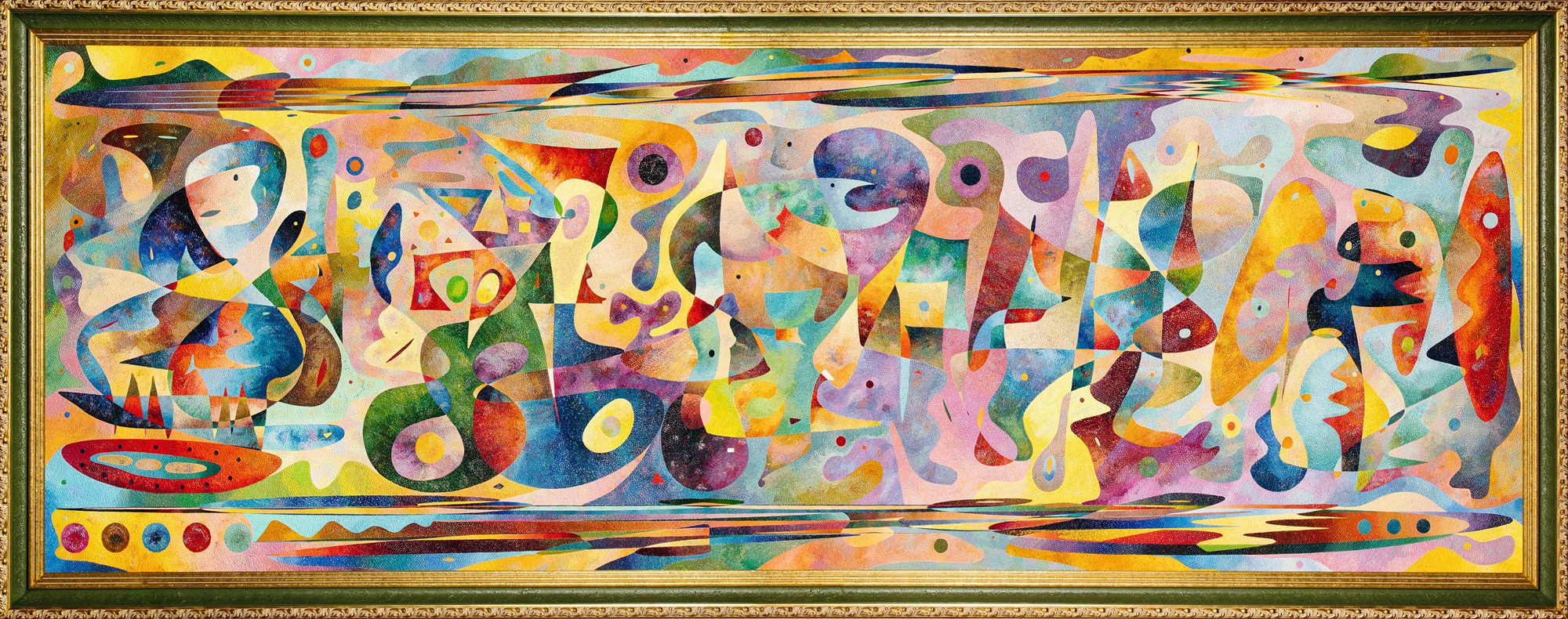
Hinduism, 2017 Oil on canvas

Grand-Scale Oil Painting with Powerful Presence

Grand-Scale Oil Painting with Powerful Presence

This artwork envisions Hinduism as a spatial experience, treating the painting as an immersive environment rather than a conventional pictorial object.

View Work

Concept & Meaning

The work emphasizes presence, inviting viewers to engage with the dimensions of Hindu philosophy and mythology on an almost physical level. Symbolic motifs and narratives, and vibrant colors converge to create an environment where the sacred and the sensory intertwine, transforming the act of viewing into a contemplative journey. Every element—scale, composition, and texture—is designed to evoke the rhythm, and energy inherent in Hindu cosmology, making the painting not just an image, but an enveloping experience of presence.

View Work

Scale & Spatial Impact

The painting’s vast dimensions redefine the viewer’s relationship with the artwork. Its 2m × 6m expanse creates an enveloping field that heightens depth, proportion, and movement within the composition. Rather than remaining a passive image, the work transforms viewing into active engagement, where perception shifts with each act of visual apprehension.

View Work

Artistic Context & Inspirations

Initiated in 2015 and completed in 2017, this painting reflects the artist’s engagement with Hinduism through spiritual and symbolic frameworks, interpreted in Virtosu’s unique style. The work synthesizes traditional iconography with contemporary compositional strategies, drawing on the cultural, social, and artistic currents of the pre-COVID period to explore ritual, mythology, and sacred narrative.

View Work

Materiality & Technique

This monumental painting is executed in oil on cotton canvas, a combination that allows for both richness of color and subtle layering of textures. The oil medium provides depth and luminosity, while the cotton canvas offers a responsive surface that captures every gesture of the artist’s brush. Through careful application of glazes, impasto, and blending, the painting achieves a tactile quality that invites close viewing, revealing intricate details, nuanced tones, and the physicality of each mark. The material choices enhance the work’s immersive presence, reinforcing its spatial and contemplative impact.

View Work

Immersive in Size and Theme

Through its vast scale, the painting presents Hinduism as a complex network of spiritual and symbolic structures. Rather than offering passive contemplation, the work invites the viewer into a strategic dialogue—an intellectual game in which meaning unfolds through attention, analysis, and discovery.

Institutional & Collector Context

This monumental oil painting is designed to resonate in both institutional and private settings. Its scale, thematic depth, and immersive presence make it ideal for museums, galleries, and cultural institutions seeking works that invite contemplation and dialogue. Collectors drawn to spiritual narratives and large-format, experiential art will find in this piece a transformative addition, one that commands space while offering enduring aesthetic and intellectual engagement.

View Work

Closing Statement

This expansive oil work draws viewers into a contemplative encounter with Hinduism’s spiritual and thematic dimensions, expressed through Virtosu’s singular abstract vision.

View Work

Artist Insights

Learn more about the artist’s background, practice, and professional journey.

View Artist Profile

Expert Analysis on Style - Hinduism, 2017

This is clearly a monumental abstract work, but it has distinct traits that place it in a nuanced lineage of 20th- and 21st-century abstraction.

View Work

Abstract Expressionism with Biomorphic Forms

The painting uses fluid, organic shapes that suggest living forms such as eyes, masks, creatures, and plant-like or aquatic elements.

These shapes do not depict real objects, but they evoke the psychological or spiritual presence of life. This approach aligns with biomorphic abstraction, popularized by artists such as Joan Miró and Jean Arp.

Key traits:

  • Smooth, rounded contours
  • Interlocking and overlapping forms
  • Shapes that suggest motion and transformation
View Work

Surrealist Influence

The work exhibits dreamlike, subconscious imagery with unexpected juxtapositions of forms.

Some shapes hint at faces, eyes, and fantastical creatures, reminiscent of Surrealist artists such as Max Ernst and Salvador Dalí, yet expressed through a purely abstract visual language.

The painting evokes a mental or psychological landscape rather than a literal physical one.

View Work

Chromatic Abstraction and Color Field Techniques

The palette is vivid, highly saturated, and evenly balanced across the surface.

Warm and cool colors are interwoven to create energy, depth, and a sense of expansive space.

  • Strong contrasts between warm and cool tones
  • Gradual color transitions
  • Color used as both structural and emotional language

While not strictly a Color Field painting, the chromatic approach recalls the expressive color structures developed by Wassily Kandinsky and later abstract painters of the twentieth century.

View Work

Panoramic Composition

The painting’s horizontal expanse emphasizes movement across the canvas, functioning almost like a visual narrative.

  • No single focal point
  • Rhythmic visual movement from left to right
  • Repetition of motifs such as circles, triangles, and biomorphic forms

This flowing structure creates the sensation of continuous transformation or cosmic motion.

View Work

Geometric and Organic Hybridization

The painting merges curved organic forms with geometric elements such as triangles, circles, and lines.

This contrast creates:

  • Tension between natural forms and abstract structure
  • Multiple spatial layers
  • Floating forms that seem to exist on several planes

This hybrid language recalls the later abstract compositions of Kandinsky.

View Work

Symbolic and Spiritual Undertones

The motifs suggest themes of life, consciousness, transformation, and interconnection.

  • Eyes and circles suggesting awareness or cosmic vision
  • Spirals and crescents implying cycles and movement
  • Organic forms evoking biological growth

Such symbolic language appears in the work of spiritually oriented abstract artists such as Hilma af Klint and Emil Bisttram.

View Work

Technical and Stylistic Observations

The painting is executed using oils on linen, suggested by the smooth transitions and luminous color layers.

  • Layered translucent washes creating depth
  • Balanced composition despite apparent spontaneity
  • Careful structural planning beneath expressive gestures

This combination of spontaneity and structure is characteristic of sophisticated abstract practice.

View Work

Overall Stylistic Classification

Primary style: Monumental biomorphic abstraction

Secondary influences: Surrealism, abstract expressionism, and chromatic abstraction

Key characteristics:

  • Organic, living shapes
  • Symbolic motifs such as eyes, masks, and spirals
  • Dynamic yet harmonious color palette
  • Panoramic rhythm and visual flow
  • Cosmic, spiritual, or ecological undertones

In summary: This painting can be understood as a monumental, spiritually infused biomorphic abstraction. It combines the rhythmic color language of Kandinsky, the surreal organic forms of Miró, and the expansive compositional vision of contemporary abstract muralism. Rather than serving as mere decoration, it functions as an immersive symbolic environment.

View Work

Hinduism, 2017 - Expert Analysis of Narrative and Symbolism

Hinduism, 2017 contains many symbol-like visual elements, even though it remains abstract. In large abstract compositions like this, artists often build a visual language where shapes suggest ideas rather than literal objects.

This section explores a deeper interpretation of the possible narrative and symbolic meanings within the composition.

View Work

Overall Narrative Structure — The Cosmic Continuum

The composition reads like a horizontal cosmology rather than a conventional scene.

Key narrative idea: A visual metaphor for the flow of existence—from primordial chaos through manifestation, consciousness, and dissolution.

Three conceptual zones appear:

  • Left Section – Emergence / Creation
  • Central Section – Consciousness and Multiplicity
  • Right Section – Transformation / Dissolution

This structure parallels Hindu cosmological cycles such as Samsara and Trimurti.

View Work

Fluid Forms — Maya (Illusion and Perception)

The painting avoids rigid outlines; shapes morph into one another.

Symbolically this reflects:

  • Maya — the world as a shifting perception rather than fixed reality.
  • The idea that form and identity are temporary.

You can see faces, creatures, landscapes, and symbols appearing and dissolving simultaneously.

This ambiguity is deliberate: the viewer becomes part of interpreting reality.

View Work

Multiplicity of Faces — Consciousness Within All Things

Throughout the composition are fragmented facial profiles and eyes.

Possible meanings:

  • Universal consciousness
  • The presence of awareness in all forms
  • The observer within the observed

This connects conceptually to Atman and Brahman.

In Hindu metaphysics, Atman = Brahman. The repeated faces visually hint that all beings share the same underlying consciousness.

View Work

The Waterline Motif — Reflection Between Worlds

The horizontal reflective band across the painting resembles a cosmic waterline.

Symbolic possibilities:

  • Boundary between material and spiritual realms
  • Mirror of reality (illusion vs truth)
  • The cosmic ocean described in Hindu cosmology

It echoes mythological imagery such as Kshira Sagara, the primordial ocean from which creation emerges.

View Work

Color Symbolism

The intense color palette is not random.

Blue represents:

  • Infinity
  • Cosmic depth
  • Divine presence

Blue is strongly associated with deities such as Vishnu and Krishna.

Gold / Yellow symbolizes:

  • Enlightenment
  • Sacred knowledge
  • Divinity

Red is often tied to:

  • Life force
  • Transformation
  • Cosmic energy (similar to Shakti)

Together the colors produce a spiritual spectrum of existence.

View Work

Organic–Mechanical Hybrid Shapes

Some forms resemble:

  • Cells
  • Planetary bodies
  • Ritual objects
  • Mythic creatures

This blending suggests unity between science, nature, and spirituality.

Narrative implication: the universe is a living organism.

View Work

The Circular Motifs — Cycles of Time

Repeated circular elements likely symbolize cosmic cycles.

These may reference Kala and the endless cycle of creation–preservation–destruction.

The painting visually reinforces the idea that time is circular rather than linear.

View Work

Symbolic Reading of the Composition

A simplified philosophical reading:

  • Left: Chaos and primordial creation
  • Center: Consciousness and multiplicity of life
  • Right: Transformation and return to cosmic unity

Thus the painting can be interpreted as a visual journey of existence itself.

View Work

Stylistic Influences

The work appears to combine several traditions:

  • Surrealism (dreamlike morphing imagery)
  • Abstract Expressionism (color fields and emotion)
  • Symbolic cosmological diagrams found in Hindu mandala traditions

But instead of a circular mandala, Virtosu expands the concept into a panoramic mandala.

View Work

Core Interpretation

The painting likely represents the unfolding of the universe and consciousness, expressing key Hindu philosophical ideas:

  • Unity of existence
  • Illusion of separateness
  • Cyclical time
  • Divine presence within all forms

In essence: it reads as a visual meditation on the structure of reality.

View Work
𐰘𐰙𐰖𐰢𐰡𐰘𐰟𐰞𐰜𐰛𐰡𐰘𐰚𐰝𐰡𐰖𐰡𐰖𐰝𐰤𐰙𐰖𐰝𐰘𐰘𐰣𐰤𐰡𐰘𐰣𐰘𐰢𐰝𐰘𐰡𐰥𐰞𐰘𐰣𐰤𐰞𐰢𐰖w𐰘𐰝𐰙𐰢𐰟𐰞𐰛𐰤𐰝𐰖𐰟𐰖𐰣𐰚𐰝𐰠𐰛𐰟𐰖𐰣𐰢𐰖𐰡𐰟𐰤𐰖𐰣𐰚𐰖𐰣𐰛𐰟𐰟