
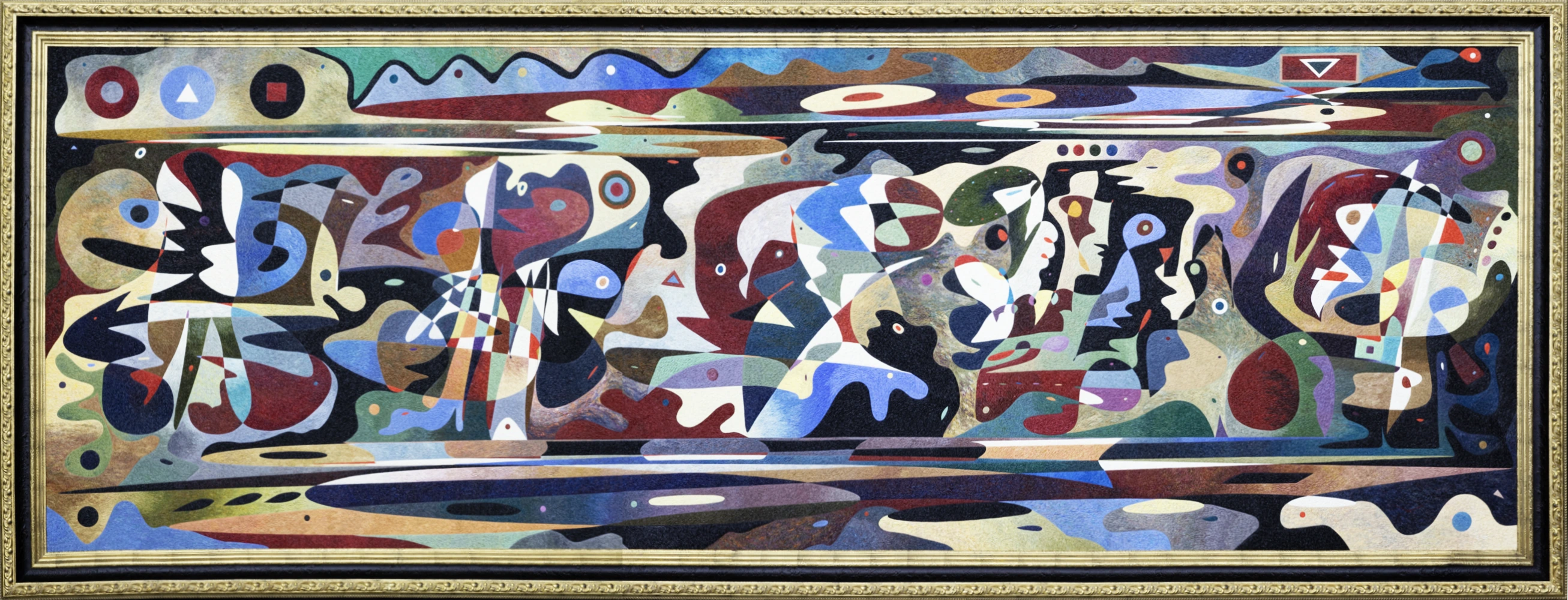
Islam, 2019 Oil on canvas
Transforming Sacred Themes into an Engaging Visual Experience
An Artistic Meditation on Islam Wisdom and Presence
Articulated through a contemporary lens, this beautiful work reinterprets Islamic dimensions with conceptual clarity and visual fluidity. In Virtosu’s distinctive abstract language, layered forms and spatial nuance converge to create a contemplative field that invites curiosity and reflection on faith, philosophy, and enduring spiritual presence.
View WorkConcept & Meaning
The work’s commanding scale and immersive spatial construction extend it beyond mere representation, positioning it as a contemporary meditation on the universal tenets of Islamic wisdom.
View WorkArtistic Context & Inspirations
Initiated in 2016 and completed in 2019, this painting reflects a sustained period of engagement with cultural, spiritual, and philosophical dialogues within the Islamic tradition. Drawing on the artist’s exposure to contemporary Islamic art, sacred narratives, and symbolic motifs, the work translates these influences into a measured visual language, balancing conceptual rigor with refined compositional presence. Its scale, materiality, and layered symbolism articulate a deliberate negotiation between tradition and contemporary expression, situating the painting within both institutional and private collection contexts.
View WorkScale & Spatial Impact
At 2 meters by 6 meters, the work establishes a formidable spatial presence, transforming its architectural context into a field of immersive engagement.
View WorkMateriality & Technique
Oil on linen canvas, the painting balances chromatic richness with subtle surface articulation. Glazes and restrained impasto cultivate a tactile presence that rewards sustained viewing.
View WorkImmersive in Size and Theme
Layered symbolism and spiritual narrative create a unique reflection on Islamic philosophy. Through spatial orchestration and compositional depth, the work transforms viewing into a contemplative, immersive exchange, standing among the most accomplished explorations of this theme.
View WorkInstitutional & Collector Context
Equally suited to institutional settings and distinguished private collections, the work combines scale, conceptual rigor, and immersive presence, offering lasting visual authority and intellectual substance.
View WorkClosing Statement
Monumental in presence and rich in symbolic depth, the painting transforms Islamic narratives into an intimate visual meditation—an intellectual reflection whose subtle power invites viewers to return time and again.
View WorkArtist Insights
Learn more about the artist’s background, practice, and professional journey.
View Artist ProfileExpert Analysis on Style - Islam, 2019
This painting appears to belong primarily to abstract art, but it blends several recognizable stylistic influences. Based on the visual elements—color, composition, shapes, and symbolism—here is a deeper breakdown.
View Work1. Monumental Panoramic Abstraction
The first defining stylistic feature is the horizontal panoramic composition. Unlike traditional abstract paintings that focus on a central focal point, this work unfolds like a continuous visual narrative across the canvas.
The composition functions almost like a cosmic frieze or expanded mural, where forms evolve gradually from left to right. This panoramic rhythm suggests a process rather than a moment, aligning the work more with cosmological storytelling than with static abstraction.
The spatial logic resembles a visual landscape of consciousness, where imagery emerges, mutates, and dissolves.
View Work2. Biomorphic Abstraction
One of the most dominant stylistic traits is biomorphic abstraction—organic shapes that resemble living organisms.
These forms evoke cellular structures, marine organisms, embryonic life forms, and mythological creatures.
This approach places the painting within the lineage of artists such as Joan Miró, whose surreal organic forms blurred the boundary between biological and symbolic imagery.
However, the forms here are denser and more structurally layered, suggesting a system rather than spontaneous surreal automatism.
View Work3. Chromatic Architecture
Color in the painting functions structurally rather than decoratively.
Large zones of deep blues, crimson reds, muted golds, and pale mineral tones create a chromatic architecture that organizes the visual space.
This approach recalls the color philosophy of Wassily Kandinsky, where color carries emotional and metaphysical meaning rather than descriptive function.
Here, color acts as emotional atmosphere, spatial divider, and symbolic language. The palette suggests cosmic depth and psychological space simultaneously.
View Work4. Symbolic Geometry Embedded in Organic Forms
While the composition appears fluid, geometric symbols repeatedly appear throughout the painting.
Circles, triangles, concentric rings, and segmented discs introduce visual punctuation within the organic flow.
This duality between organic and geometric forms creates a tension between nature and order, intuition and structure.
The symbolic geometry echoes spiritual abstraction traditions associated with artists like Hilma af Klint, where geometric signs represent metaphysical principles.
View Work5. Fragmented Faces and Psychological Surrealism
Throughout the composition, partially hidden faces and profiles emerge from the forms.
These are not portraits but archetypal fragments.
Their presence introduces a psychological dimension: the relationship between observer and observed, consciousness embedded within matter, and the multiplicity of identity.
This technique connects the work to surrealist psychological landscapes, but the faces here are structurally integrated into the composition rather than floating independently.
View Work6. Reflective Horizon Motif
A striking structural feature is the horizontal reflective band near the top and bottom sections of the composition.
It resembles water reflections, atmospheric mirroring, or cosmic horizon lines.
This device creates a sense of dual worlds, as if the painting depicts both reality and its reflection simultaneously.
Such mirroring reinforces the philosophical theme of perception versus reality.
View Work7. Density and Layering
Unlike minimal abstraction, this painting employs high visual density.
Multiple layers of forms overlap, including silhouettes, translucent shapes, patterned fragments, and symbolic markers.
This layered complexity creates slow-looking art—a painting designed to be explored gradually.
Each viewing reveals additional structures and visual associations.
View Work8. Rhythmic Composition
Despite the complexity, the painting maintains strong rhythmic control.
The eye moves through repeating visual beats such as circular motifs, curved contours, and alternating color masses.
This produces a visual cadence similar to music.
The entire composition behaves like a symphonic movement, where motifs appear, transform, and reappear.
View Work9. Contemporary Abstract Cosmology
Stylistically, the work can be placed within a category that might be called cosmic abstraction or metaphysical abstraction.
Rather than focusing on pure form, the painting suggests universal structures, evolutionary processes, and interconnected consciousness.
This positions it between modernist abstraction and contemporary symbolic painting.
View WorkFinal Stylistic Classification
Primary Style
Monumental biomorphic abstraction
Secondary Influences
Surrealist organic imagery
Kandinskian chromatic abstraction
Symbolic spiritual geometry
Contemporary cosmic abstraction
Expert Summary
The painting represents a large-scale metaphysical abstraction where organic forms, symbolic geometry, and chromatic architecture combine to create a panoramic vision of consciousness and cosmic evolution.
Rather than depicting a scene, the work constructs an immersive symbolic universe, inviting the viewer to experience reality as a fluid continuum of form, energy, and perception.
View WorkIslam, 2019 - Expert Analysis of Narrative and Symbolism
Islam, 2019 contains many symbol-like visual elements, even though it remains abstract. In large abstract compositions like this, artists often build a visual language where shapes suggest ideas rather than literal objects.
This section explores a deeper interpretation of the possible narrative and symbolic meanings within the composition.
View Work1. Cosmological Narrative Structure
The painting appears to operate as a horizontal cosmological narrative rather than a single moment captured in time. The long panoramic format encourages the viewer’s eye to travel gradually across the composition, creating the sense of a temporal unfolding.
The imagery suggests a symbolic progression that can be interpreted as three conceptual stages:
Left zone — Emergence and primal formation
Central zone — Multiplicity and consciousness
Right zone — Transformation and dissolution
This narrative structure evokes philosophical ideas associated with cyclical cosmology, where creation, existence, and transformation occur continuously rather than linearly.
View Work2. Symbolic Fluidity and the Concept of Illusion
A striking narrative element is the constant transformation of forms. Shapes merge into one another without rigid boundaries: figures dissolve into landscapes, and abstract forms hint at recognizable imagery.
This fluidity suggests a philosophical reflection on the instability of perception.
Rather than presenting fixed symbols, the painting encourages the viewer to experience shifting identities, evolving forms, and multiple interpretations.
The result is a visual metaphor for the idea that reality is perceived rather than absolute.
View Work3. Faces as Symbols of Consciousness
Throughout the composition, fragmented faces and eyes emerge from the abstract forms.
These faces are not clearly individualized portraits. Instead, they appear as archetypal presences, embedded within the environment itself.
Symbolically, they may represent consciousness within the universe, the observer within the observed, and awareness emerging from matter.
Because the faces appear repeatedly and merge with other shapes, they suggest that consciousness is distributed rather than isolated.
View Work4. The Reflective Horizon
One of the most structurally important motifs is the horizontal reflective band running across the composition. This element resembles a reflective waterline or mirrored horizon.
Narratively, it may symbolize a boundary between two realms: the visible world and a deeper, hidden dimension.
The reflective motif introduces the idea that what we perceive may be a surface reflection of deeper structures.
It also reinforces the painting’s overall theme of duality and mirrored reality.
View Work5. Organic Forms and Universal Life
Many shapes resemble biological structures—cells, embryos, and marine organisms—while others suggest mythic or symbolic entities.
This blending of imagery implies that the universe is being portrayed as a living organism.
Symbolically, this suggests interconnected life, evolution and transformation, and continuity between microcosm and macrocosm.
The visual language blurs the boundary between cosmic scale and biological scale, reinforcing the idea that similar patterns exist throughout nature.
View Work6. Geometric Symbols as Archetypal Signs
Embedded within the organic forms are geometric motifs such as circles, triangles, segmented discs, and concentric rings.
These shapes function like symbolic markers within the visual flow.
Historically, geometric symbols have been associated with universal principles:
Circles often symbolize unity or infinity.
Triangles can represent transformation or dynamic balance.
Concentric rings may evoke cycles, vibration, or expansion.
In the painting, these geometric elements create moments of order within the fluid environment.
View Work7. Chromatic Symbolism
Color plays an essential narrative role.
The palette contains strong contrasts between cool and warm tones.
Deep blues suggest depth, infinity, and the cosmic unknown.
Reds and crimsons introduce vitality, energy, and transformation.
Golds and pale yellows evoke illumination and spiritual insight.
Together these colors produce a symbolic spectrum of existence, moving between mystery, life force, and enlightenment.
View Work8. Cyclical Time and Repetition
Repetition of circular shapes and recurring motifs reinforces the idea that time within the painting is cyclical rather than linear.
Patterns reappear in altered forms across the canvas, suggesting recurrence, transformation, and renewal.
This cyclical structure implies that creation and dissolution are part of a continuous cosmic rhythm.
View Work9. The Painting as a Symbolic Universe
Taken as a whole, the composition can be interpreted as a visual metaphor for the structure of reality itself.
Rather than illustrating a specific myth or narrative event, the painting constructs an environment in which consciousness appears embedded in matter, forms evolve continuously, and order and chaos coexist.
The viewer becomes part of this interpretive process, discovering meanings within the shifting imagery.
View WorkConcluding Interpretation
From an expert perspective, the painting functions as a symbolic cosmology expressed through abstract visual language.
Its narrative suggests the emergence of form from primordial chaos, the development of consciousness within the universe, and continual transformation and renewal.
Through fluid shapes, embedded faces, geometric archetypes, and chromatic symbolism, the work constructs a meditative reflection on existence itself, presenting reality not as fixed structure but as an ever-changing continuum of energy, perception, and form.
View Work𐰘𐰙𐰖𐰢𐰡𐰘𐰟𐰞𐰜𐰛𐰡𐰘𐰚𐰝𐰡𐰖𐰡𐰖𐰝𐰤𐰙𐰖𐰝𐰘𐰘𐰣𐰤𐰡𐰘𐰣𐰘𐰢𐰝𐰘𐰡𐰥𐰞𐰘𐰣𐰤𐰞𐰢𐰖w𐰘𐰝𐰙𐰢𐰟𐰞𐰛𐰤𐰝𐰖𐰟𐰖𐰣𐰚𐰝𐰠𐰛𐰟𐰖𐰣𐰢𐰖𐰡𐰟𐰤𐰖𐰣𐰚𐰖𐰣𐰛𐰟𐰟