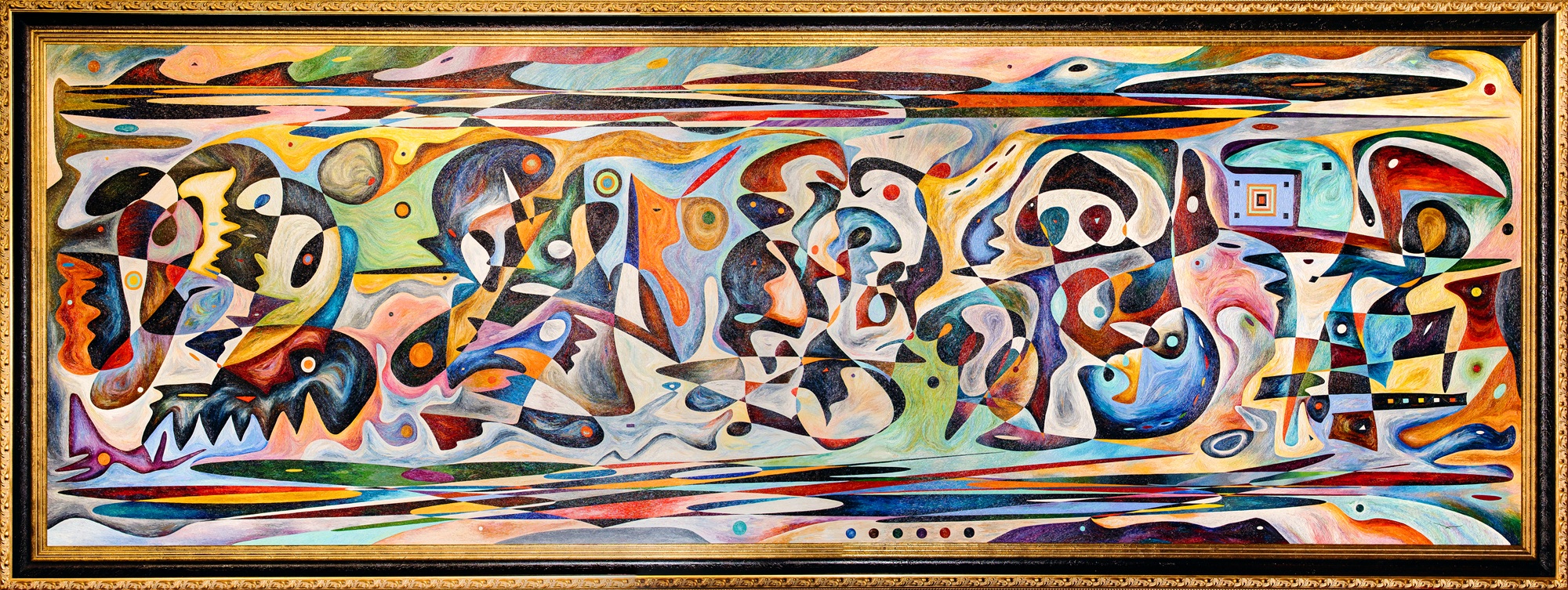
Judaism, 2024 Oil on canvas
Transforming Sacred Themes into a Contemporary Visual Experience
An Artistic Meditation on Judaism: Faith and Presence
Through a contemporary lens, this expansive oil painting reimagines Judaism in Virtosu’s unique abstract language, blending symbolism with subtle conceptual precision.
Interwoven layers and considered spatial composition create a meditative field that evokes reflection on devotion, transcendence, sacrifice, and the enduring presence of the spiritual path.
View WorkConcept & Meaning
Through its expansive form and immersive spatial layers, the painting transforms into a contemporary contemplation of Judaism, evoking grace, endurance, spiritual struggle, and renewal.
View WorkArtistic Context & Inspirations
Born from extensive research and studio exploration, this painting embodies a sustained, exclusive inquiry into layered systems of meaning, moving beyond an explicit sacred narrative.
While referencing historical iconographic traditions, it asserts a distinctly contemporary visual language, embedding subtle symbolic cues that reward careful interpretation. Its significance unfolds gradually, revealed through attentive engagement with visual motifs, structural interplay, and material textures.
The work’s expansive presence, intricate symbolism, and deliberate compositional strategy establish a rare dialogue between inherited cultural forms and contemporary perception.
View WorkScale & Spatial Impact
At 2 meters by 6 meters, the work establishes a formidable spatial presence, transforming its architectural environment into a field of immersive contemplation.
View WorkMateriality & Technique
Executed in oil on linen canvas, the painting balances chromatic depth with subtle surface articulation. Layered glazes and restrained impasto cultivate a tactile presence that rewards sustained and reflective viewing.
View WorkImmersive in Size and Theme
By weaving layered symbolism with spiritual themes, the painting offers a contemporary meditation on Judaism philosophy, where its commanding scale and carefully orchestrated space turn the act of viewing into an immersive and contemplative experience.
View WorkInstitutional & Collector Context
Equally suited to ecclesiastical, institutional, or distinguished private collections, the painting combines scale, conceptual rigor, and immersive presence, offering enduring visual authority and intellectual depth.
View WorkClosing Statement
Inspired by decades of studying Jewish rituals, texts, and iconography, the artist layered oil and color to create a visual map of faith and tradition.
Each form reflects a deliberate choice—drawing from historical symbolism while introducing contemporary gestures—and invites viewers to trace the dialogue between past and present.
The painting stands as a testament to the artist’s investigative process, revealing itself more fully with each careful viewing.
View WorkArtist Insights
Learn more about the artist’s background, practice, and professional journey.
View Artist ProfileExpert Analysis on Style - Judaism, 2024
This painting appears to belong primarily to abstract art, but it blends several recognizable stylistic influences. Based on the visual elements—color, composition, shapes, and symbolism—here is a deeper breakdown.
View Work1. Panoramic Structural Composition
The painting is constructed as an expansive panoramic composition stretching across a 2-meter by 6-meter horizontal field. This elongated format establishes a continuous visual environment rather than a single focal scene.
Instead of concentrating attention in one location, the artist distributes visual weight across multiple compositional centers. The viewer’s gaze travels laterally through a network of interlocking shapes, creating a dynamic visual rhythm that unfolds gradually across the surface.
This panoramic strategy transforms the work into an immersive abstract landscape where structure and movement become the primary stylistic drivers.
View Work2. Biomorphic and Organic Form Language
A dominant stylistic feature of the composition is the presence of biomorphic shapes—fluid, organic forms that evoke living organisms without directly depicting them.
Curving silhouettes suggest biological growth, cellular structures, and natural evolution. These forms appear to morph into one another, generating a sense of continuous transformation across the canvas.
The organic vocabulary softens the structural geometry of the painting and introduces a sense of vitality and motion.
View Work3. Geometric Interventions
Interwoven with the organic shapes are sharply defined geometric structures including triangles, segmented circles, angular planes, and rectilinear blocks.
These geometric elements create structural anchors within the fluid composition. Their clarity contrasts with the surrounding organic movement, establishing a visual dialogue between order and spontaneity.
The interaction between geometry and biomorphism forms a central stylistic tension that drives the painting’s complexity.
View Work4. Layered Spatial Construction
Rather than employing classical perspective, the painting builds spatial depth through overlapping planes and interlocking forms.
Shapes appear to slide above and beneath each other, producing a shifting spatial hierarchy where foreground and background continually exchange roles.
This layered construction creates an optical complexity that invites prolonged visual exploration.
View Work5. Chromatic System and Color Architecture
Color in the composition functions as an architectural element rather than purely decorative ornamentation.
The palette combines deep blues, muted greens, warm earth tones, soft creams, and accents of red and yellow. These colors are organized into carefully defined zones that reinforce the segmented structure of the composition.
Subtle tonal transitions and textured pigment layers create depth while maintaining the planar integrity of the abstract surface.
View Work6. Rhythmic Linear Networks
The painting is unified by an intricate network of flowing contour lines that weave through the composition.
These lines guide the viewer’s eye from one visual cluster to another, creating pathways that connect distant areas of the canvas.
The result is a visual rhythm resembling abstract calligraphy, where line becomes a structural force shaping the entire composition.
View Work7. Surface Texture and Material Depth
The surface treatment reveals a carefully layered painting technique that produces subtle variations in texture and pigment density.
Grain-like textures and softly blended tonal fields evoke mineral surfaces and atmospheric depth. These tactile qualities prevent the large composition from appearing mechanically flat.
The result is a surface that feels both visually complex and materially rich.
View Work8. Stylistic Synthesis
The painting ultimately synthesizes several key strategies of modern and contemporary abstraction: biomorphic form, geometric structuring, chromatic architecture, and panoramic spatial rhythm.
Through the integration of these elements, the artist constructs a complex visual ecosystem in which form, color, and movement operate as interconnected components of a unified stylistic system.
This synthesis situates the work within a broader lineage of spiritual and philosophical abstraction while maintaining a distinctive panoramic visual language.
View WorkSummary
Stylistically, “Judaism” represents a sophisticated example of contemporary panoramic abstraction. Through the integration of organic forms, geometric structures, layered spatial planes, and a carefully orchestrated chromatic system, the painting establishes an immersive visual environment defined by rhythm, balance, and structural complexity.
View WorkJudaism, 2024 - Expert Analysis of Narrative and Symbolism
Judaism, 2024 contains many symbol-like visual elements, even though it remains abstract. In large abstract compositions like this, artists often build a visual language where shapes suggest ideas rather than literal objects.
This section explores a deeper interpretation of the possible narrative and symbolic meanings within the composition.
View Work1. Cosmological Narrative Structure
The narrative structure of the composition unfolds across the panoramic horizontal field, creating a symbolic journey through layers of spiritual and historical consciousness. Rather than depicting a literal scene, the painting constructs a continuous visual environment where forms evolve and interact across the surface.
This expansive structure encourages the viewer to read the composition as a metaphysical landscape in which time, memory, and spiritual tradition are interwoven into a unified visual field.
View Work2. Symbolic Language of Abstraction
Instead of illustrating historical events or identifiable religious figures, the painting communicates through symbolic abstraction. Organic forms, geometric fragments, and layered color planes operate as metaphoric elements that evoke spiritual ideas and cultural continuity.
This abstract language allows the composition to express philosophical themes without relying on literal representation, creating a visual vocabulary that remains open to interpretation.
View Work3. Interwoven Realms of Experience
The overlapping forms and interlocking shapes suggest a layered reality in which multiple dimensions of experience coexist simultaneously. Visual passages between shapes create the impression of movement between symbolic realms.
This structural complexity can be interpreted as a reflection of the relationship between the material world and the spiritual domain, where visible and invisible forces interact within a shared cosmic order.
View Work4. Movement as Historical and Spiritual Continuity
Flowing lines and directional contours generate a sense of continuous motion throughout the composition. The viewer’s gaze moves from one visual cluster to another, tracing pathways that connect distant areas of the painting.
This dynamic movement can be interpreted as a metaphor for historical continuity and cultural endurance, suggesting an ongoing journey shaped by memory, transformation, and resilience.
View Work5. Balance Between Chaos and Order
The composition balances contrasting visual forces—organic forms against geometric structures, dense clusters against open areas, warm tones against cooler hues.
This equilibrium reflects the philosophical tension between complexity and harmony, where diverse elements are brought into a dynamic but coherent relationship.
View Work6. Symbolic Landscape of Cultural Memory
The painting may also be interpreted as a symbolic landscape representing collective memory and cultural identity. Abstract forms resemble fragments of signs, pathways, and architectural traces that emerge and dissolve across the canvas.
This visual environment evokes the idea of tradition unfolding across generations, where past and present coexist within an evolving continuum.
View Work7. Narrative Without Literal Figures
One of the most distinctive narrative strategies of the painting is the absence of literal characters. Instead of representing identifiable figures or events, the composition constructs meaning through relationships between shapes, colors, and spatial movement.
This approach transforms the artwork into a symbolic environment where narrative emerges through visual interaction rather than traditional storytelling.
View WorkSummary
The narrative dimension of “Judaism, 2024” unfolds through symbolic relationships rather than literal depiction. Through flowing structures, layered forms, and carefully balanced visual forces, the painting constructs a contemplative environment that reflects ideas of continuity, spiritual depth, and the enduring dialogue between history and transcendence.
View Work𐰘𐰙𐰖𐰢𐰡𐰘𐰟𐰞𐰜𐰛𐰡𐰘𐰚𐰝𐰡𐰖𐰡𐰖𐰝𐰤𐰙𐰖𐰝𐰘𐰘𐰣𐰤𐰡𐰘𐰣𐰘𐰢𐰝𐰘𐰡𐰥𐰞𐰘𐰣𐰤𐰞𐰢𐰖w𐰘𐰝𐰙𐰢𐰟𐰞𐰛𐰤𐰝𐰖𐰟𐰖𐰣𐰚𐰝𐰠𐰛𐰟𐰖𐰣𐰢𐰖𐰡𐰟𐰤𐰖𐰣𐰚𐰖𐰣𐰛𐰟𐰟