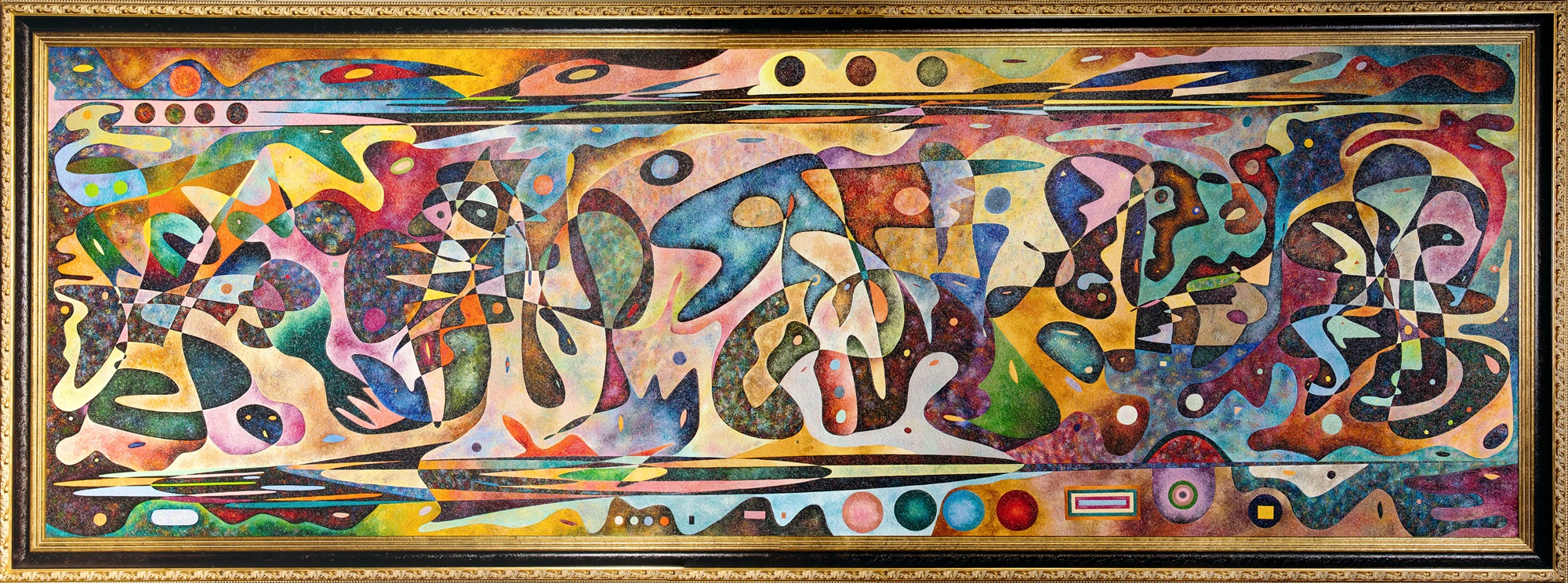
Satanism, 2025 Oil on canvas
Translating archetypal and transgressive motifs into a modern visual meditation
An Artistic Meditation on Satanism: Faith and Presence
Seen through a contemporary lens, this monumental oil painting explores Satanism as a religious and philosophical framework. Influenced by post-COVID political shifts, global conflicts, and the rise of cult movements, Virtosu channels these forces into layered symbolism and deliberate spatial orchestration, creating a contemplative field that invites reflection on autonomy, transcendence, duality, and the enduring assertion of spiritual identity.
View WorkConcept & Meaning
Through its expansive form and immersive spatial construction, the painting unfolds as a contemporary meditation on Satanism, evoking themes of autonomy, defiance, spiritual self-determination, and transformative renewal.
View WorkArtistic Context & Inspirations
Rooted in sustained research and studio inquiry, this abstract painting engages layered systems of meaning rather than presenting an explicit sacred narrative. While drawing from historical iconographic traditions, it asserts a distinctly contemporary visual language, embedding symbols that reflect the perils and moral dilemmas of humanity in the technological era. Its significance emerges gradually through attentive engagement with visual motifs, structural dynamics, and material presence. Monumental in scale and dense with stratified symbolism, the work establishes a considered dialogue between inherited cultural forms, contemporary perception, and the ethical challenges of a hyper-connected world.
View WorkScale & Spatial Impact
At 2 meters by 6 meters, the work establishes a formidable spatial presence, transforming its architectural environment into a field of immersive contemplation.
View WorkMateriality & Technique
Executed in oil on linen canvas, the painting balances chromatic depth with subtle surface articulation. Layered glazes and restrained impasto cultivate a tactile presence that rewards sustained and reflective viewing.
View WorkImmersive in Scale and Theme
Through layered symbolism and spiritual inquiry, the painting presents a contemporary meditation on Satanism as a religious philosophy. Its commanding presence and deliberate spatial composition transform viewing into a deeply immersive and contemplative encounter.
As the final work in Virtosu’s "10 Religions" Collection, it stands as a stark testament to the apocalyptic challenges and existential dangers that may confront humanity in the near future.
View WorkInstitutional & Collector Context
Equally suited to ecclesiastical, institutional, or distinguished private collections, the painting combines scale, conceptual rigor, and immersive presence, offering enduring visual authority and intellectual depth.
View WorkClosing Statement
With its commanding scale and deep spiritual resonance, the painting reinterprets Satanism’s narratives into a modern visual meditation, evoking a lasting sense of reflection and transcendence.
View WorkArtist Insights
Learn more about the artist’s background, practice, and professional journey.
View Artist ProfileExpert Analysis on Style - Satanism, 2025
This painting appears to belong primarily to abstract art, but it blends several recognizable stylistic influences. Based on the visual elements—color, composition, shapes, and symbolism—here is a deeper breakdown.
View Work1. Panoramic Symbolic Abstraction
The painting adopts a panoramic horizontal composition that unfolds as a continuous symbolic environment. Instead of discrete scenes or figurative storytelling, the canvas becomes a flowing abstract terrain in which shapes, colors, and forms interconnect across the entire visual field.
This panoramic approach transforms the artwork into a visual narrative of movement and transformation, allowing the viewer’s eye to travel through a complex network of forms that appear to emerge, collide, and dissolve across the canvas.
View Work2. Biomorphic Surrealism
The composition is dominated by biomorphic shapes that resemble living organisms, spectral figures, animal silhouettes, and fluid anatomical fragments. These organic forms appear to morph continuously, blurring the boundary between creature, landscape, and spirit.
This stylistic strategy evokes the surrealist tradition of subconscious imagery, where forms emerge from instinctive and psychological impulses rather than direct observation of reality.
View Work3. Geometric Fragmentation
Interwoven with the organic forms are geometric structures composed of triangles, circles, and intersecting planes. These fragments introduce structural tension within the composition, creating visual anchors that contrast with the fluid movement of surrounding shapes.
The interaction between geometry and organic abstraction produces a layered stylistic dialogue between order and chaos, suggesting a universe where rational structure and instinctive forces coexist.
View Work4. Chromatic Intensity and Atmospheric Depth
The palette combines deep cosmic blues, earthy greens, glowing golds, and flashes of crimson and violet. These colors overlap and blend through textured transitions that produce a layered atmospheric depth across the canvas.
Rather than functioning as simple decorative elements, the colors generate emotional and psychological resonance, intensifying the sense of mystery and metaphysical tension within the composition.
View Work5. Rhythmic Structural Flow
The painting’s visual rhythm is driven by sweeping curves and elongated shapes that guide the viewer’s gaze horizontally across the canvas. These rhythmic structures create alternating zones of visual density and openness.
This pacing gives the artwork a musical quality, where moments of compression and expansion generate a dynamic sense of movement and tension throughout the composition.
View Work6. Layered Spatial Complexity
Depth within the painting is constructed through overlapping forms and shifting tonal planes rather than traditional perspective. Foreground and background dissolve into one another, creating a multidimensional visual space.
This layered spatial structure allows forms to appear simultaneously emerging and receding, reinforcing the sense of a symbolic world unfolding across multiple levels of perception.
View Work7. Symbolic Ecosystem of Forms
Rather than depicting literal religious or mythological figures, the artist constructs an ecosystem of symbolic forms that evoke masks, eyes, animals, and spectral presences. These motifs appear embedded within the composition rather than standing apart from it.
This stylistic approach transforms the painting into a psychological and symbolic landscape where meaning emerges through relationships between shapes, colors, and movement rather than through narrative illustration.
View Work8. Contemporary Abstract Synthesis
The artwork synthesizes several modern artistic traditions, including surrealist biomorphism, geometric abstraction, and expressive color-field techniques. Through this integration, the artist constructs a complex visual language that balances instinctive imagery with structural composition.
The result is a contemporary abstract style in which symbolic intensity, spatial complexity, and chromatic energy converge to form a panoramic visual experience.
View WorkSatanism, 2025 - Expert Analysis of Narrative and Symbolism
Satanism, 2025 contains many symbol-like visual elements, even though it remains abstract. In large abstract compositions like this, artists often build a visual language where shapes suggest ideas rather than literal objects.
This section explores a deeper interpretation of the possible narrative and symbolic meanings within the composition.
View Work1. Cosmological Narrative Structure
The composition unfolds as a wide panoramic continuum, guiding the viewer through a symbolic landscape of transformation and self-realization. Rather than presenting a conventional story with defined characters, the painting builds a narrative through the gradual evolution of abstract forms across the horizontal axis.
On the left side, fragmented and fluid shapes suggest emergence and the primal state of consciousness. Toward the center, forms become denser and more interwoven, representing confrontation with inner forces and the complexity of identity. The right section gradually reveals a more structured rhythm, implying a synthesis of opposing energies and the emergence of personal autonomy.
View Work2. Symbolic Visual Language
The painting communicates through an intricate symbolic vocabulary built from abstract shapes rather than literal representations. Organic silhouettes resemble animals, masks, or hybrid beings, evoking shifting identities and psychological archetypes.
Circular elements, geometric fragments, and intersecting lines appear throughout the composition, creating visual tensions that suggest the interaction of opposing forces. These motifs function as metaphoric structures reflecting themes of individuality, rebellion, and transformation.
View Work3. The Philosophical Narrative
Instead of depicting religious figures or mythological scenes, the artwork presents a philosophical narrative centered on self-awareness and the assertion of personal will. The painting becomes a symbolic arena where inner conflicts, desires, and aspirations interact.
Through abstract relationships between forms, the artist evokes the process of questioning authority and redefining identity. The narrative emerges as a visual metaphor for the journey toward intellectual independence and self-determined meaning.
View Work4. Movement and Energetic Flow
The painting is structured around sweeping curves, layered shapes, and elongated forms that generate a strong sense of motion. The viewer’s gaze moves fluidly across the surface, following pathways created by color transitions and rhythmic contours.
This movement suggests psychological energy circulating through cycles of confrontation, transformation, and renewal. The composition captures the tension between chaos and order, reflecting a dynamic process of internal evolution.
View Work5. Chromatic Symbolism
Color plays a crucial narrative role in shaping the emotional landscape of the painting. Deep blues and shadowed tones evoke mystery and introspection, while warmer hues—reds, ambers, and ochres—introduce intensity and dramatic contrast.
Intermittent passages of softer greens, violets, and luminous tones create moments of balance within the composition. The chromatic interplay reinforces the underlying tension between darkness and illumination that permeates the visual narrative.
View Work6. Mythic Landscape Interpretation
The composition may also be interpreted as a mythic terrain where abstract shapes evoke caves, mountains, celestial pathways, and shadowy presences. These elements merge into a symbolic environment that resembles an internal psychological landscape.
Within this terrain, hybrid forms appear and dissolve, suggesting archetypal guardians or forces encountered during a journey of self-exploration. The landscape becomes a metaphorical stage where inner transformation unfolds.
View Work7. Narrative Without Characters
One of the most compelling aspects of the painting is the absence of literal protagonists or historical figures. Instead of presenting identifiable characters, the artist constructs a symbolic ecosystem of forms, energies, and archetypal silhouettes.
This strategy transforms the artwork into a universal psychological map rather than a fixed narrative illustration. The viewer is invited to interpret the abstract imagery through personal reflection, allowing the painting to function as a contemplative environment exploring individuality, autonomy, and transformation.
View Work𐰘𐰙𐰖𐰢𐰡𐰘𐰟𐰞𐰜𐰛𐰡𐰘𐰚𐰝𐰡𐰖𐰡𐰖𐰝𐰤𐰙𐰖𐰝𐰘𐰘𐰣𐰤𐰡𐰘𐰣𐰘𐰢𐰝𐰘𐰡𐰥𐰞𐰘𐰣𐰤𐰞𐰢𐰖w𐰘𐰝𐰙𐰢𐰟𐰞𐰛𐰤𐰝𐰖𐰟𐰖𐰣𐰚𐰝𐰠𐰛𐰟𐰖𐰣𐰢𐰖𐰡𐰟𐰤𐰖𐰣𐰚𐰖𐰣𐰛𐰟𐰟