
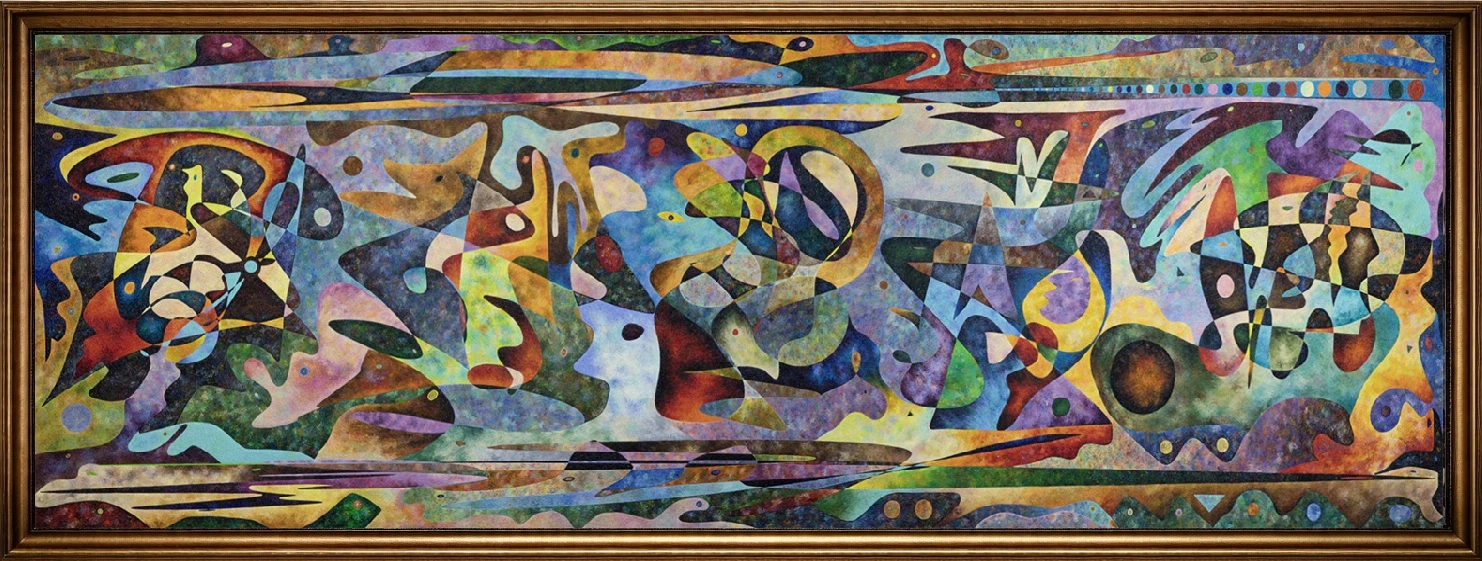
Shintoism, 2023 Oil on canvas
Transforming Sacred Themes into a Contemporary Visual Experience
An Artistic Meditation on Shintoism Faith and Presence
Through a modern perspective, this monumental oil painting reimagines Shintoism, blending symbolism with subtle conceptual precision, brought to life through Virtosu’s singular artistic vision.
Interwoven layers and thoughtful spatial composition form a meditative space that evokes reflection on devotion, transcendence, sacrifice, and the timeless presence of the spiritual path.
View WorkConcept & Meaning
Through its expansive form and immersive spatial layers, the painting transforms into a contemporary contemplation of Shintoism, evoking grace, endurance, spiritual struggle, and renewal. This work is a distinguished part of Virtosu’s "10 Religions" Collection, reflecting a singular approach to faith, symbolism, and abstract meditation.
View WorkArtistic Context & Inspirations
Born from extensive research and studio exploration, this painting embodies a sustained inquiry into layered systems of meaning rather than presenting an explicit sacred narrative. It references historical iconographic traditions while asserting a distinctly contemporary visual language, embedding symbolic cues that reward careful interpretation. Its significance unfolds gradually, revealed through attentive engagement with visual motifs, structural interplay, and material textures.
As part of Virtosu’s "10 Religions" Collection, a series of ten works developed over a decade, its monumental presence and intricate symbolism create a thoughtful dialogue between inherited cultural forms and contemporary perception.
View WorkScale & Spatial Impact
At 2 meters by 6 meters, the work establishes a formidable spatial presence, transforming its architectural environment into a field of immersive contemplation.
View WorkMateriality & Technique
Executed in oil on linen canvas, the painting balances chromatic depth with subtle surface articulation. Layered glazes and restrained impasto cultivate a tactile presence that rewards sustained and reflective viewing.
View WorkImmersive in Size and Theme
By weaving layered symbolism with spiritual themes, the painting offers a contemporary meditation on Shintoism philosophy, where its commanding scale and carefully orchestrated space turn the act of viewing into an immersive and contemplative experience.
View WorkInstitutional & Collector Context
Equally suited to ecclesiastical, institutional, or distinguished private collections, the painting combines scale, conceptual rigor, and immersive presence, offering enduring visual authority and intellectual depth.
View WorkClosing Statement
With its commanding presence and profound spiritual resonance, the painting reinterprets Shintoism’s narratives into a modern visual meditation.
This work represents a singular artistic endeavor: part of a consecutive series of ten masterpieces depicting the world’s major religions.
View WorkArtist Insights
Learn more about the artist’s background, practice, and professional journey.
View Artist ProfileExpert Analysis on Style - Shintoism, 2023
This painting appears to belong primarily to abstract art, but it blends several recognizable stylistic influences. Based on the visual elements—color, composition, shapes, and symbolism—here is a deeper breakdown.
View Work1. Panoramic Compositional Field
The painting unfolds across a panoramic 2-meter by 6-meter horizontal format, establishing a broad visual field that functions more as an immersive environment than a contained scene. This extended format encourages lateral movement of the viewer’s gaze and transforms the composition into a continuous visual landscape.
Instead of concentrating visual attention at a single focal point, the artist distributes compositional energy across multiple interacting zones. This structural strategy creates a dynamic visual rhythm that flows steadily across the entire surface.
View Work2. Biomorphic Organic Forms
A dominant stylistic feature of the composition is the use of biomorphic shapes that evoke natural organisms and living systems. Curving silhouettes and fluid contours suggest plant forms, flowing water, cellular structures, and organic growth.
These organic elements introduce a sense of vitality and natural movement into the composition. Their fluid transformations allow one form to evolve into another, reinforcing the painting’s sense of continuous life and motion.
View Work3. Geometric Structural Counterpoints
Contrasting with the organic forms are geometric elements including triangles, angular planes, circular motifs, and structured linear shapes. These geometric interventions act as visual anchors within the fluid composition.
The dialogue between geometric order and organic spontaneity establishes a balanced stylistic tension that defines much of the painting’s visual complexity.
View Work4. Layered Spatial Organization
The composition avoids traditional perspective and instead constructs depth through overlapping shapes and layered planes. Forms slide across one another, producing a shifting relationship between foreground and background.
This spatial ambiguity generates a multidimensional visual field in which depth is suggested through intersection and transparency rather than through linear perspective.
View Work5. Chromatic Architecture
Color functions as a structural component within the composition. The palette includes vibrant blues, greens, ochres, purples, and warm earth tones arranged in layered chromatic fields.
Rather than blending gradually, colors are organized into clearly defined zones that reinforce the geometry of the painting while maintaining a fluid visual rhythm.
View Work6. Rhythmic Linear Movement
Flowing contour lines traverse the composition, linking distant visual elements into a cohesive structural network. These lines guide the viewer’s eye across the panoramic surface and create pathways that unify the composition.
The resulting visual rhythm resembles a form of abstract calligraphy, where line functions not only as outline but also as an organizing principle for the entire painting.
View Work7. Surface Texture and Material Complexity
The painting demonstrates a layered application of pigment that produces subtle variations in surface texture. Grain-like passages, tonal transitions, and atmospheric color shifts contribute to the tactile richness of the composition.
These textural qualities prevent the expansive surface from appearing flat and instead give the work a sense of material depth and visual density.
View Work8. Stylistic Integration
The painting synthesizes several key strategies of contemporary abstract art: biomorphic form, geometric structuring, layered spatial construction, and complex chromatic orchestration.
Through the integration of these elements, the artist creates a panoramic abstract environment in which color, form, and movement operate together as a unified visual language.
View WorkSummary
Stylistically, “Shintoism” represents a sophisticated example of panoramic contemporary abstraction. Through organic forms, geometric counterpoints, layered spatial relationships, and a carefully structured chromatic palette, the painting constructs a visually immersive field defined by rhythm, balance, and structural harmony.
View WorkShintoism, 2023 - Expert Analysis of Narrative and Symbolism
Shintoism, 2023 contains many symbol-like visual elements, even though it remains abstract. In large abstract compositions like this, artists often build a visual language where shapes suggest ideas rather than literal objects.
This section explores a deeper interpretation of the possible narrative and symbolic meanings within the composition.
View Work1. Cosmological Narrative Structure
The composition unfolds as a panoramic spiritual landscape, extending across the horizontal plane like a continuous current of natural and metaphysical forces.
Rather than presenting discrete scenes, the painting constructs a flowing environment where sacred energy moves through interconnected organic and geometric forms. The left portion evokes origins and emergence, the center reflects interaction between human and natural realms, and the right side suggests harmony and spiritual alignment.
View Work2. Symbolic Visual Language
The work communicates primarily through symbolic abstraction, where recognizable shapes dissolve into metaphoric structures that evoke spiritual presences.
Organic silhouettes suggest animals, birds, or spiritual beings, while circular forms evoke cycles of nature and cosmic balance. Interwoven geometries appear as fragments of order emerging from fluid natural forces, forming a symbolic vocabulary that mirrors sacred structures within the natural world.
View Work3. The Sacred Ecology Narrative
Instead of illustrating mythological episodes or religious figures, the composition presents nature itself as the primary sacred narrative.
Forest-like textures, flowing shapes reminiscent of rivers, and airborne forms resembling birds merge into a symbolic ecosystem. Through this approach, the painting emphasizes a worldview in which divinity permeates the environment and spiritual presence emerges through the rhythms of nature.
View Work4. Movement and Spiritual Flow
Sweeping curves and overlapping shapes create a rhythmic visual movement across the canvas. The composition feels alive with circulating energy.
This dynamic flow suggests cycles of renewal, purification, and transformation. The viewer’s gaze travels across the painting as if moving through a spiritual landscape where invisible forces guide the journey from natural emergence toward metaphysical harmony.
View Work5. Chromatic Symbolism
Color functions as a narrative element that shapes the emotional and spiritual atmosphere of the composition.
Warm golds and ambers evoke sunlight and sacred vitality, while deep blues suggest water, sky, and cosmic depth. Greens and earthy tones reference forests and living landscapes, creating a balanced palette that bridges earthly vitality with spiritual transcendence.
View Work6. Mythic Landscape Interpretation
The painting can also be interpreted as a mythic terrain composed of symbolic mountains, rivers, celestial pathways, and spiritual portals.
Abstract forms evoke sacred landscapes where natural and spiritual realms intersect. These elements construct a metaphysical geography in which the viewer encounters layers of existence that extend beyond the visible world.
View Work7. Narrative Without Deities
One of the most distinctive aspects of the work is its absence of literal religious figures or mythological deities.
Instead of portraying specific gods, the artist distributes sacred presence across the entire visual field. Through this strategy, the painting transforms into a universal symbolic environment where the divine is embedded within natural forms and energetic movement.
View Work8. Stylistic Integration
The painting synthesizes several key strategies of contemporary abstract art: biomorphic form, geometric structuring, layered spatial construction, and complex chromatic orchestration.
Through the integration of these elements, the artist creates a panoramic abstract environment in which color, form, and movement operate together as a unified visual language.
View Work𐰘𐰙𐰖𐰢𐰡𐰘𐰟𐰞𐰜𐰛𐰡𐰘𐰚𐰝𐰡𐰖𐰡𐰖𐰝𐰤𐰙𐰖𐰝𐰘𐰘𐰣𐰤𐰡𐰘𐰣𐰘𐰢𐰝𐰘𐰡𐰥𐰞𐰘𐰣𐰤𐰞𐰢𐰖w𐰘𐰝𐰙𐰢𐰟𐰞𐰛𐰤𐰝𐰖𐰟𐰖𐰣𐰚𐰝𐰠𐰛𐰟𐰖𐰣𐰢𐰖𐰡𐰟𐰤𐰖𐰣𐰚𐰖𐰣𐰛𐰟𐰟