
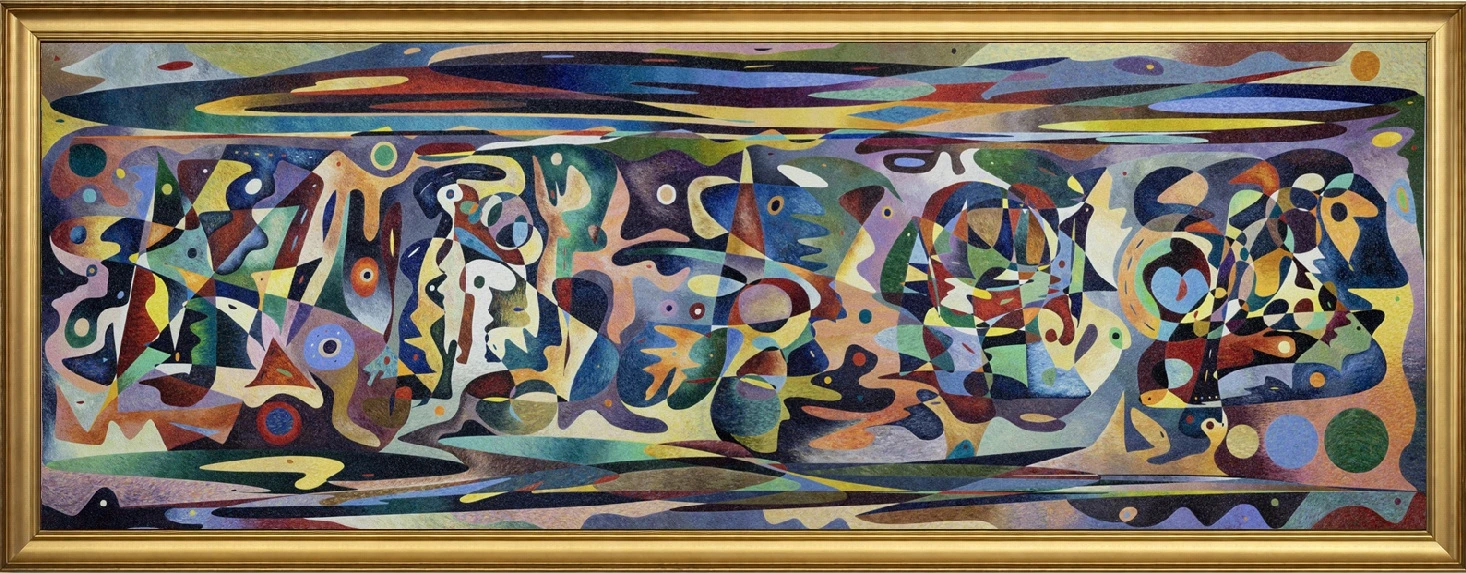
Taoism, 2024 Oil on canvas
Transforming Sacred Themes into a Contemporary Visual Experience
An Artistic Meditation on Taoism Faith and Presence
Viewed through a contemporary lens, this monumental oil painting reinterprets Taoism with symbolic restraint and conceptual depth. Layered forms and deliberate spatial composition create a contemplative field, inviting reflection on transcendence, balance, sacrifice, and the enduring presence of the spiritual path.
View WorkConcept & Meaning
Through its expansive form and immersive spatial layers, the painting transforms into a contemporary contemplation of Taoism, evoking grace, endurance, spiritual struggle, and renewal. It is a distinguished piece within Virtosu’s "10 Religions" Collection, exemplifying the artist’s singular approach to faith, symbolism, and abstract meditation.
View WorkArtistic Context & Inspirations
Emerging from sustained research and studio investigation, the painting engages layered systems of meaning rather than a direct sacred narrative. Drawing upon historical iconographic traditions while asserting a contemporary visual language, it embeds symbols that reward deliberate interpretation. Meaning unfolds gradually through close attention to visual motifs, structural relationships, and material presence.
Monumental in scale and rich in stratified symbolism, the work establishes a measured dialogue between inherited cultural forms and contemporary perception.
View WorkScale & Spatial Impact
At 2 meters by 6 meters, the work establishes a formidable spatial presence, transforming its architectural environment into a field of immersive contemplation.
View WorkMateriality & Technique
Executed in oil on linen canvas, the painting balances chromatic depth with subtle surface articulation. Layered glazes and restrained impasto cultivate a tactile presence that rewards sustained and reflective viewing.
View WorkImmersive in Size and Theme
By weaving layered symbolism with spiritual themes, the painting offers a contemporary meditation on Taoist philosophy. Its commanding presence and carefully orchestrated spatial design transform viewing into an immersive, contemplative experience.
This work is a key piece in Virtosu’s "10 Religions" epic collection, exemplifying the artist’s ambitious exploration of faith, symbolism, and abstract vision across ten masterpieces.
View WorkInstitutional & Collector Context
Equally suited to ecclesiastical, institutional, or distinguished private collections, the painting combines scale, conceptual rigor, and immersive presence, offering enduring visual authority and intellectual depth.
View WorkClosing Statement
With its commanding presence and profound spiritual resonance, the painting transforms Taoism’s narratives into a modern visual meditation.
Inspired by a personal experience of profound loss, which left a lasting mark on Virtosu, the work channels that emotional intensity into reflection and transcendence, inviting viewers into a dialogue with both the philosophy and the artist’s inner journey.
View WorkArtist Insights
Learn more about the artist’s background, practice, and professional journey.
View Artist ProfileExpert Analysis on Style - Taoism, 2024
This painting appears to belong primarily to abstract art, but it blends several recognizable stylistic influences. Based on the visual elements—color, composition, shapes, and symbolism—here is a deeper breakdown.
View Work1. Panoramic Abstract Composition
The painting adopts a horizontal panoramic structure, extending across the canvas as a continuous visual field. This compositional strategy emphasizes flow rather than segmentation, creating the impression of an unfolding landscape of movement and transformation.
Forms interconnect seamlessly from one side to the other, guiding the viewer’s gaze through a dynamic spatial rhythm. The panoramic arrangement transforms the canvas into a visual continuum where every element evolves organically into the next.
View Work2. Biomorphic Abstraction
A defining stylistic feature of the work is its use of biomorphic abstraction. The shapes resemble organisms, flowing liquids, animal silhouettes, and natural formations.
These forms evoke rivers, plant structures, birds, fish-like silhouettes, and human fragments dissolving into nature. The artist allows forms to shift between identities, creating a visual language where organic vitality and abstract rhythm merge into a unified expression.
View Work3. Geometric Counterbalance
While organic forms dominate the composition, geometric structures introduce moments of visual stability and structure.
Triangles, circular rings, arcs, and crystalline fragments appear throughout the painting, establishing a structural counterpoint to the flowing shapes. This contrast creates a dynamic equilibrium where movement and order coexist within the same visual system.
View Work4. Layered Spatial Construction
The painting demonstrates a sophisticated approach to spatial layering. Instead of relying on traditional perspective, the artist constructs depth through overlapping shapes, tonal variation, and chromatic transitions.
Foreground and background dissolve into one another, producing a multidimensional environment in which forms appear to drift across different visual planes, creating a sense of fluid spatial continuity.
View Work5. Chromatic Complexity
Color functions as a central stylistic force shaping the painting’s emotional and atmospheric resonance.
Deep blues and indigos evoke cosmic depth, while earthy greens and browns suggest landscapes and vegetation. Warm reds and ochres introduce energy and vitality, while softer pastels create transitional zones that harmonize the composition.
View Work6. Rhythmic Line and Visual Flow
Curving lines and elongated shapes generate a rhythmic motion that carries the viewer’s eye across the entire painting.
Areas of visual density alternate with more open passages, producing a pattern of tension and release that gives the composition a musical quality. This rhythmic movement reinforces the sense of natural flow and energetic circulation across the canvas.
View Work7. Symbolic Abstraction
Rather than depicting specific philosophical figures or literal imagery, the artist relies on symbolic abstraction to evoke deeper conceptual meanings.
Circular forms suggest unity and cosmic cycles, while intersecting shapes evoke transformation and interconnectedness. The painting becomes a philosophical landscape where meaning emerges through relationships between color, form, and movement.
View Work8. Stylistic Synthesis
The painting synthesizes several key strategies of contemporary abstract art: biomorphic form, geometric structuring, layered spatial construction, and complex chromatic orchestration.
Through the integration of these elements, the artist creates a panoramic abstract environment in which color, form, and movement operate together as a unified visual language.
View WorkClosing Statement
With its commanding presence and profound spiritual resonance, the painting transforms Taoism’s philosophical principles into a modern visual meditation.
Inspired by a personal experience of profound loss, which left a lasting mark on Virtosu, the work channels that emotional intensity into reflection and transcendence, inviting viewers into a dialogue with both the philosophy and the artist’s inner journey.
View WorkTaoism, 2024 - Expert Analysis of Narrative and Symbolism
Taoism, 2024 contains many symbol-like visual elements, even though it remains abstract. In large abstract compositions like this, artists often build a visual language where shapes suggest ideas rather than literal objects.
This section explores a deeper interpretation of the possible narrative and symbolic meanings within the composition.
View Work1. Cosmological Narrative Structure
The composition unfolds as a panoramic philosophical landscape, extending across the horizontal plane as a continuous current of transformation. Instead of separating events into distinct scenes, the painting constructs a flowing visual continuum that suggests the unfolding of existence.
Forms appear to evolve across the canvas from fluid organic clusters to more structured geometric constellations, evoking a journey from primordial chaos toward harmonious balance. This progression mirrors the philosophical vision of Taoism, where the universe emerges through continuous transformation rather than fixed creation.
View Work2. Symbolic Visual Language
The painting communicates through symbolic abstraction, where recognizable motifs dissolve into metaphoric forms. Organic silhouettes resemble animals, spirits, and natural elements, while geometric fragments introduce moments of cosmic structure.
Circles, arcs, and triangular structures evoke cycles of energy and the hidden architecture of the universe. Rather than representing specific symbols directly, the artist allows visual elements to remain fluid and open to interpretation, encouraging the viewer to experience symbolism through relationships between shapes.
View Work3. The Philosophical Narrative
Rather than illustrating historical episodes or religious figures, the painting expresses philosophical ideas through abstract visual relationships. The composition becomes a metaphor for the Tao itself—the invisible force that generates and sustains all forms.
By avoiding literal storytelling, the work shifts the focus toward universal processes such as transformation, balance, and emergence. The viewer encounters a visual environment that reflects the continuous interplay between opposites and complementary forces.
View Work4. Movement and Energetic Flow
The painting is structured around sweeping curves, elongated forms, and interlocking shapes that generate a powerful sense of movement. The viewer’s eye travels across the composition in a fluid rhythm, guided by the directional flow of lines and color transitions.
This visual motion suggests the circulation of cosmic energy, echoing the Taoist idea that life unfolds through natural currents rather than rigid structures. The painting becomes a visual expression of harmony within motion.
View Work5. Chromatic Symbolism
Color functions as a symbolic language that reinforces the philosophical atmosphere of the painting. Deep blues and indigos evoke cosmic depth and mystery, while earthy greens and browns suggest natural landscapes and organic growth.
Warm tones such as reds, golds, and ochres introduce vitality and transformation, creating moments of energetic intensity within the broader composition. The palette as a whole reflects the balance between opposing forces, reinforcing the theme of universal harmony.
View Work6. Mythic Landscape Interpretation
The composition may also be interpreted as a symbolic landscape where mountains, rivers, winds, and celestial pathways emerge through abstraction. The shapes evoke natural terrains that appear to shift between earthly geography and spiritual realms.
Within this mythic terrain, animals, birds, and flowing water-like forms suggest the interconnectedness of life. The painting becomes a metaphysical environment in which the boundaries between the physical world and the spiritual cosmos dissolve.
View Work7. Narrative Without Figures
One of the most distinctive aspects of the painting is its absence of literal human figures or historical personalities. Instead of depicting sages or philosophers, the artist constructs a symbolic ecosystem of forms and energies.
This approach transforms the artwork into a universal philosophical map rather than a narrative illustration. The viewer is invited to interpret the imagery through personal reflection, allowing the painting to function as a contemplative space where philosophical meaning emerges through experience.
View Work𐰘𐰙𐰖𐰢𐰡𐰘𐰟𐰞𐰜𐰛𐰡𐰘𐰚𐰝𐰡𐰖𐰡𐰖𐰝𐰤𐰙𐰖𐰝𐰘𐰘𐰣𐰤𐰡𐰘𐰣𐰘𐰢𐰝𐰘𐰡𐰥𐰞𐰘𐰣𐰤𐰞𐰢𐰖w𐰘𐰝𐰙𐰢𐰟𐰞𐰛𐰤𐰝𐰖𐰟𐰖𐰣𐰚𐰝𐰠𐰛𐰟𐰖𐰣𐰢𐰖𐰡𐰟𐰤𐰖𐰣𐰚𐰖𐰣𐰛𐰟𐰟