
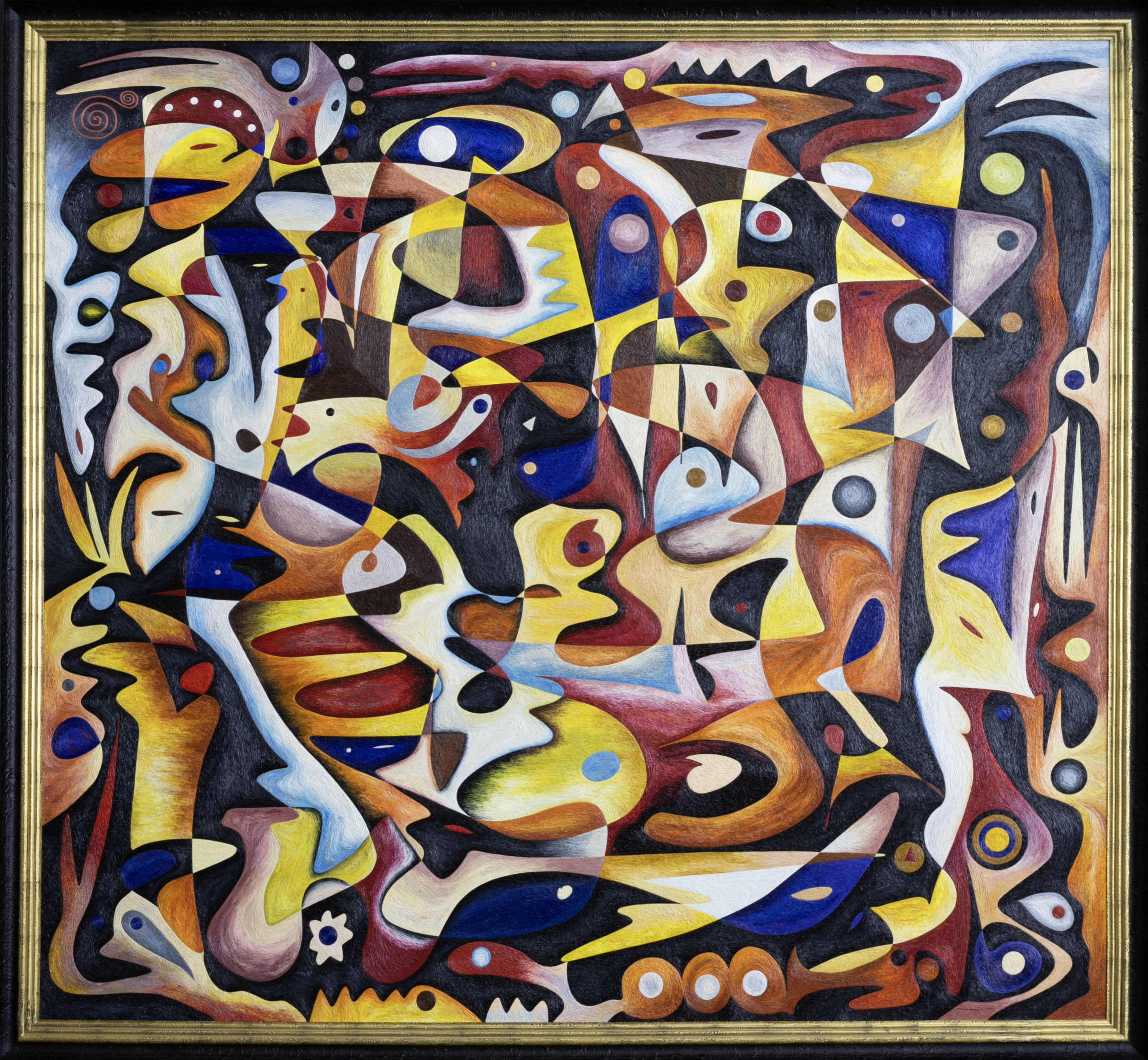
Battle of Waterloo, 2003 Oil on canvas
A monumental depiction of strategy, valor, and the forces that shaped modern Europe.
Monumental, immersive, and historically charged
Battle of Waterloo is conceived as a spatial painting, capturing the intensity, scale, and decisive moments of Napoleon’s final battle.
View WorkConcept & Meaning
The painting interprets the confrontation between Napoleon and the Allied forces under Wellington and Blücher, emphasizing the tension, strategy, and shifting momentum of battle.
Virtosu presents Waterloo as a visual language of command and maneuver, where compositional flows mirror the dynamics of armies, terrain, and chance.
Rather than depicting individual combatants, the work embodies the collective forces, chaos, and turning points that determined the outcome of European history.
View WorkScale & Spatial Impact
At 3.0 m height and 3.6 m width, the painting engages the viewer physically, inviting movement alongside the canvas to experience shifting densities and strategic tension.
From a distance, the composition conveys overall formations and coherence; up close, it dissolves into energetic brushstrokes, reflecting the simultaneous immediacy and vastness of conflict.
View WorkArtistic Context & Inspirations
Created in 2003, Battle of Waterloo was developed during a period of reflection on historical narrative, monumental composition, and large-scale painterly exploration.
The work demonstrates a nuanced orchestration of form, movement, and texture, providing viewers with an immersive encounter with both history and abstraction.
View WorkMateriality & Technique
Executed in oil on canvas, the surface reflects layered application, compression, and dynamic brushwork. Materiality conveys both energy and weight, mirroring historical intensity.
Paint functions structurally, emphasizing duration, force, and deliberate engagement with the medium rather than illustration.
View WorkInstitutional & Collector Context
Battle of Waterloo aligns with discussions of historical narrative, post-abstraction, and monumental painting, making it suitable for:
- Museum or institutional collections
- Architectural or site-specific installations
- Major private collections focused on historical statement works
Its singular presence reinforces rarity, authority, and lasting significance.
View WorkClosing Statement
Battle of Waterloo asserts presence and endurance. Through scale, material, and structure, it presents painting as a carrier of history and encoded meaning—timeless, physical, and resonant.
A work to study, move alongside, and return to.
View WorkExpert Analysis on Style - Battle of Waterloo, 2003
“Battle of Waterloo, 2003” is conceived as a monumental abstract composition in which historical narrative is translated into a dynamic visual language of form, color, and movement. Rather than depicting soldiers or landscapes directly, the artist transforms the famous battle into a dense constellation of symbolic shapes and intersecting geometries.
The painting functions as an energetic visual field where organic and geometric forms collide, overlap, and interact. These elements evoke the turbulence, strategy, and emotional intensity associated with one of history’s most decisive military confrontations.
View WorkMonumental Abstract Expression
The work employs a fully abstract visual language to reinterpret historical reality. Instead of literal representation, the artist constructs a field of interacting forms that symbolize movement, confrontation, and shifting momentum.
This approach transforms the battlefield into an energetic system of forces where shapes function as symbolic agents rather than physical objects.
The scale of the painting enhances its immersive impact, allowing viewers to experience the composition as a panoramic environment of visual tension and movement.
View WorkChromatic Intensity
The palette is vibrant and highly contrasted, featuring strong yellows, deep reds, cobalt blues, and luminous whites set against dark background tones.
This intense color interplay creates a sense of visual vibration and emotional drama. Bright chromatic zones appear to push forward while darker areas recede, producing spatial depth and visual rhythm.
The result is a dynamic chromatic structure that reinforces the sense of movement and energy across the canvas.
View WorkBiomorphic and Symbolic Forms
The composition contains numerous biomorphic shapes that resemble creatures, masks, wings, and abstract figures.
These forms are not literal representations but symbolic motifs suggesting life, motion, and psychological presence within the battlefield.
- Eye-like circles suggesting awareness or surveillance
- Wing-like shapes implying speed and momentum
- Organic silhouettes suggesting living forces within the composition
Through these motifs the battlefield becomes a symbolic ecosystem of interacting energies.
View WorkFragmented Geometry
The painting is structured through intersecting lines and geometric divisions that break the surface into multiple visual zones.
This fragmentation creates a sense of spatial tension and movement, guiding the viewer’s gaze across the composition.
The geometric divisions evoke the strategic organization of armies and the shifting structure of battle formations, translated here into abstract spatial relationships.
View WorkRhythmic Composition
The painting exhibits a strong rhythmic structure created by repeating motifs, curved lines, and alternating color fields.
Rather than guiding the viewer through a fixed narrative sequence, the composition encourages visual exploration. The eye moves fluidly across clusters of forms, discovering new relationships and patterns.
This rhythmic complexity reinforces the sense of constant motion and interaction that defines the painting’s visual atmosphere.
View WorkDecorative Framing and Contained Universe
The ornate golden frame surrounding the painting creates a visual boundary that contains the energetic composition within a defined space.
This framing element enhances the perception of the painting as a self-contained visual universe, where numerous forces interact within a symbolic battlefield.
The contrast between the structured frame and the dynamic internal composition heightens the sense of tension between order and chaos.
View WorkStyle Classification
The painting can be classified as a form of contemporary monumental abstraction that integrates several modern artistic traditions.
Its stylistic characteristics include:
- Monumental abstract expressionism
- Biomorphic surreal abstraction
- Symbolic narrative abstraction
The synthesis of geometric structure, organic shapes, and intense color relationships creates a distinctive visual language that merges expressive spontaneity with compositional control.
Summary
“Battle of Waterloo, 2003” transforms a pivotal historical confrontation into a vibrant abstract cosmos of movement and symbolic interaction.
Through layered colors, fragmented geometry, and biomorphic motifs, the painting reimagines the dynamics of battle as a complex visual system where rhythm, tension, and transformation unfold across the surface.
View WorkBattle of Waterloo, 2003 - Expert Analysis of Narrative and Symbolism
Battle of Waterloo, 2003 is a monumental 3.0 × 3.6 meter painting that reinterprets one of the most decisive battles in European history through a dense symbolic visual language. Rather than illustrating the historical event literally, the artist transforms the Battle of Waterloo into an abstract field of interacting forces.
The composition reads like a dynamic battlefield of shapes, where movement, collision, and tension unfold through color, geometry, and biomorphic forms. Instead of a linear story, the painting presents a symbolic narrative of conflict, strategy, and historical transformation.
View WorkThe Battlefield as a Network of Forces
The painting contains numerous abstract figures and shapes that interact like units within a complex battlefield.
These elements may symbolize:
- Opposing armies maneuvering across terrain
- Clusters of soldiers or battalions
- Moments of collision between opposing forces
- The dynamic movement of battle formations
The battlefield is therefore not shown as a landscape but as a living system of interacting energies and strategic movements.
View WorkEye Motifs – Awareness and Strategic Vision
Circular shapes resembling eyes appear repeatedly across the composition.
Symbolically these forms may represent:
- Strategic awareness and observation
- The watchful perception of commanders
- The intelligence required to read the battlefield
- The psychological dimension of warfare
The recurrence of these motifs suggests that perception and foresight are central forces shaping the outcome of battle.
View WorkWinged and Flowing Forms – Movement and Momentum
Some shapes resemble wings, birds, or flowing organic silhouettes that appear to move across the composition.
These forms may symbolize:
- Rapid cavalry maneuvers
- The shifting momentum of battle
- Strategic advances and retreats
- The unpredictable flow of conflict
These dynamic shapes contribute to the sensation that the battlefield is constantly shifting and evolving.
View WorkBlade-Like Geometry – Conflict and Impact
Angular and pointed forms appear throughout the composition, resembling blades, spears, or sharp instruments.
These shapes may represent:
- The weapons of Napoleonic warfare
- The direct clash between opposing forces
- The violence and intensity of battle
- Moments of decisive confrontation
Placed within the abstract structure, these elements introduce flashes of tension and aggression within the overall visual rhythm.
View WorkFragmented Space – Tactical Complexity
The canvas is divided by intersecting geometric planes that create numerous spatial zones.
These divisions may symbolize:
- Different sectors of the battlefield
- Strategic lines of attack and defense
- The fragmentation of military formations
- The complex choreography of troop movements
This spatial fragmentation transforms the composition into a symbolic battlefield map where multiple forces interact simultaneously.
View WorkColor as Emotional Narrative
The painting’s vibrant palette contributes strongly to its symbolic storytelling.
- Reds and oranges → energy, tension, and conflict
- Deep blues → depth and atmospheric intensity
- Bright yellows → flashes of action and dramatic momentum
- White accents → moments of contrast and clarity
These chromatic relationships create waves of emotional intensity that guide the viewer through the visual drama of the composition.
View WorkThe Frame – History Preserved as Memory
The ornate golden frame surrounding the painting functions symbolically as a boundary between historical reality and artistic interpretation.
This frame may represent:
- The passage of time enclosing the historical event
- The transformation of history into cultural memory
- A ceremonial space honoring a pivotal moment in European history
The frame reinforces the idea that the painting acts as a visual monument to the historical significance of the Battle of Waterloo.
View WorkOverall Symbolic Message
The painting transforms the Battle of Waterloo into a symbolic meditation on power, strategy, and the forces that shape historical change.
Through hundreds of interacting forms, the artist suggests that decisive moments in history emerge from countless movements, decisions, and collisions of energy.
In essence:
The painting presents Waterloo not simply as a military event, but as a universal drama where human ambition, strategy, and destiny intersect to reshape the course of history.
View Work𐰘𐰙𐰖𐰢𐰡𐰘𐰟𐰞𐰜𐰛𐰡𐰘𐰚𐰝𐰡𐰖𐰡𐰖𐰝𐰤𐰙𐰖𐰝𐰘𐰘𐰣𐰤𐰡𐰘𐰣𐰘𐰢𐰝𐰘𐰡𐰥𐰞𐰘𐰣𐰤𐰞𐰢𐰖w𐰘𐰝𐰙𐰢𐰟𐰞𐰛𐰤𐰝𐰖𐰟𐰖𐰣𐰚𐰝𐰠𐰛𐰟𐰖𐰣𐰢𐰖𐰡𐰟𐰤𐰖𐰣𐰚𐰖𐰣𐰛𐰟𐰟