
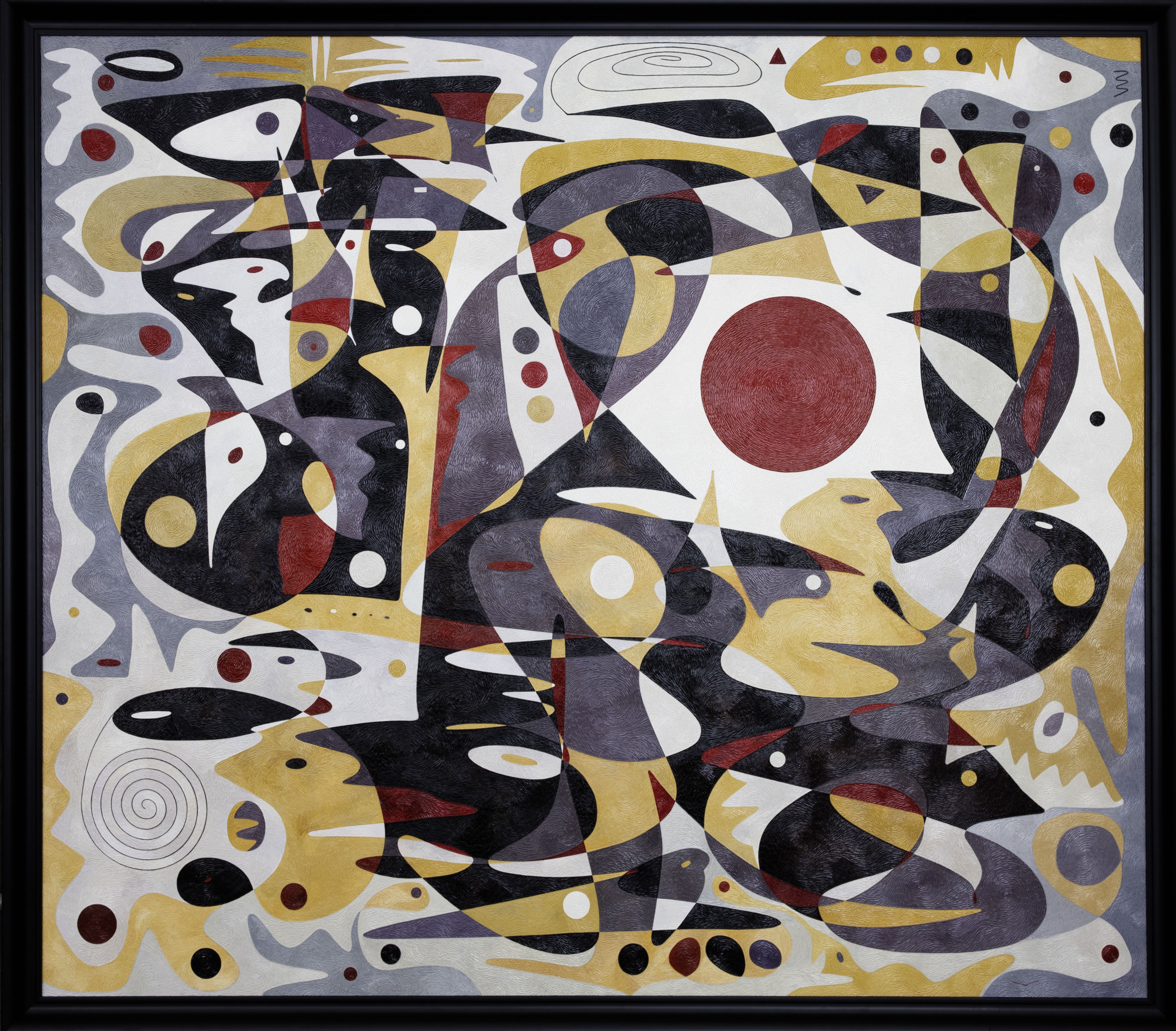
Hawai Sakusen, 2004 Oil on canvas
A monumental depiction of strategy, tension, and decisive moments in military history.
Monumental, immersive, and historically charged
Hawai Sakusen is conceived as a spatial painting, capturing the scale, strategy, and intensity of one of the pivotal military operations of the 20th century.
View WorkConcept & Meaning
The painting interprets the dynamics of the Hawai Sakusen operation through abstraction, emphasizing movement, planning, and the human dimension of conflict.
Virtosu presents the operation as a visual language of strategy and coordination, where composition mirrors the interaction of forces, timing, and decision-making.
Rather than depicting individual combatants, the work embodies the collective tension, urgency, and decisive turns of the historical event.
View WorkScale & Spatial Impact
At 3.0 m height and 3.6 m width, the painting engages the viewer physically, inviting movement alongside the canvas to experience shifting densities and operational dynamics.
From afar, the composition communicates strategy and coordination; up close, it dissolves into energetic brushwork, reflecting immediacy and tension.
View WorkArtistic Context & Inspirations
Created in 2004, Hawai Sakusen emerges from a period of reflection on historical military operations, large-scale composition, and immersive painterly exploration.
The work demonstrates orchestration of form, movement, and texture, providing viewers an encounter with both history and abstraction.
View WorkMateriality & Technique
Executed in oil on canvas, the surface reflects layered application, compression, and energetic brushwork. Materiality conveys both force and precision, mirroring operational intensity.
Paint functions structurally rather than illustratively, emphasizing duration, energy, and deliberate engagement with the medium.
View WorkInstitutional & Collector Context
Hawai Sakusen aligns with discussions of historical narrative, post-abstraction, and monumental painting, making it suitable for:
- Museum or institutional collections
- Architectural or site-specific installations
- Major private collections focused on historical statement works
Its singular presence reinforces rarity, authority, and lasting significance.
View WorkClosing Statement
Hawai Sakusen asserts presence and endurance. Through scale, material, and structure, it presents painting as a carrier of history and encoded meaning—timeless, physical, and resonant.
A work to study, move alongside, and return to.
View WorkExpert Analysis on Style - Hawai Sakusen, 2004
Hawai Sakusen, 2004 is conceived as a monumental abstract composition where historical narrative is translated into a restrained yet powerful visual language. Instead of literal representation, the artist constructs a symbolic field of intersecting forms, muted tones, and rhythmic geometry that evokes tension, strategy, and historical gravity.
The composition is structured through a complex interplay of organic silhouettes and sharp geometric divisions. These elements create a visual environment where shapes appear to move, collide, and reorganize across the surface, suggesting a hidden narrative beneath the abstract structure.
View WorkRestrained Monumental Abstraction
The painting adopts a controlled abstract language that emphasizes clarity of form and compositional balance. The monumental scale amplifies the impact of each shape, allowing the viewer to experience the painting as an immersive visual field.
Rather than relying on expressive chaos, the composition reveals a carefully organized structure where each element contributes to a unified spatial rhythm.
View WorkMinimalist Chromatic Palette
The color palette is deliberately restrained, dominated by whites, deep blacks, muted greys, ochre tones, and subdued reds.
This limited palette produces a calm yet tense atmosphere, allowing the viewer to focus on the interaction of shapes and the subtle movement of tonal contrasts.
The red circular form near the center becomes a powerful chromatic anchor, acting as a focal point that stabilizes the visual composition.
View WorkGeometric Structure
The painting is constructed through intersecting geometric divisions that segment the surface into multiple visual zones. Triangles, arcs, circles, and elongated shapes intersect to produce a layered spatial framework.
This geometric organization provides the painting with architectural stability while simultaneously guiding the viewer’s gaze through a continuous visual flow.
The structured geometry suggests an underlying system of order beneath the abstract surface.
View WorkBiomorphic Motifs
Amid the geometric framework, numerous biomorphic shapes appear throughout the composition. These forms resemble creatures, masks, eyes, or abstract figures that seem to inhabit the pictorial space.
These organic silhouettes introduce a sense of life and psychological presence within the composition, transforming the painting into a symbolic ecosystem of interacting forms.
The juxtaposition between rigid geometry and organic curves generates a dynamic tension across the surface.
View WorkRhythmic Spatial Movement
The composition encourages the viewer’s eye to move continuously across the canvas. Repeating motifs, circular elements, and curved shapes establish a rhythmic visual flow.
Rather than directing attention toward a single narrative center, the painting creates multiple zones of visual interest that unfold gradually as the viewer explores the surface.
This rhythmic organization contributes to the sensation that the painting is in constant motion despite its structured geometry.
View WorkContained Visual Universe
The dark frame surrounding the painting creates a clear boundary that contains the internal complexity of the composition. Within this boundary, the painting functions as a self-contained visual universe.
The contrast between the calm frame and the intricate internal structure reinforces the perception of the painting as a condensed symbolic world where multiple visual forces coexist.
View WorkStyle Classification
Hawai Sakusen can be positioned within the broader field of contemporary monumental abstraction, integrating several artistic traditions.
- Monumental abstract expression
- Biomorphic surreal abstraction
- Symbolic geometric abstraction
The synthesis of geometric order, organic shapes, and restrained chromatic relationships produces a distinctive visual language that balances expressive movement with compositional control.
View WorkSummary
Hawai Sakusen, 2004 presents a refined form of monumental abstraction in which geometry, biomorphic imagery, and controlled color relationships combine to create a complex visual structure.
The painting transforms historical inspiration into a symbolic field of rhythm, balance, and spatial interaction, allowing viewers to experience the composition as both an intellectual construction and an immersive visual environment.
View WorkHawai Sakusen, 2004 - Expert Analysis of Narrative and Symbolism
Hawai Sakusen, 2004 transforms a historic military operation into an abstract symbolic landscape where strategy, movement, and tension are expressed through geometric forms and restrained color relationships. Rather than narrating the event literally, the artist constructs a visual field in which shapes interact as metaphors for forces, decisions, and moments of impact.
The composition operates like a strategic map rendered in abstract language. Intersecting forms, directional shapes, and central symbolic elements create a visual narrative that evokes coordination, anticipation, and the sudden transformation of historical events.
View WorkThe Central Red Circle – Symbol of Origin and Impact
A dominant red circular form occupies a prominent position within the composition. This element functions as both a visual anchor and a powerful symbolic reference.
The circle may represent:
- The rising sun motif associated with Japanese national identity
- The focal point of strategic action
- The moment from which events radiate outward
- The symbolic center of historical transformation
Within the visual narrative, this circle acts as a gravitational center around which surrounding forms organize and respond.
View WorkDirectional Shapes – Movement and Tactical Coordination
Throughout the painting, numerous elongated shapes, triangular forms, and curved lines suggest direction and motion.
These forms may symbolize:
- The coordinated movement of military forces
- Strategic routes and planned trajectories
- The precision of organized operations
- The dynamic unfolding of tactical decisions
The resulting visual rhythm evokes the choreography of movement that precedes and accompanies decisive historical actions.
View WorkFragmented Spatial Fields – Layers of Strategy
The composition is divided into numerous intersecting planes that create a fragmented visual space.
This fragmentation may represent:
- Multiple phases of a complex operation
- Simultaneous events unfolding in different locations
- The layered structure of strategic planning
- The complexity of decision-making in moments of conflict
Through these divisions, the painting becomes a symbolic cartography of action and reaction.
View WorkBiomorphic Silhouettes – Human Presence Within Strategy
Among the geometric structures appear organic shapes resembling faces, masks, birds, or living creatures.
These biomorphic forms may symbolize:
- The human participants within historical events
- The psychological dimension of strategy and conflict
- The emotional tension experienced by individuals
- The presence of life within an otherwise abstract system
The interaction between organic forms and rigid geometry reflects the tension between human instinct and calculated strategy.
View WorkColor as Symbolic Atmosphere
The restrained palette contributes significantly to the narrative atmosphere of the painting.
- White fields → silence, anticipation, and open space
- Black forms → tension, structure, and shadow
- Muted ochres → material presence and grounded stability
- Deep reds → energy, intensity, and decisive action
Together these colors generate a visual environment that oscillates between calm planning and sudden historical rupture.
View WorkThe Frame – Memory and Historical Distance
The dark frame surrounding the painting establishes a boundary that separates the internal symbolic world from the external reality of the viewer.
This framing element may represent:
- The passage of time enclosing historical events
- The transformation of conflict into cultural memory
- The preservation of history within artistic reflection
Through this framing, the painting becomes a visual monument that invites contemplation rather than direct depiction.
View WorkOverall Symbolic Interpretation
Hawai Sakusen, 2004 presents history not as a literal record but as a system of interacting forces, decisions, and consequences.
Through geometry, rhythm, and symbolic motifs, the painting suggests that decisive historical moments arise from complex networks of movement, perception, and intention.
Ultimately, the composition becomes a symbolic meditation on strategy, anticipation, and the transformative power of human actions within the flow of history.
View Work𐰘𐰙𐰖𐰢𐰡𐰘𐰟𐰞𐰜𐰛𐰡𐰘𐰚𐰝𐰡𐰖𐰡𐰖𐰝𐰤𐰙𐰖𐰝𐰘𐰘𐰣𐰤𐰡𐰘𐰣𐰘𐰢𐰝𐰘𐰡𐰥𐰞𐰘𐰣𐰤𐰞𐰢𐰖w𐰘𐰝𐰙𐰢𐰟𐰞𐰛𐰤𐰝𐰖𐰟𐰖𐰣𐰚𐰝𐰠𐰛𐰟𐰖𐰣𐰢𐰖𐰡𐰟𐰤𐰖𐰣𐰚𐰖𐰣𐰛𐰟𐰟