
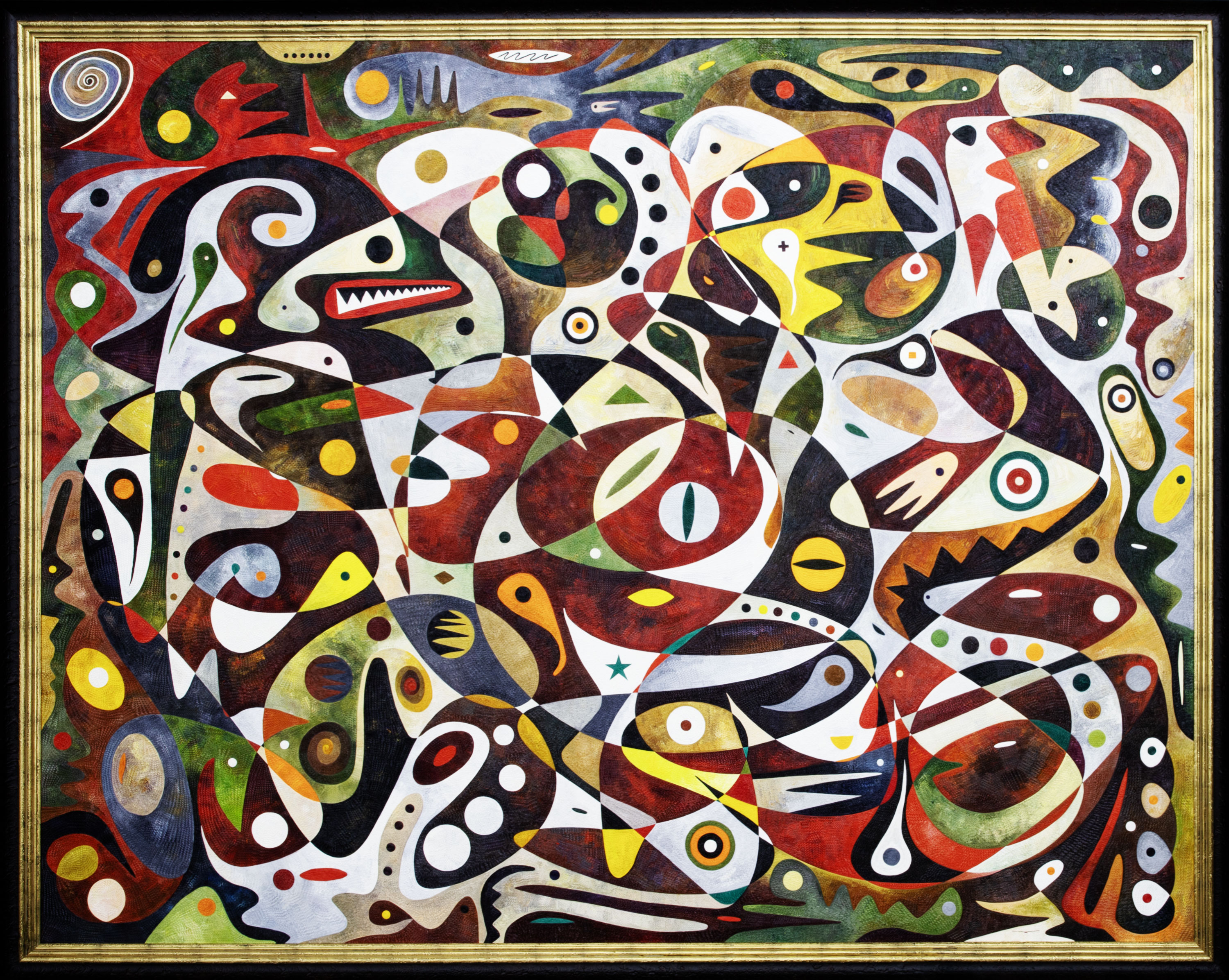
World War II, 2008 Oil on canvas
A monumental reflection on the scale, devastation, and transformation of the Second World War.
Monumental, immersive, and historically resonant
World War II is conceived as a spatial painting reflecting the immense global conflict that reshaped nations, societies, and the trajectory of modern history.
View WorkConcept & Meaning
The painting interprets the Second World War through abstraction, transforming the magnitude of global confrontation into visual rhythms of tension, collision, and convergence.
Rather than illustrating specific battles or leaders, the composition evokes the collective forces of technological warfare, shifting alliances, and global transformation.
Layered movements and structural contrasts suggest the simultaneous destruction and reconfiguration of the world order that emerged from the conflict.
View WorkScale & Spatial Impact
The monumental scale establishes a physical relationship with the viewer, inviting movement across the surface and revealing shifting visual intensities.
From a distance, the composition conveys structural unity; up close, energetic painterly gestures reflect the fragmentation, urgency, and complexity of global war.
View WorkArtistic Context & Inspirations
Created in 2008, World War II reflects an exploration of collective memory, monumental composition, and the role of painting in addressing historical transformation.
The work engages abstraction as a means to contemplate the scale of human conflict while preserving openness of interpretation.
View WorkMateriality & Technique
Executed in oil on canvas, the surface is constructed through layered accumulation and energetic gesture, emphasizing the physicality and duration of the painting process.
Paint operates structurally rather than illustratively, creating a material record of force, movement, and intention.
View WorkInstitutional & Collector Context
World War II aligns with discussions around historical narrative, monumental abstraction, and the expanded role of painting in cultural memory, making it suitable for:
- Museum or institutional collections
- Cultural or architectural installations
- Major private collections focused on historical works
Its scale and conceptual clarity reinforce its presence as a singular and enduring work.
View WorkClosing Statement
World War II proposes painting as a vessel for historical reflection. Through scale, abstraction, and material presence, the work invites sustained engagement with one of the defining events of the twentieth century.
A work to contemplate, move alongside, and return to.
View WorkArtist Insights
Monumental oil paintings exploring scale and historical presence
View Artist ProfileExpert Analysis on Style - World War II, 2008
World War II, 2008 is conceived as a monumental abstract composition that translates the immense scale and complexity of the Second World War into a dynamic visual language of color, geometry, and biomorphic forms. Rather than presenting literal scenes of conflict, the artist constructs an intricate network of shapes that evoke the turbulence, strategic tension, and global magnitude of the historical event.
The painting unfolds as a dense visual field where organic silhouettes, geometric fragments, and flowing lines interact continuously. Through this layered structure the composition transforms historical narrative into an abstract system of rhythm, movement, and symbolic energy.
View WorkChromatic Complexity
The painting employs a rich and varied palette composed of deep blues, muted greens, luminous yellows, and contrasting dark tonal fields. These colors generate an atmospheric depth that suggests both vast spatial environments and psychological intensity.
Subtle accents of red and warm tones punctuate the composition, creating moments of heightened visual tension that interrupt the broader chromatic harmony.
This interplay of cool and warm colors produces a dynamic chromatic structure that guides the viewer through the painting’s complex visual terrain.
View WorkBiomorphic Abstraction
The composition contains numerous biomorphic shapes that resemble creatures, faces, wings, or abstract figures. These organic silhouettes populate the canvas, creating the impression of a living ecosystem of forms.
Rather than representing specific objects, these shapes function as symbolic presences that contribute to the painting’s expressive complexity.
The fluid contours of these motifs generate an impression of transformation and movement throughout the composition.
View WorkFragmented Geometric Structure
The painting is organized through intersecting geometric divisions that break the surface into multiple overlapping zones. Triangular fragments, circular motifs, and sweeping curves intersect to create a layered spatial framework.
This structural fragmentation encourages the viewer’s gaze to move across the canvas in multiple directions rather than focusing on a single visual center.
The resulting structure produces a sense of complexity and tension within the pictorial space.
View WorkRhythmic Visual Movement
Repeating curves, circular motifs, and elongated shapes establish a rhythmic pattern across the surface of the canvas. These recurring elements create a continuous visual flow that guides the viewer through the painting.
Instead of presenting a static composition, the painting conveys the sensation of constant motion as forms appear to shift and interact within a fluid visual environment.
This rhythmic organization reinforces the painting’s sense of internal energy and dynamic structure.
View WorkDecorative Framing and Contained Universe
The ornate frame surrounding the painting provides a visual boundary that contains the intricate internal composition. Within this frame the painting functions as a self-contained universe of interacting forms.
The contrast between the structured frame and the fluid internal imagery heightens the perception of contained movement and tension within the composition.
This framing emphasizes the monumental presence of the painting and reinforces its visual coherence.
View WorkStyle Classification
World War II can be situated within the broader field of contemporary monumental abstraction, combining several artistic approaches.
- Monumental abstract expression
- Biomorphic surreal abstraction
- Symbolic narrative abstraction
The synthesis of atmospheric color, organic shapes, and geometric structure produces a distinctive visual language that balances expressive freedom with compositional order.
View WorkSummary
World War II, 2008 transforms historical inspiration into a complex abstract environment of rhythm, form, and color. Through its monumental scale and intricate visual structure, the painting invites viewers to explore a symbolic landscape where movement, tension, and transformation unfold across the canvas.
View WorkWorld War II, 2008 - Expert Analysis of Narrative and Symbolism
World War II, 2008 interprets the Second World War through an expansive abstract language that transforms one of the most transformative conflicts in human history into a symbolic visual landscape. Rather than illustrating specific battles or historical figures, the painting constructs a complex field of interacting forms that evoke the global scale, strategic tensions, and human consequences of the war.
The composition unfolds as an intricate constellation of shapes, suggesting the simultaneous interaction of political powers, military movements, and human experiences across multiple continents. Through abstraction, the painting conveys the immense complexity of a conflict that reshaped the modern world.
View WorkFragmented Spatial Structure – A Divided World
The painting is organized through numerous intersecting geometric divisions that break the canvas into overlapping spatial zones.
These fragmented structures may symbolize:
- The division of nations and alliances during the war
- The fragmentation of geopolitical power across multiple theaters of conflict
- The disruption of established political orders
- The shifting balance between opposing forces
The composition therefore mirrors the global complexity of the war, where events unfolded simultaneously across Europe, Asia, Africa, and the Pacific.
View WorkBiomorphic Figures – Humanity Within Conflict
Throughout the painting, numerous organic shapes appear that resemble faces, masks, creatures, or human silhouettes. These biomorphic elements introduce a subtle but powerful suggestion of human presence within the otherwise abstract structure.
Symbolically, these forms may represent:
- The millions of individuals affected by the war
- The psychological transformation experienced during global conflict
- The resilience and vulnerability of human life
- The silent witnesses to historical upheaval
The coexistence of organic forms with rigid geometric divisions reflects the tension between human experience and the vast systems of military and political power.
View WorkDirectional Motifs – Movements of War
Elongated shapes, sweeping curves, and arrow-like forms appear throughout the composition, creating a sense of directional movement across the canvas.
These visual trajectories may symbolize:
- The movement of armies and fleets across continents and oceans
- The strategic maneuvers that shaped the course of the war
- The shifting front lines and evolving alliances
- The dynamic progression of historical events
The viewer’s eye is guided through the composition in a continuous flow, echoing the global scale of military and political interactions.
View WorkChromatic Symbolism – Emotional and Historical Atmosphere
The painting’s rich palette contributes to the symbolic interpretation of the composition.
- Deep blues and dark tonal areas suggest uncertainty, night operations, and the shadow of global crisis
- Muted greens evoke landscapes transformed by conflict
- Warm golden tones introduce moments of illumination and historical turning points
- Small accents of red punctuate the composition with visual intensity
These chromatic contrasts create an emotional atmosphere that reflects both the gravity and transformative power of the historical moment.
View WorkCircular Motifs – Cycles of History
Scattered circular elements appear across the painting, functioning as rhythmic visual anchors within the composition.
These circles may symbolize:
- The interconnected nature of global events
- The cyclical patterns of conflict and transformation in history
- The passage of time during moments of historical upheaval
- The enduring memory of global conflict
Through these recurring motifs, the painting suggests that historical events reverberate far beyond the moment in which they occur.
View WorkThe Painting as a Historical Cosmos
Ultimately, World War II, 2008 presents the Second World War not as a linear narrative but as a complex constellation of human actions, political decisions, and historical forces.
The painting becomes a symbolic universe in which countless trajectories intersect, collide, and transform one another. Through this abstract approach, the work invites viewers to reflect on the profound impact of global conflict on the course of modern history.
In this way, the painting functions as both a visual meditation on war and a monumental reflection on the interconnected nature of historical change.
View Work𐰘𐰙𐰖𐰢𐰡𐰘𐰟𐰞𐰜𐰛𐰡𐰘𐰚𐰝𐰡𐰖𐰡𐰖𐰝𐰤𐰙𐰖𐰝𐰘𐰘𐰣𐰤𐰡𐰘𐰣𐰘𐰢𐰝𐰘𐰡𐰥𐰞𐰘𐰣𐰤𐰞𐰢𐰖w𐰘𐰝𐰙𐰢𐰟𐰞𐰛𐰤𐰝𐰖𐰟𐰖𐰣𐰚𐰝𐰠𐰛𐰟𐰖𐰣𐰢𐰖𐰡𐰟𐰤𐰖𐰣𐰚𐰖𐰣𐰛𐰟𐰟