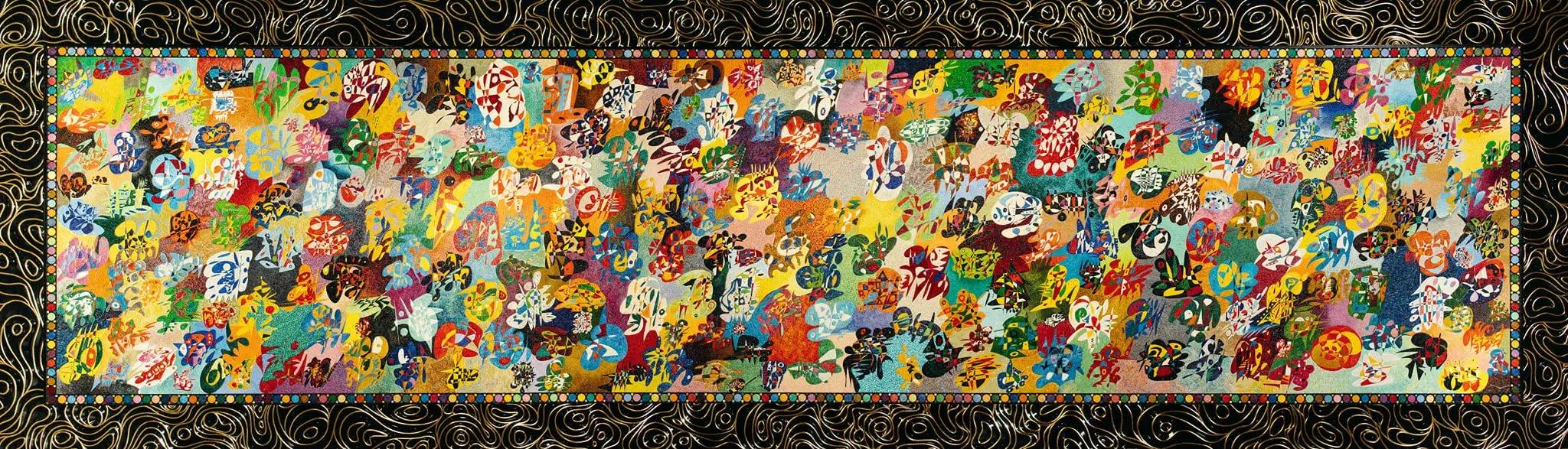
Divine DNA, 2016 Oil on canvas
The unity of humanity as the last refuge for preserving our collective future.
Monumental, immersive, and architecturally scaled
Divine DNA is conceived as a spatial painting rather than a conventional pictorial object—one of the most intelligent works the world has produced, depicting the profound unity of humanity.
View WorkConcept & Meaning
Divine DNA depicts the unity of all nations of the world through abstraction. The work approaches humanity not through flags, borders, or figurative representation, but through the idea of a shared, underlying code—a collective origin that transcends geography, culture, and history.
Virtosu interprets Divine DNA as a universal language, a symbolic system in which all human differences are variations of a single source. The painting’s continuous visual flow suggests coexistence rather than separation, emphasizing interconnectedness, simultaneity, and mutual presence.
Rather than illustrating diversity, the work embodies it structurally: through layered rhythms, interruptions, and convergences that mirror the complexity of global humanity within a unified whole.
See how the installation worksScale & Spatial Impact
At 3 m height and 12.5 m width, the painting establishes a direct relationship with architectural space. It is experienced through movement: the viewer walks alongside the work, encountering shifting visual densities and perceptual states.
From distance, the composition asserts coherence and structure. Up close, it dissolves into tactile painterly events—mirroring the dual nature of DNA itself, simultaneously vast and microscopic.
View Work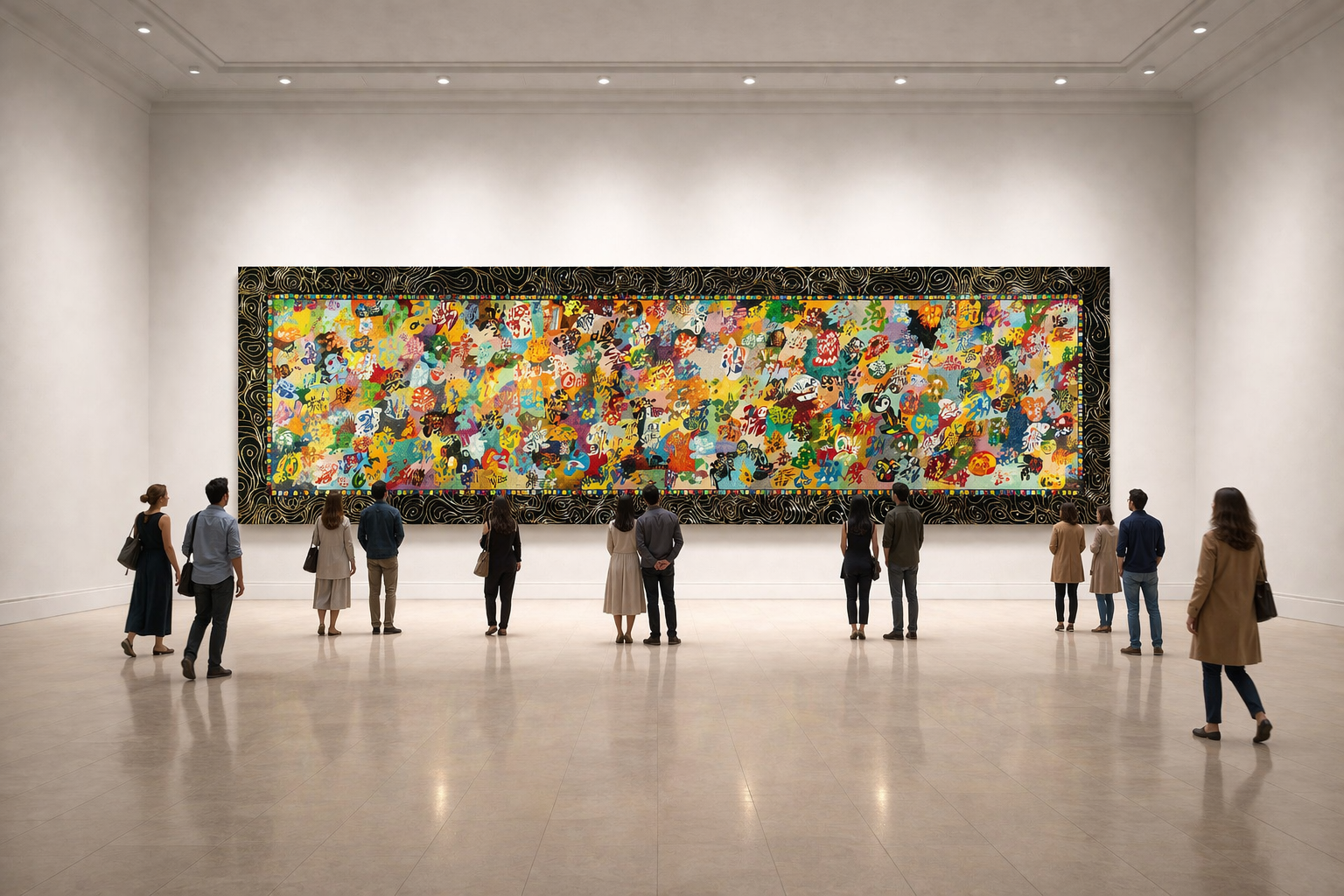
Artistic Context & Inspirations
Initiated in 2010 and completed in 2016, Divine DNA reflects a sustained period of expansive exploration in the artist’s practice, during which cultural narratives, spiritual inquiry, and contemporary philosophical thought converged.
Developed over six years, the work demonstrates a meticulous engagement with symbolism, composition, and materiality. Its layered forms and nuanced textures articulate an evolving dialogue between tradition and innovation, offering viewers an immersive encounter that anticipates the thematic and conceptual depth of the artist’s later explorations.
View WorkMateriality & Technique
Executed in oil on canvas, the surface is built through layered accumulation, compression, and controlled disruption. The painting retains visible traces of process, emphasizing duration and physical engagement with the medium.
Materiality is central to the work’s authority: paint is not illustrative, but structural. The surface functions as a record of time, force, and intention.
View WorkArchitectural Frame
The 0.5 m wide custom frame is an integral conceptual element. It transforms the painting into a contained object, reinforcing its presence as a constructed entity rather than an image window.
The frame introduces a sense of threshold and reverence—almost reliquary—elevating the work from wall-mounted painting to spatial artifact.
View WorkInstitutional & Collector Context
Divine DNA aligns with contemporary discussions around monumentality, post-abstraction, and the expanded field of painting. Its scale and conceptual clarity position it for:
- Museum or institutional collections
- Architectural or site-specific installations
- Major private collections focused on statement works
The work is singular in presence and not easily replicated, reinforcing its rarity and long-term value.
View WorkClosing Statement
Divine DNA is a work of assertion and permanence. It does not seek immediate interpretation, but sustained engagement. Through scale, material, and structure, it proposes painting as a carrier of encoded meaning—timeless, physical, and resonant.
A work to live with, move alongside, and return to.
View WorkPresentation Video
Artist Insights
Learn more about the artist’s background, practice, and professional journey.
View Artist ProfileExpert Analysis on Style - Divine DNA, 2016
A 3 × 12 meter painting like this functions almost like a visual universe or tapestry. The density of symbols across the canvas suggests a complex narrative made of many interconnected visual elements.
By examining the shapes, colors, and rhythm of the composition, several layers of symbolism and possible storytelling begin to emerge.
View WorkAbstract Expressionism / Monumental Abstraction
The painting is fully non-representational: it does not depict recognizable objects in a realistic sense.
It relies on color, rhythm, and density of forms to create emotional and visual impact.
The scale (3 × 12 m) amplifies its immersive quality, making the viewer feel enveloped in its world.
The dense layering of shapes recalls abstract expressionist murals by artists like Wassily Kandinsky or Jackson Pollock but with more color segmentation.
View WorkPolychromatic Complexity
This work is highly polychromatic: every small form has distinct color combinations.
The repeated use of primary and secondary colors alongside black-and-white contrasts creates visual vibration, almost like a kaleidoscopic effect.
The border framing (black with swirling gold lines) isolates the composition, giving it the sense of a contained universe or tapestry.
View WorkFragmented Biomorphic Elements
The shapes are organic but fragmented: small, almost mosaic-like biomorphic figures.
Many resemble:
- Eyes, butterflies, or small creatures
- Cells or abstract flora
- Symbolic patterns (some geometric)
This creates visual density and gives the painting a sense of microcosmic life within a macrocosm.
View WorkPatterning and Rhythm
The repeated motifs form rhythmic patterns, almost like musical notation.
Unlike a linear narrative, the eye can jump around the painting, discovering clusters of forms.
This suggests a universe teeming with energy, where each fragment has a role in the overall choreography.
View WorkSurrealist / Symbolic Layer
Although abstract, the motifs suggest hidden symbolic meaning:
- Swirling lines → movement, energy, cosmic currents
- Small creatures → life, multiplicity, diversity
- Black-and-gold frame → sacred or ornamental context
The work can be interpreted as a cosmic ecosystem or spiritual map, much like a visual meditation on life and interaction.
View WorkVisual Texture and Detail
At this scale, the painting rewards close inspection:
- Tiny interlocking shapes
- Subtle color gradients within forms
- Contrasts between flat and slightly textured areas
These details create a dynamic tension between distance (overall composition) and proximity (micro-level forms).
View WorkStyle Classification
A precise classification: Contemporary monumental abstract expressionism with kaleidoscopic biomorphic and symbolic motifs.
Key influences:
- Kandinsky / Abstract Expressionism: spiritual abstraction, color as emotional force
- Miró / Surreal Biomorphism: dreamlike organic shapes
- Muralism / Panoramic Composition: epic scale and immersive rhythm
Summary
This 3 × 12 m painting is a visual universe in miniature: every cluster of shapes interacts like organisms in a complex ecosystem, while the frame gives it a sacred, ornamental quality.
It’s an abstract, surreal, and biomorphic masterpiece designed to immerse the viewer and evoke cosmic, spiritual, or life-force concepts.
View WorkDivine DNA, 2016 - Expert Analysis of Narrative and Symbolism
Divine DNA, 2016 3 × 12 meter monumental painting reads almost like a cosmic garden or map of life. Because the surface is densely populated with repeating symbolic forms, the narrative is likely collective rather than linear—it describes a system, a universe, or an ecosystem rather than a single story.
This section explores a deeper interpretation of the possible narrative and symbolic meanings within the composition.
View WorkA Universe of Living Forms
The painting contains hundreds of small organic figures that resemble living forms.
Many shapes evoke:
- Butterflies
- Insects
- Seeds
- Leaves
- Flowers
- Microscopic organisms
Together these elements create the impression of a vibrant biosphere. The painting may symbolize the diversity of life and the way countless organisms coexist within one vast system.
Rather than focusing on a single subject, the work celebrates multiplicity and abundance.
View WorkButterflies – Transformation and the Soul
Butterfly-like shapes appear frequently across the surface of the painting.
Across many cultures butterflies symbolize:
- Transformation
- Rebirth
- Spiritual evolution
- The soul leaving the body
The repetition of these forms suggests that change and transformation are constant forces within this symbolic universe.
View WorkSeeds and Flowers – Creation and Growth
Many shapes resemble petals, blossoms, or germinating seeds.
Possible symbolism:
- The origin of life
- Fertility and creation
- Nature’s regenerative cycles
These motifs suggest that life is constantly emerging and multiplying, reinforcing the theme of continuous creation.
View WorkMask or Face-Like Shapes – Human Consciousness
Hidden among the organic forms are shapes that resemble stylized faces or ritual masks.
They may represent:
- Human presence within nature
- Ancestral spirits
- Archetypal identities
This idea—human consciousness embedded within a natural cosmos—appears frequently in symbolic modern art.
View WorkInsects and Small Creatures – The Invisible World
Some motifs resemble beetles, caterpillars, or microscopic organisms.
These forms may represent:
- The unseen layers of life
- The importance of small creatures within ecosystems
- The microcosm within the macrocosm
The painting suggests that life exists simultaneously on many scales.
View WorkColor as Emotional Energy
The colors are highly saturated and varied.
- Yellows and oranges → vitality and sunlight
- Blues and greens → water, growth, and nature
- Reds → energy and life force
The palette creates the sensation of biological energy, making the painting feel less like a landscape and more like a living field of forces.
View WorkThe Golden Cosmic Border
The swirling gold patterns surrounding the painting appear almost cosmic or celestial.
Possible meanings:
- The universe enclosing the ecosystem within the painting
- Cosmic energy or spiritual space
- The idea that life exists within a larger universal structure
This border transforms the painting into something like a portal into a living universe.
View WorkThe Narrative Across Twelve Meters
Because the painting is extremely wide, it may represent the passage of life across time or space.
A possible interpretation:
- Emergence of simple forms
- Growth and diversification
- Interaction between species
- Flourishing biodiversity
- Harmony within a living system
Rather than telling a single story, the composition can be read as a visual map of evolution and coexistence.
View WorkOverall Symbolic Message
The painting may express a philosophical idea: life is an interconnected network of transformations within the larger universe.
Every creature, seed, and spirit participates in a continuous cycle of creation, change, and coexistence.
In essence:
This monumental painting can be interpreted as a symbolic ecosystem or cosmic garden where countless living forms represent the endless creativity and diversity of life.
View Work𐰘𐰙𐰖𐰢𐰡𐰘𐰟𐰞𐰜𐰛𐰡𐰘𐰚𐰝𐰡𐰖𐰡𐰖𐰝𐰤𐰙𐰖𐰝𐰘𐰘𐰣𐰤𐰡𐰘𐰣𐰘𐰢𐰝𐰘𐰡𐰥𐰞𐰘𐰣𐰤𐰞𐰢𐰖w𐰘𐰝𐰙𐰢𐰟𐰞𐰛𐰤𐰝𐰖𐰟𐰖𐰣𐰚𐰝𐰠𐰛𐰟𐰖𐰣𐰢𐰖𐰡𐰟𐰤𐰖𐰣𐰚𐰖𐰣𐰛𐰟𐰟