
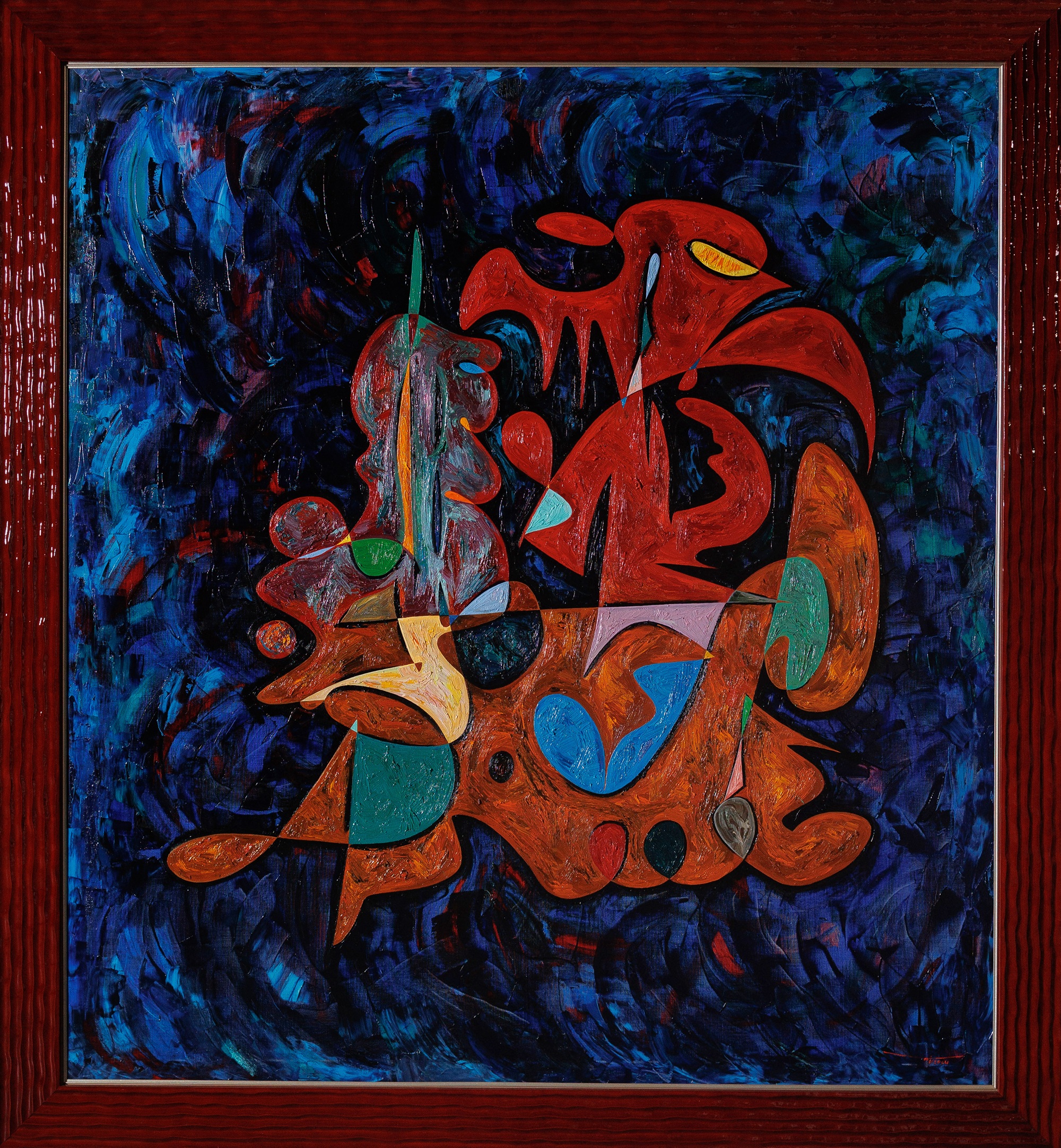
Alexander The great, 2009 Oil on canvas
A Symbolic Architecture of Conquest, Transformation, Mythology, and Imperial Power
Visionary, Expansive, and Historically Transformative
Alexander The great transforms the figure of Alexander the Great into a dynamic abstract architecture that examines conquest, leadership, cultural integration, and the enduring systems through which imperial influence reshapes civilizations. Rather than portraying a historical event or individual likeness, the painting investigates the symbolic structures through which power expands, adapts, and survives beyond the lifespan of its creator.
Concept & Meaning
Alexander The great explores Alexander not merely as a military commander but as a civilizational force whose campaigns transformed geography, culture, governance, and collective imagination. Through fragmented forms, intersecting structures, and energetic chromatic relationships, the composition visualizes the collision between ambition, strategy, mythology, and historical transformation.
The painting suggests that empire functions as an architectural system rather than a singular act of domination. Influence extends through networks of exchange, cultural transmission, symbolic authority, and institutional continuity. Alexander emerges as a catalyst through which multiple worlds converge, creating new political and cultural realities that continue to resonate through history.
Within The Architecture of Power, the work examines how leadership transcends individual identity and becomes embedded within enduring systems of memory, mythology, and civilization. Power appears as a dynamic force capable of both transformation and permanence.
Scale & Visual Presence
Measuring 168 × 167 cm, the painting establishes a monumental presence through its expansive composition and concentrated symbolic density. The near-square format creates an immersive field in which historical narrative dissolves into abstract systems of movement, conflict, and transformation.
Vibrant structures emerge from a richly layered environment of contrasting colours and textures. The interaction between explosive chromatic energy and organized architectural forms generates a visual dialogue between conquest and order, reflecting the tensions inherent within imperial expansion.
Artistic Context & Inspirations
The painting forms part of Gheorghe Virtosu’s broader investigation into authority, historical memory, geopolitical transformation, and the symbolic mechanisms through which power shapes civilizations. Historical figures become vehicles for examining larger systemic questions concerning leadership, legitimacy, cultural integration, and the construction of collective identity.
Drawing upon ancient history, political philosophy, mythology, military strategy, systems thinking, and symbolic abstraction, the work reflects upon the lasting consequences of imperial ambition. Rather than illustrating a historical narrative, the painting investigates the structural forces through which civilizations emerge, expand, and leave enduring cultural legacies.
Materiality & Technique
Executed in oil on canvas, the composition combines expressive brushwork, layered pigment applications, and carefully orchestrated structural relationships. Variations in texture and colour density create a dynamic visual environment that simultaneously conveys movement, complexity, and monumentality.
Materiality functions as an active component of meaning. The interaction between controlled architectural forms and spontaneous painterly gestures mirrors the relationship between strategic planning and historical unpredictability that characterized Alexander’s campaigns. Through these material contrasts, abstraction becomes a language of historical transformation.
Colour, Symbol & Construction
Colour operates as a language of conquest, ambition, vision, conflict, and cultural synthesis. Gold, crimson, blue, black, white, and luminous accents interact across the composition to create a symbolic network that evokes military expansion, imperial authority, cultural exchange, and mythological permanence.
Rather than functioning descriptively, colour operates structurally, directing movement between forms and reinforcing the painting’s investigation into the psychological and political dimensions of power. Chromatic relationships become symbolic expressions of historical momentum and civilizational transformation.
Structure & Symbolic Architecture
The composition is organized around an evolving architectural framework composed of intersecting geometric forms, organic contours, fragmented planes, and concentrated symbolic centers. These structures suggest territories, routes, networks of influence, and the expanding reach of imperial vision.
No single element fully dominates the composition. Instead, authority emerges through interaction, movement, and transformation. The resulting architecture presents empire as a living system sustained through adaptation, exchange, leadership, and symbolic legitimacy. The work transforms Alexander into a metaphor for the mechanisms through which power extends beyond the individual and becomes historical structure.
Institutional & Collection Context
Alexander The great contributes to contemporary discussions concerning leadership, empire, cultural exchange, historical memory, political systems, and the enduring influence of transformative figures upon global civilization. Its conceptual depth and symbolic complexity position the work within broader conversations surrounding authority, mythology, and historical consciousness.
Functioning simultaneously as artwork, historical reflection, and intellectual inquiry, the painting is relevant to museum collections, academic research, and exhibitions examining ancient civilizations, leadership, empire, political abstraction, and cultural transformation.
Closing Statement
Alexander The great presents Alexander the Great as an enduring architecture of ambition, transformation, and historical influence. Through symbolic abstraction, Gheorghe Virtosu reveals how conquest extends beyond territory to reshape memory, culture, identity, and the structures through which civilizations understand themselves.
A meditation on leadership, mythology, expansion, and the enduring architecture of empire.
Artist Insights
Learn more about Gheorghe Virtosu’s research into power, historical memory, empire, leadership, abstraction, geopolitical transformation, collective consciousness, and the systemic structures that shape civilizations across time.
Through his theory of Systemic Abstraction, Virtosu investigates how authority operates beyond individual figures, revealing the hidden architectures through which influence, mythology, governance, and cultural identity are constructed and sustained.
View Artist ProfileExplore the Work
Navigate through catalogue documentation, curatorial research, and collection materials for Alexander The great, 2009, and discover its place within The Architecture of Power, Gheorghe Virtosu’s ongoing investigation into leadership, empire, mythology, and the symbolic systems of authority.
𐰘𐰙𐰖𐰢𐰡𐰘𐰟𐰞𐰜𐰛𐰡𐰘𐰚𐰝𐰡𐰖𐰡𐰖𐰝𐰤𐰙𐰖𐰝𐰘𐰘𐰣𐰤𐰡𐰘𐰣𐰘𐰢𐰝𐰘𐰡𐰥𐰞𐰘𐰣𐰤𐰞𐰢𐰖w𐰘𐰝𐰙𐰢𐰟𐰞𐰛𐰤𐰝𐰖𐰟𐰖𐰣𐰚𐰝𐰠𐰛𐰟𐰖𐰣𐰢𐰖𐰡𐰟𐰤𐰖𐰣𐰚𐰖𐰣𐰛𐰟𐰟