
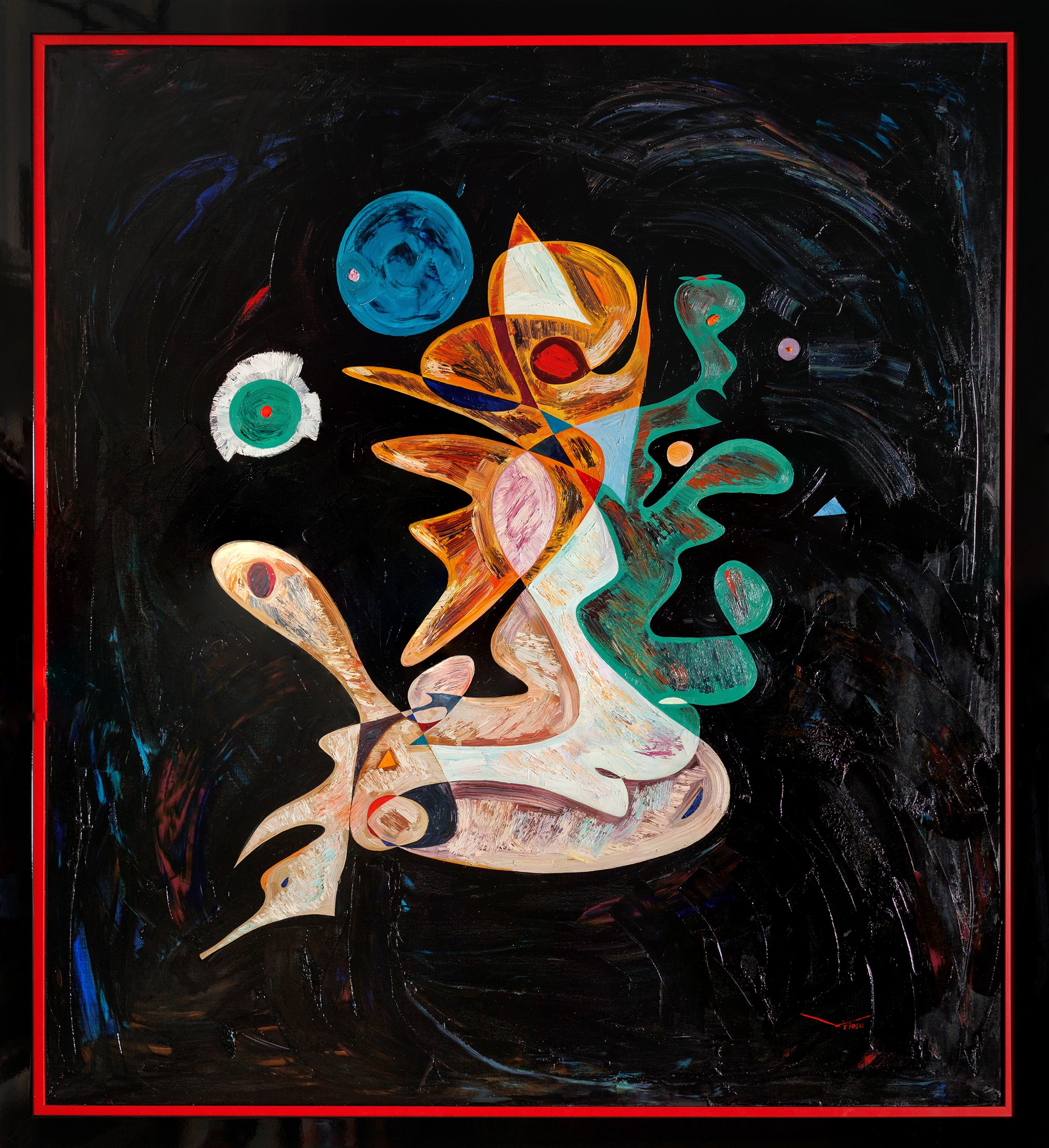
British Diplomacy, 2015 Oil on canvas
A Symbolic Architecture of Negotiation, Navigation, and International Influence
Strategic, Adaptive, and Systemically Constructed
British Diplomacy transforms diplomacy into a dynamic visual system of negotiation, connectivity, and strategic balance. Rather than depicting a historical event or political actor, the painting examines the structures through which influence is exercised, relationships are maintained, and continuity is achieved within an interconnected international environment.
Concept & Meaning
British Diplomacy explores diplomacy as a process of navigation rather than confrontation. Through interconnected forms, ascending structures, and spatial relationships, the composition suggests that influence is sustained through communication, adaptation, and the ability to balance competing interests within complex geopolitical systems.
The work investigates the mechanisms through which nations and institutions establish continuity across changing circumstances. Relationships, alliances, and exchanges become the central subjects of the composition, transforming diplomacy into a symbolic architecture of strategic engagement and international cooperation.
Within The Architecture of Power, the painting represents the global dimension of authority, examining how negotiation, coordination, and long-term relationships function as instruments through which influence extends beyond direct political or military power.
Scale & Visual Presence
Measuring 150 × 138 cm, the painting establishes a commanding visual presence through its vertical structure and concentrated internal energy. The luminous central configuration emerges from a deep black field, creating a powerful contrast that amplifies movement, direction, and symbolic significance.
The composition appears simultaneously anchored and expansive. Floating circular elements extend the visual field beyond the central image, encouraging prolonged observation and reinforcing the sensation of operating within a larger network of interconnected relationships.
Artistic Context & Inspirations
The painting belongs to a broader body of work in which Gheorghe Virtosu investigates power through systems of communication, governance, diplomacy, and cultural exchange. Historical and political themes are transformed into abstract visual structures that emphasize relationships, processes, and strategic interaction rather than narrative illustration.
Drawing upon traditions of abstraction, political thought, international relations, and symbolic representation, the work examines diplomacy as a continuous process of adaptation. Rather than presenting fixed conclusions, the painting invites reflection on the networks and negotiations that shape collective realities on a global scale.
Materiality & Technique
Executed in oil on canvas, the painting combines layered textures with carefully orchestrated formal structures. Dense passages of pigment coexist with fluid transitions and contrasting chromatic zones, generating depth, movement, and visual complexity across the composition.
Materiality functions as an active component of meaning. Variations in brushwork, colour intensity, and surface treatment reinforce the painting’s dynamic character, allowing structure and atmosphere to emerge simultaneously through the physical properties of the medium.
Colour, Symbol & Construction
Colour operates as a language of orientation and connection. Gold, turquoise, blue, white, green, and red establish a hierarchy of visual relationships against the surrounding black field, creating pathways through which the viewer navigates the composition.
Chromatic contrasts reinforce structural connections between forms while emphasizing movement, continuity, and exchange. Colour becomes an instrument of organization rather than description, transforming abstraction into a symbolic system of international interaction and strategic balance.
Structure & Symbolic Architecture
The composition is organized around a vertically ascending central structure surrounded by orbital forms and intersecting pathways. Geometric planes, curved contours, and directional elements interact within a unified system that emphasizes connectivity, adaptability, and movement across multiple levels of engagement.
Rather than functioning as isolated symbols, the forms derive meaning through their relationships. This structural interdependence transforms the painting into a visual model of diplomacy itself, revealing influence as a phenomenon sustained through negotiation, communication, and strategic coordination.
Institutional & Collection Context
British Diplomacy contributes to contemporary discussions surrounding diplomacy, international relations, symbolic power, and systems of governance. Its conceptual rigor and visual complexity position the work within broader dialogues concerning global interconnectedness and the mechanisms through which societies organize influence.
The painting functions simultaneously as image, intellectual proposition, and symbolic system, making it relevant to museum collections, academic research, and exhibitions exploring the intersections of art, politics, diplomacy, and contemporary culture.
Closing Statement
British Diplomacy presents diplomacy as an architecture of navigation, balance, and strategic continuity. Through abstraction and symbolic complexity, Gheorghe Virtosu reveals how influence emerges through networks of communication, cooperation, and sustained engagement across an ever-changing world.
A meditation on negotiation, international connectivity, and the structures through which stability is pursued within global systems of power.
Artist Insights
Learn more about the artist’s background, research interests, and investigations into power, diplomacy, abstraction, and collective consciousness.
View Artist ProfileExplore the Work
Navigate through catalogue documentation, curatorial writing, and collection context for British Diplomacy, 2015.
𐰘𐰙𐰖𐰢𐰡𐰘𐰟𐰞𐰜𐰛𐰡𐰘𐰚𐰝𐰡𐰖𐰡𐰖𐰝𐰤𐰙𐰖𐰝𐰘𐰘𐰣𐰤𐰡𐰘𐰣𐰘𐰢𐰝𐰘𐰡𐰥𐰞𐰘𐰣𐰤𐰞𐰢𐰖w𐰘𐰝𐰙𐰢𐰟𐰞𐰛𐰤𐰝𐰖𐰟𐰖𐰣𐰚𐰝𐰠𐰛𐰟𐰖𐰣𐰢𐰖𐰡𐰟𐰤𐰖𐰣𐰚𐰖𐰣𐰛𐰟𐰟