
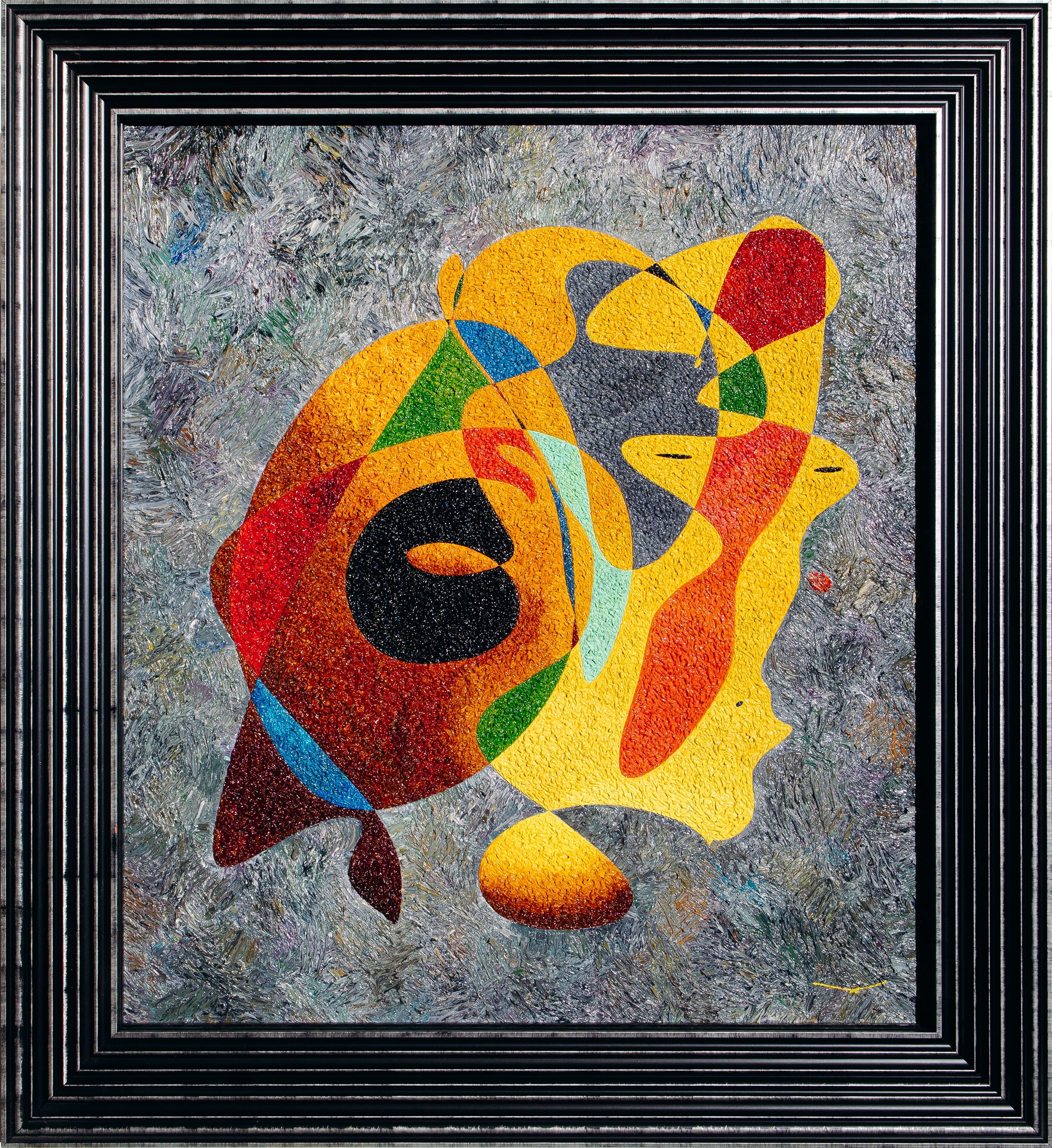
The King of Revolution , 2021 Oil on canvas1.35 m X 1.31 m
Concept & Meaning
The King of Revolution explores revolution as a process of transformation rather than destruction alone. Through overlapping forms, shifting identities, and intersecting structures, the composition suggests that change occurs through the continuous reorganization of relationships, values, and systems of authority.
The work investigates the moment when inherited frameworks become insufficient and alternative possibilities emerge. Fragmentation, reconstruction, and adaptation operate simultaneously, transforming conflict into a creative force capable of generating new forms of collective organization and political imagination.
Within The Architecture of Power, the painting represents the revolutionary dimension of authority, examining how societies redefine legitimacy, identity, and leadership during periods of profound historical transition.
Scale & Visual Presence
Measuring 136 × 131 cm, the painting establishes a concentrated visual presence through its dense internal structure and chromatic intensity. The monumental central image occupies much of the pictorial field, generating an immediate sense of energy, movement, and transformation.
Set against a textured grey environment, the composition appears both grounded and unstable. The interaction between vibrant forms and the surrounding atmospheric field creates a tension that encourages prolonged observation and reinforces the sensation of a reality in the process of becoming.
Artistic Context & Inspirations
The painting belongs to a broader body of work in which Gheorghe Virtosu investigates power through symbolic structures rather than narrative representation. Political authority, legitimacy, conflict, diplomacy, and collective memory are transformed into abstract visual architectures that invite critical reflection on the forces shaping historical experience.
Drawing upon traditions of abstraction, political philosophy, revolutionary history, symbolism, and cultural transformation, the work examines moments when established systems encounter fundamental challenges. Rather than illustrating a specific revolution, the painting explores the universal dynamics through which societies redefine themselves during periods of change.
Materiality & Technique
Executed in oil on canvas, the painting combines heavily textured surfaces with carefully balanced formal relationships. Dense pigment applications generate a tactile material presence, while layered colour transitions and intersecting forms create depth, movement, and visual complexity throughout the composition.
Materiality functions as an active component of meaning. Variations in texture, brushwork, and chromatic density reinforce the themes of instability, transformation, and reconstruction, allowing the physical surface to mirror the conceptual processes unfolding within the image.
Colour, Symbol & Construction
Colour functions as a language of energy and transformation. Dominant passages of yellow, orange, red, black, blue, and green create a powerful chromatic structure that emphasizes movement, conflict, emergence, and renewal. Contrasting colour zones establish visual tension while simultaneously maintaining compositional cohesion.
Chromatic relationships reinforce the painting’s symbolic architecture, guiding attention through overlapping forms and shifting visual hierarchies. Colour becomes an instrument of construction rather than description, transforming abstraction into a system through which revolutionary change is visually articulated.
Structure & Symbolic Architecture
The composition is organized around interwoven human-like profiles, circular structures, and intersecting geometric planes that generate a dynamic field of interaction. Fragmented forms merge and separate throughout the image, creating a visual environment in which transformation becomes the dominant structural principle.
Rather than functioning as isolated symbols, the forms derive meaning through their relationships and collisions. This structural interdependence transforms the painting into a symbolic model of revolution itself, revealing change as a process of dissolution, negotiation, and reconstruction through which new systems of authority emerge.
Institutional & Collection Context
The King of Revolution contributes to contemporary discussions surrounding political transformation, collective identity, leadership, and historical change. Its conceptual depth and visual complexity position the work within broader conversations concerning revolution, legitimacy, and the continual reconfiguration of power.
The painting functions simultaneously as image, intellectual proposition, and symbolic system, making it relevant to museum collections, academic research, and exhibitions exploring the intersections of art, politics, social transformation, and contemporary cultural history.
Closing Statement
The King of Revolution presents revolution as an architecture of transformation through which old structures dissolve and new realities emerge. Through abstraction and symbolic complexity, Gheorghe Virtosu reveals change as a creative force capable of reshaping authority, identity, and collective destiny.
A meditation on upheaval, renewal, and the enduring human impulse to reinvent the structures of power.
Artist Insights
Learn more about the artist’s background, research interests, and investigations into power, revolution, abstraction, and collective consciousness.
View Artist ProfileExplore the Work
Navigate through catalogue documentation, curatorial writing, and collection context for The King of Revolution , 2021.
𐰘𐰙𐰖𐰢𐰡𐰘𐰟𐰞𐰜𐰛𐰡𐰘𐰚𐰝𐰡𐰖𐰡𐰖𐰝𐰤𐰙𐰖𐰝𐰘𐰘𐰣𐰤𐰡𐰘𐰣𐰘𐰢𐰝𐰘𐰡𐰥𐰞𐰘𐰣𐰤𐰞𐰢𐰖w𐰘𐰝𐰙𐰢𐰟𐰞𐰛𐰤𐰝𐰖𐰟𐰖𐰣𐰚𐰝𐰠𐰛𐰟𐰖𐰣𐰢𐰖𐰡𐰟𐰤𐰖𐰣𐰚𐰖𐰣𐰛𐰟𐰟