
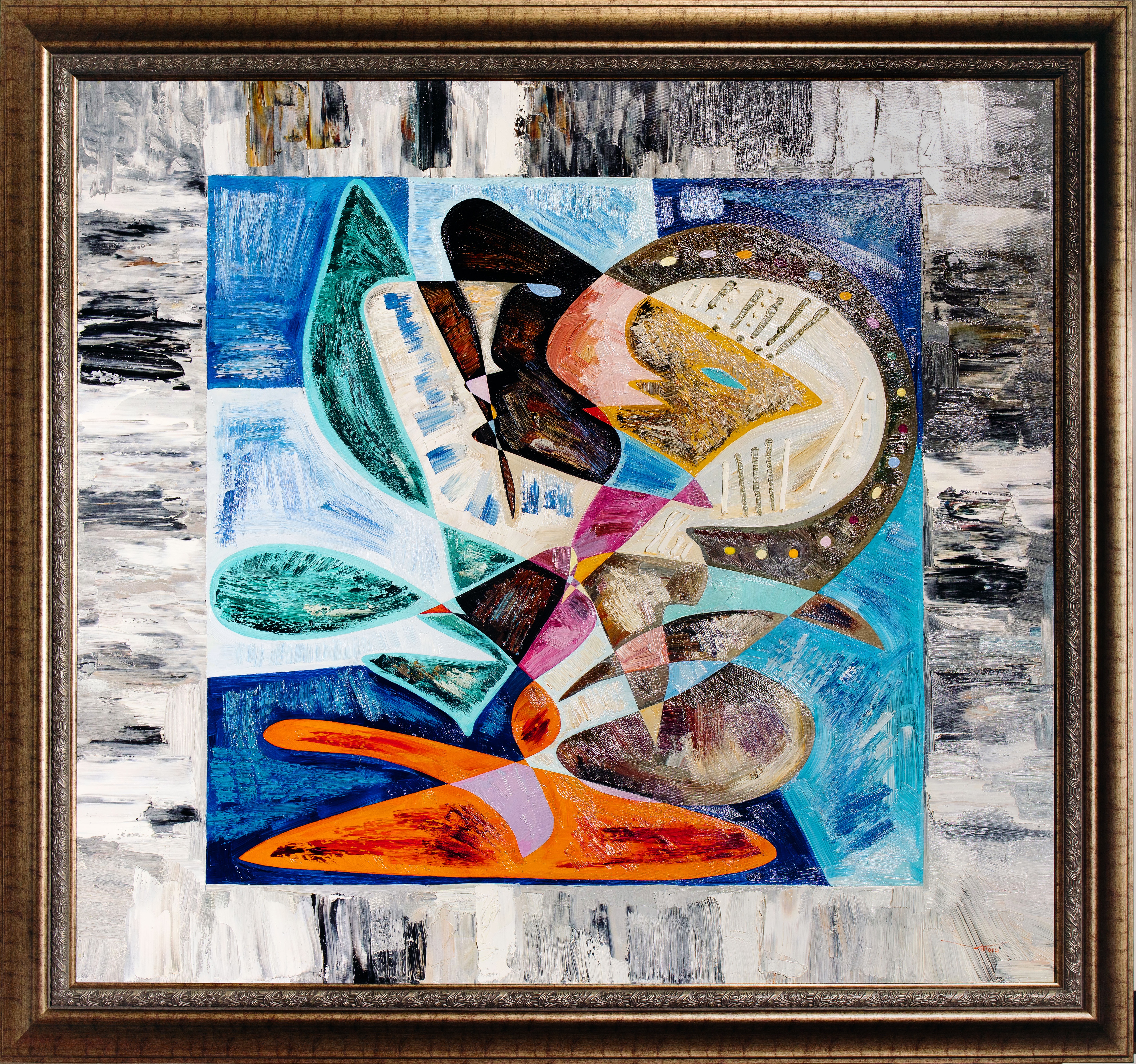
Illuminati (2015), 2015 Oil on canvas
A Symbolic Structure of Knowledge, Perception, and Invisible Influence
Monumental, Systemic, and Intellectually Constructed
Illuminati (2015) transforms the notion of hidden influence into a complex visual system. The painting investigates power not through direct representation, but through the structures of knowledge, perception, and symbolic relationships that shape collective understanding from beneath the surface of visible reality.
Concept & Meaning
Illuminati (2015) examines the relationship between visibility and concealment. Rather than illustrating a secret organization or historical narrative, the work explores the broader question of how systems of influence operate through networks of information, symbols, and cultural assumptions that often remain unseen.
Through abstraction, knowledge appears as a dynamic architecture composed of interconnected parts. Forms intersect, overlap, and transform, suggesting that authority is frequently exercised through perception itself—through the ability to shape understanding, direct attention, and establish frameworks of interpretation.
Within The Architecture of Power, the painting investigates the invisible dimension of authority, examining the intellectual and symbolic systems that exist alongside political institutions and contribute to the formation of social reality.
Scale & Visual Presence
Measuring 138 × 150 cm, the work establishes a strong visual presence through structural complexity and chromatic intensity. The composition occupies a clearly defined internal field that appears simultaneously contained and expansive, encouraging prolonged observation and interpretive engagement.
The contrast between the vibrant central image and the surrounding monochromatic environment reinforces the sensation of entering a self-contained system of relationships. The painting reveals itself gradually, rewarding close examination through successive layers of visual discovery.
Artistic Context & Inspirations
The work belongs to a broader body of paintings in which Gheorghe Virtosu investigates power through symbolic structures rather than direct representation. Political authority, ideology, diplomacy, memory, and systems of knowledge are transformed into abstract visual architectures that invite critical reflection rather than narrative interpretation.
Drawing upon traditions of abstraction, symbolism, systems theory, and philosophical inquiry, the painting dissolves familiar categories into a network of interdependent forms. This approach allows complex questions concerning influence, perception, and cultural organization to emerge through visual relationships rather than illustrative storytelling.
Materiality & Technique
Executed in oil on canvas, the painting combines layered textures with precisely organized formal structures. Dense passages of paint coexist with areas of controlled transparency, generating spatial depth and visual complexity throughout the composition.
Materiality functions as an active component of meaning. Variations in surface treatment, brushwork, and chromatic density contribute to the work’s layered character, reinforcing its exploration of revelation, concealment, and the gradual emergence of structure from complexity.
Colour, Symbol & Construction
Colour functions as a system of differentiation and connection. Dominant blues and turquoise establish a sense of intellectual order and spatial openness, while black, white, gold, pink, and orange create moments of emphasis, disruption, and transformation throughout the composition.
Chromatic relationships guide the viewer through a network of intersecting forms, creating pathways of attention that mirror the painting’s thematic concern with perception and information. Colour becomes an instrument of structure rather than description.
Structure & Symbolic Architecture
The composition is organized as an interconnected system rather than a singular image. Geometric planes, curved forms, and directional vectors overlap to produce a dynamic network of relationships in which no single element remains entirely independent from the others.
This structural interdependence transforms the painting into a visual model of influence itself. Meaning emerges not from isolated symbols but from the relationships between them, revealing power as a phenomenon embedded within systems of connection, interpretation, and exchange.
Institutional & Collection Context
Illuminati (2015) contributes to contemporary discussions surrounding abstraction, systems thinking, perception, and the cultural construction of knowledge. Its conceptual rigor and visual complexity position the work within broader dialogues concerning symbolic power and the invisible mechanisms through which societies organize meaning.
The painting functions simultaneously as image, intellectual proposition, and perceptual system, making it relevant to museum collections, academic research, and exhibitions exploring the intersection of art, philosophy, and political culture.
Closing Statement
Illuminati (2015) presents influence as an architecture of relationships rather than a visible instrument of control. Through abstraction and systemic organization, Gheorghe Virtosu reveals the hidden structures through which perception, knowledge, and authority are continuously formed and sustained.
A meditation on visibility, interpretation, and the unseen systems that shape collective reality.
Artist Insights
Learn more about the artist’s background, conceptual frameworks, and investigations into power, abstraction, and collective consciousness.
View Artist ProfileExplore the Work
Navigate through catalogue documentation, curatorial writing, and collection context for Illuminati (2015), 2015.
𐰘𐰙𐰖𐰢𐰡𐰘𐰟𐰞𐰜𐰛𐰡𐰘𐰚𐰝𐰡𐰖𐰡𐰖𐰝𐰤𐰙𐰖𐰝𐰘𐰘𐰣𐰤𐰡𐰘𐰣𐰘𐰢𐰝𐰘𐰡𐰥𐰞𐰘𐰣𐰤𐰞𐰢𐰖w𐰘𐰝𐰙𐰢𐰟𐰞𐰛𐰤𐰝𐰖𐰟𐰖𐰣𐰚𐰝𐰠𐰛𐰟𐰖𐰣𐰢𐰖𐰡𐰟𐰤𐰖𐰣𐰚𐰖𐰣𐰛𐰟𐰟