
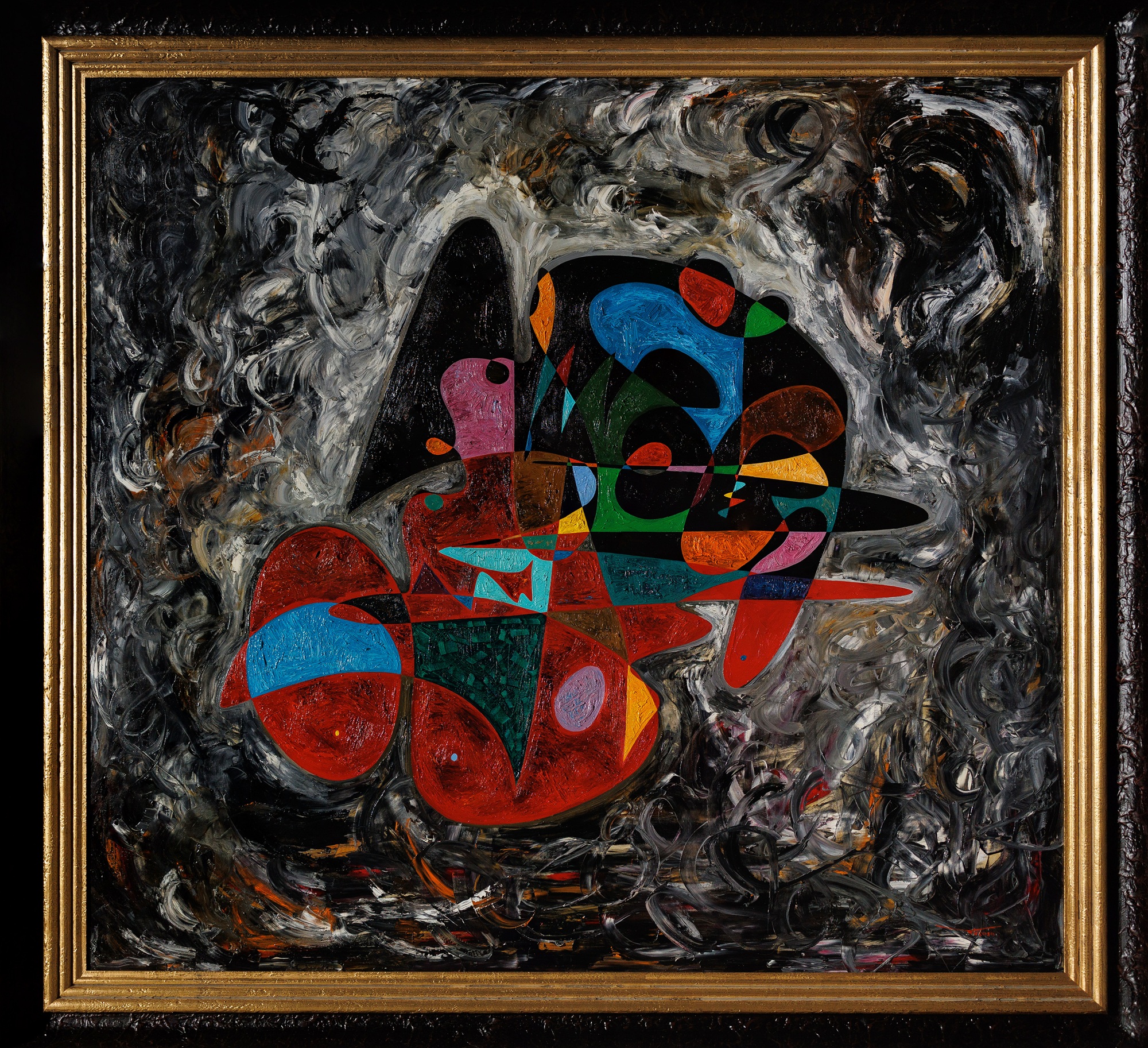
New and Old World Order, 2016 Oil on canvas
A Symbolic Architecture of Geopolitical Transition, Historical Continuity, and Emerging Global Systems
Transitional, Systemic, and Historically Constructed
New and Old World Order transforms geopolitical change into a complex visual system that examines the relationship between inherited structures of authority and emerging configurations of global influence. Rather than depicting specific political events, the painting investigates how historical orders evolve, adapt, and give way to new arrangements of power across successive generations.
Concept & Meaning
New and Old World Order explores the tension between continuity and transformation. Through overlapping geometric forms, interconnected symbolic elements, and contrasting spatial environments, the composition presents history as a dynamic process in which established institutions coexist with emerging structures seeking influence and legitimacy.
The painting suggests that world orders are neither permanent nor isolated. Political systems, economic networks, cultural identities, and diplomatic relationships continuously interact, producing periods of stability, uncertainty, negotiation, and renewal. The work reveals power as a fluid phenomenon shaped by adaptation rather than permanence.
Within The Architecture of Power, the painting examines the mechanisms through which societies navigate historical transition. Authority appears not as a fixed possession but as an evolving structure constantly redefined through conflict, cooperation, memory, innovation, and collective aspiration.
Scale & Visual Presence
Measuring 138 × 150 cm, the work establishes a powerful visual presence through its contrast between a dense central architecture and a turbulent surrounding environment. The composition appears suspended within a moment of transformation, encouraging viewers to consider the forces shaping historical continuity and systemic change.
The luminous geometric structure emerges from a surrounding field of gestural monochromatic movement, generating a visual dialogue between order and instability. This relationship reinforces the sensation of transition, suggesting that new systems emerge through interaction with the uncertainties and complexities of their historical context.
Artistic Context & Inspirations
The painting belongs to a broader body of work in which Gheorghe Virtosu investigates the structures through which power is organized, challenged, transmitted, and transformed. Diplomacy, ideology, revolution, legitimacy, cultural memory, and geopolitical change become abstract visual architectures that encourage reflection on the forces shaping civilizations across time.
Drawing upon traditions of abstraction, political philosophy, systems theory, historical inquiry, and symbolic thought, the work examines how global structures evolve through interaction rather than isolation. Instead of illustrating historical events directly, the painting explores universal questions concerning continuity, adaptation, influence, and the changing architecture of international power.
Materiality & Technique
Executed in oil on canvas, the painting combines expressive gestural brushwork with carefully organized structural relationships. Dense applications of pigment coexist with fluid transitions and layered chromatic interactions, generating depth, movement, and visual complexity throughout the composition.
Materiality functions as an active participant in meaning. Variations in surface treatment, texture, and paint density reinforce themes of emergence, instability, and reconstruction, allowing the physical character of the painting to mirror the processes of transformation explored conceptually within the work.
Colour, Symbol & Construction
Colour functions as a language of interaction and transition. Reds, blues, greens, oranges, pinks, blacks, and turquoise establish a network of visual relationships that simultaneously suggest conflict, negotiation, adaptation, and integration. Chromatic contrasts generate energy while reinforcing the interconnected character of the composition.
Rather than describing specific objects, colour operates structurally, guiding movement through overlapping forms and symbolic intersections. The resulting visual system reflects the painting’s central concern with evolving relationships between competing yet interdependent centers of influence.
Structure & Symbolic Architecture
The composition is organized around an interconnected central architecture positioned within a threshold-like spatial environment. Geometric planes, circular motifs, directional elements, and organic forms intersect to create a network of relationships that appears simultaneously stable and in transition. No single element dominates entirely; meaning emerges through interaction and balance.
This structural interdependence transforms the painting into a visual model of historical succession itself. Established systems remain present even as new configurations emerge, revealing power as a process of continual negotiation between continuity and transformation. Through abstraction, the work presents world order as an evolving architecture rather than a permanent arrangement.
Institutional & Collection Context
New and Old World Order contributes to contemporary discussions concerning geopolitical change, historical continuity, global governance, and the evolution of international systems. Its conceptual depth and structural complexity position the work within broader dialogues surrounding the transformation of authority in an increasingly interconnected world.
The painting functions simultaneously as image, intellectual proposition, and symbolic model, making it relevant to museum collections, academic research, and exhibitions exploring politics, globalization, systems theory, and contemporary abstraction.
Closing Statement
New and Old World Order presents world order as a living architecture shaped by continuity, disruption, adaptation, and renewal. Through abstraction and systemic complexity, Gheorghe Virtosu reveals how inherited institutions and emerging structures coexist within the ongoing transformation of global power.
A meditation on geopolitical evolution, historical succession, and the changing frameworks through which societies organize collective reality.
Artist Insights
Learn more about the artist’s background, research interests, and investigations into power, history, diplomacy, abstraction, and collective consciousness.
View Artist ProfileExplore the Work
Navigate through catalogue documentation, curatorial writing, and collection context for New and Old World Order, 2016.
𐰘𐰙𐰖𐰢𐰡𐰘𐰟𐰞𐰜𐰛𐰡𐰘𐰚𐰝𐰡𐰖𐰡𐰖𐰝𐰤𐰙𐰖𐰝𐰘𐰘𐰣𐰤𐰡𐰘𐰣𐰘𐰢𐰝𐰘𐰡𐰥𐰞𐰘𐰣𐰤𐰞𐰢𐰖w𐰘𐰝𐰙𐰢𐰟𐰞𐰛𐰤𐰝𐰖𐰟𐰖𐰣𐰚𐰝𐰠𐰛𐰟𐰖𐰣𐰢𐰖𐰡𐰟𐰤𐰖𐰣𐰚𐰖𐰣𐰛𐰟𐰟