
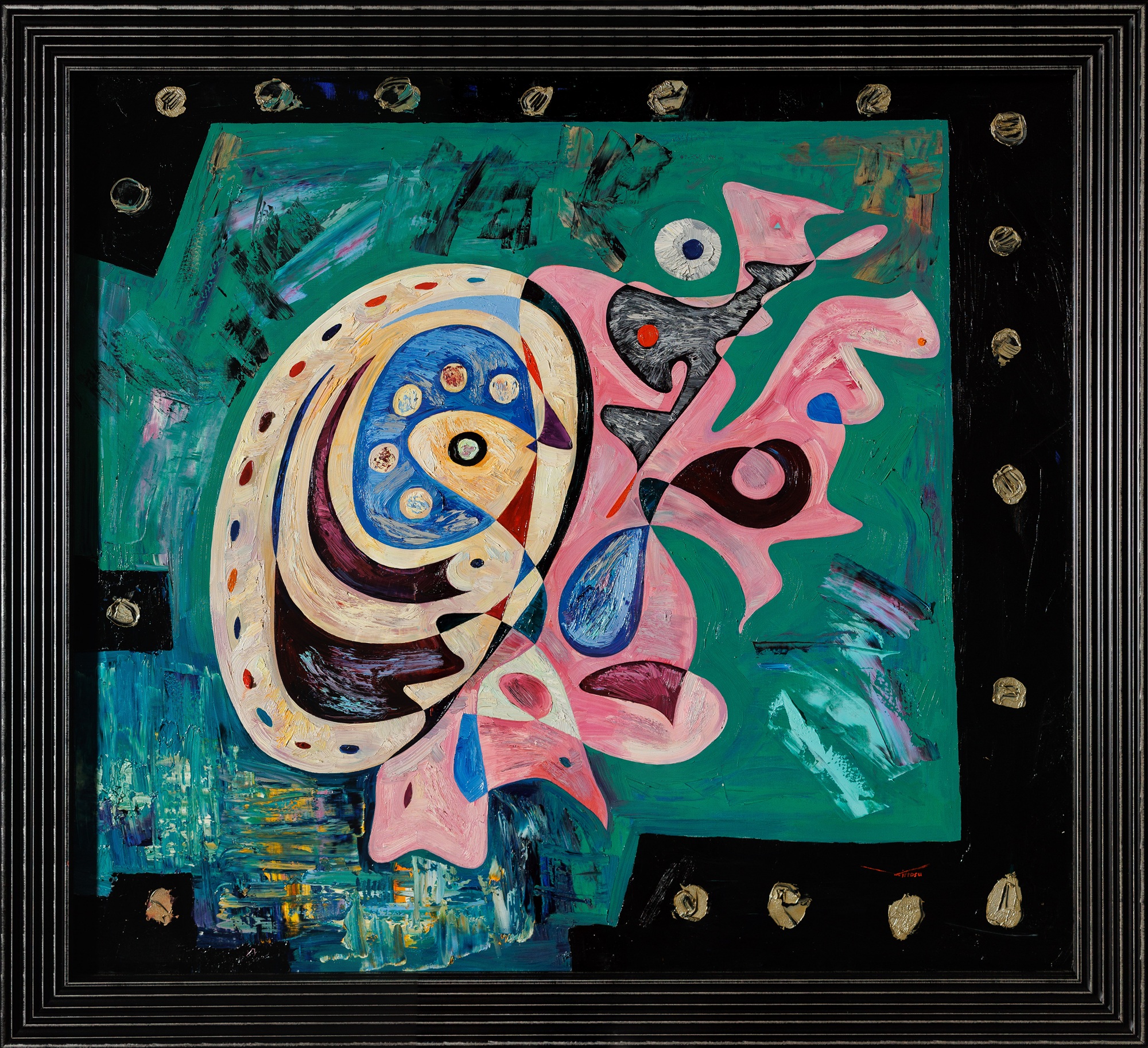
The Beast of Nazism, 2015 Oil on canvas1.3.8 m X 1.50 m
Concept & Meaning
The Beast of Nazism explores Nazism not as a historical narrative alone, but as a symbolic model of ideological domination. Through concentric structures, fragmented organic forms, and distorted visual relationships, the composition suggests the emergence of a self-perpetuating system capable of reshaping consciousness and redefining reality according to rigid doctrines of power.
The painting investigates how authoritarian ideologies transform social structures into instruments of control. Individual identity becomes fragmented, perception becomes regulated, and collective behavior becomes increasingly subordinated to centralized systems of authority. The image presents power as an invasive force capable of extending beyond institutions into thought itself.
Within The Architecture of Power, the work represents the destructive dimension of authority, examining how political systems become dangerous when they subordinate human dignity, diversity, and moral responsibility to ideological absolutism.
Scale & Visual Presence
Measuring 138 × 150 cm, the painting establishes a commanding presence through structural density and psychological intensity. The dominant eye-like form immediately attracts attention, functioning as the visual center of an interconnected system that appears simultaneously organized, oppressive, and unstable.
The contrast between the vivid internal composition and the surrounding black border reinforces a sensation of enclosure and control. The viewer is drawn into a confined symbolic environment where observation, repetition, and ideological influence become recurring visual experiences.
Artistic Context & Inspirations
The painting belongs to a broader body of work in which Gheorghe Virtosu investigates the structures through which power is organized, exercised, and sustained. Political authority, legitimacy, diplomacy, revolution, and collective memory are translated into abstract visual architectures that encourage reflection on the forces shaping historical experience.
Drawing upon traditions of symbolic abstraction, political philosophy, historical analysis, and psychological inquiry, the work examines the mechanisms through which ideological systems achieve influence. Rather than functioning as historical illustration, the painting explores universal questions concerning manipulation, obedience, conformity, and the vulnerability of social institutions to authoritarian transformation.
Materiality & Technique
Executed in oil on canvas, the painting combines layered textures with carefully structured formal relationships. Dense pigment applications, contrasting colour zones, and complex surface interactions generate depth and visual tension throughout the composition, creating an atmosphere of psychological intensity and symbolic complexity.
Materiality functions as an active component of meaning. Variations in paint density, brushwork, and chromatic saturation reinforce themes of pressure, distortion, and ideological intrusion, allowing the physical surface to participate directly in the conceptual construction of the work.
Colour, Symbol & Construction
Colour functions as a language of domination, tension, and psychological influence. Turquoise, blue, pink, black, white, red, and gold establish a complex chromatic structure in which contrasting zones simultaneously attract and destabilize attention. These relationships create an environment characterized by control, fragmentation, and symbolic conflict.
Chromatic contrasts reinforce the painting’s architecture of surveillance and ideological pressure. Colour becomes an instrument of structural organization rather than description, guiding perception through concentric forms, fragmented bodies, and recurring symbolic elements that collectively construct an atmosphere of authoritarian control.
Structure & Symbolic Architecture
The composition is organized around a dominant eye-like structure surrounded by concentric formations, fragmented organic forms, and directional visual pathways. These interconnected elements create a closed symbolic system in which observation, repetition, and control become the primary organizing principles.
Rather than functioning as isolated symbols, the forms derive significance through their relationships. The resulting architecture resembles an ideological organism whose influence extends across the entire visual field. Through this structural interdependence, the painting presents totalitarian power as a self-reinforcing network capable of shaping perception, behavior, and collective consciousness.
Institutional & Collection Context
The Beast of Nazism contributes to contemporary discussions surrounding authoritarianism, political ideology, collective memory, and the psychological dimensions of power. Its conceptual depth and visual complexity position the work within broader dialogues concerning the dangers of totalitarian systems and the mechanisms through which societies become vulnerable to ideological domination.
The painting functions simultaneously as image, historical reflection, and symbolic warning, making it relevant to museum collections, academic research, and exhibitions examining the intersections of art, politics, memory, and twentieth-century history.
Closing Statement
The Beast of Nazism presents totalitarian ideology as a symbolic beast sustained through surveillance, manipulation, and the distortion of human perception. Through abstraction and structural complexity, Gheorghe Virtosu reveals how systems of domination emerge, expand, and ultimately threaten the foundations of individual freedom and collective responsibility.
A meditation on authoritarian power, ideological control, and the enduring necessity of vigilance in the defense of human dignity.
Artist Insights
Learn more about the artist’s background, research interests, and investigations into power, ideology, abstraction, historical memory, and collective consciousness.
View Artist ProfileExplore the Work
Navigate through catalogue documentation, curatorial writing, and collection context for The Beast of Nazism, 2015.
𐰘𐰙𐰖𐰢𐰡𐰘𐰟𐰞𐰜𐰛𐰡𐰘𐰚𐰝𐰡𐰖𐰡𐰖𐰝𐰤𐰙𐰖𐰝𐰘𐰘𐰣𐰤𐰡𐰘𐰣𐰘𐰢𐰝𐰘𐰡𐰥𐰞𐰘𐰣𐰤𐰞𐰢𐰖w𐰘𐰝𐰙𐰢𐰟𐰞𐰛𐰤𐰝𐰖𐰟𐰖𐰣𐰚𐰝𐰠𐰛𐰟𐰖𐰣𐰢𐰖𐰡𐰟𐰤𐰖𐰣𐰚𐰖𐰣𐰛𐰟𐰟